GT Voice: Misplaced priority on 'reducing China reliance' will be costly detour for EU
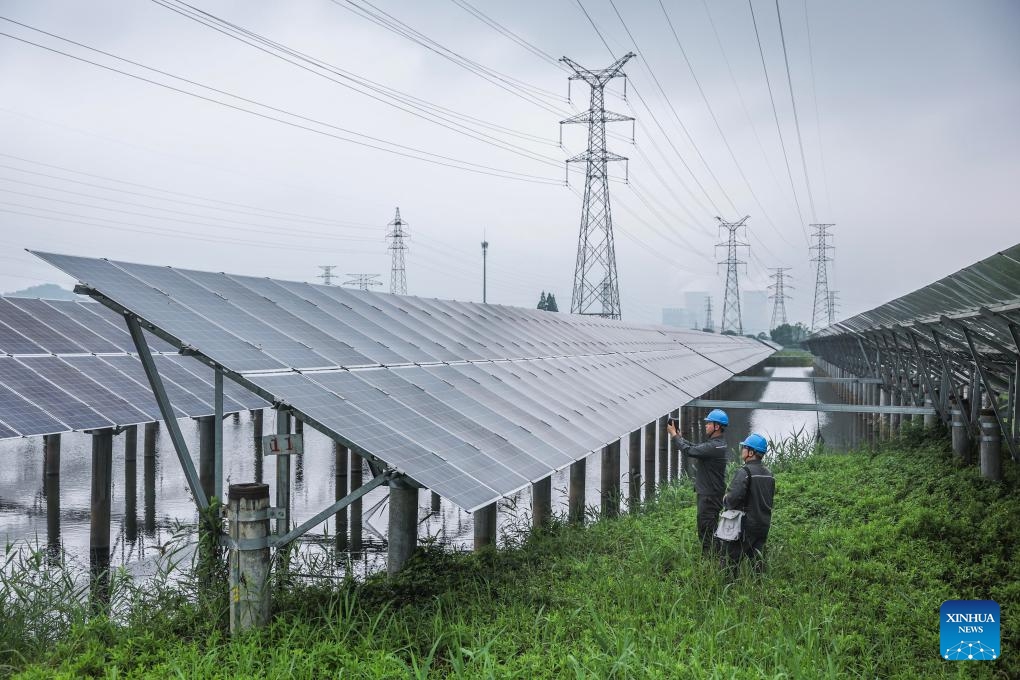
Staff members of State Grid Huzhou power supply company conduct inspection on the photovoltaic lines and equipment at a photovoltaic power station in Changxing County of Huzhou City, east China's Zhejiang Province, May 27, 2026. In recent years, State Grid Huzhou power supply company has been constantly promoting the upgrading of the county-level power grids, advancing the integration of renewable energy sources into power grids, and endeavoring to construct a safer, greener and smarter power grid. (Photo: Xinhua)
EU climate action commissioner Wopke Hoekstra claimed that Europe must accept higher short-term costs to reduce its dependence on China for clean-energy technologies, warning that delaying action will make the strategic vulnerability harder and more expensive to unwind, according to an exclusive Euronews interview published on Monday.
These remarks by a senior EU official responsible for policies on climate change lay bare a troubling policy inclination, with geopolitical considerations gradually overshadowing the economic logic of the energy transition in Europe. According to Hoekstra, his preferred formula combines climate action, competitiveness and European independence, by which he means continuing the green transition while reducing Europe's dependence on China for clean technologies.
Yet, such an all-encompassing ambition risks achieving little on any front. Forcing European companies and consumers to pay more for green products would only slow the energy transition and erode the bloc's industrial competitiveness.
The core purpose of the global clean-energy transition is to achieve cost-effective emissions reduction through mature industrial systems and economies of scale to address the climate crisis. This is also the climate governance goal that the EU itself has vigorously advocated for decades. However, geopolitical games are increasingly distorting the mission of Europe's green transition. In a push to reduce so-called dependence on China's green products, some within the EU even appear willing to drive up the cost of building and deploying clean energy, a plainly shortsighted approach.
Energy supply has already become a critical bottleneck for Europe's industrial development. Soaring energy prices and fragile supply chains are plaguing European manufacturing industries. In this context, an efficient energy transition is no longer an optional policy choice but a vital imperative for Europe's economic recovery. Slowing down the green shift and erecting industrial barriers could yield higher prices that Europe may have to pay.
According to a recent policy brief from the Brussels-based economic think tank Bruegel, the European Commission's own impact assessment estimates that excluding Chinese solar cell imports would more than double the price European governments pay for solar panels, while supply chains would still depend on polysilicon imports from China. More expensive solar panels will increase wholesale electricity prices, rippling through downstream industries and harming broader industrial competitiveness.
It is also questionable whether the so-called short-term costs highlighted by Hoekstra will truly remain short-term. After more than a decade of continuous investment, technological iteration and large-scale manufacturing, China has built the world's most complete, efficient and cost-optimized industrial chain for photovoltaics, wind power, energy storage and power batteries.
Creating equivalent domestic industrial capacity in Europe will require massive public subsidies, extremely long construction cycles, and painful structural adjustments to address entrenched challenges including high regional energy costs, shortages of skilled technical workers and lengthy approval processes. Should this strategy fail to deliver the promised outcomes, Europe would lose a precious window of opportunity in the global transition race.
China's competitive edge in the global clean-energy market is forged through years of full market competition and continuous technological upgrading. Boasting a complete industrial chain layout, robust large-scale production capacity and optimized technical systems, China provides cost-effective and highly reliable public goods for the global energy transition. It has substantially lowered the green transition threshold for countries worldwide, injecting strong momentum into global decarbonization efforts.
Ultimately, the real question for the EU is this: At a time when the climate crisis deepens and industrial recovery pressures mount, which approach is more costly - sticking with multilateral cooperation and existing global supply chains to speed up the transition, or sealing off its market and pouring decades of investment into high-cost homegrown alternatives?
The global energy transition is a systemic undertaking that hinges on international division of labor, collaboration, and complementary strengths. Reducing it to a geopolitical tool will end up harming not others, but Europe's own climate goals and economic future.
RELATED ARTICLES