ARTS / ART
At foot of the pyramids, Grand Egyptian Museum offers new lens for China-Egypt civilizational exchange
Grand Egyptian Museum offers new lens for China-Egypt civilizational exchange
By and Hu Feilian in Cairo Published: Sep 01, 2026 10:32 PM

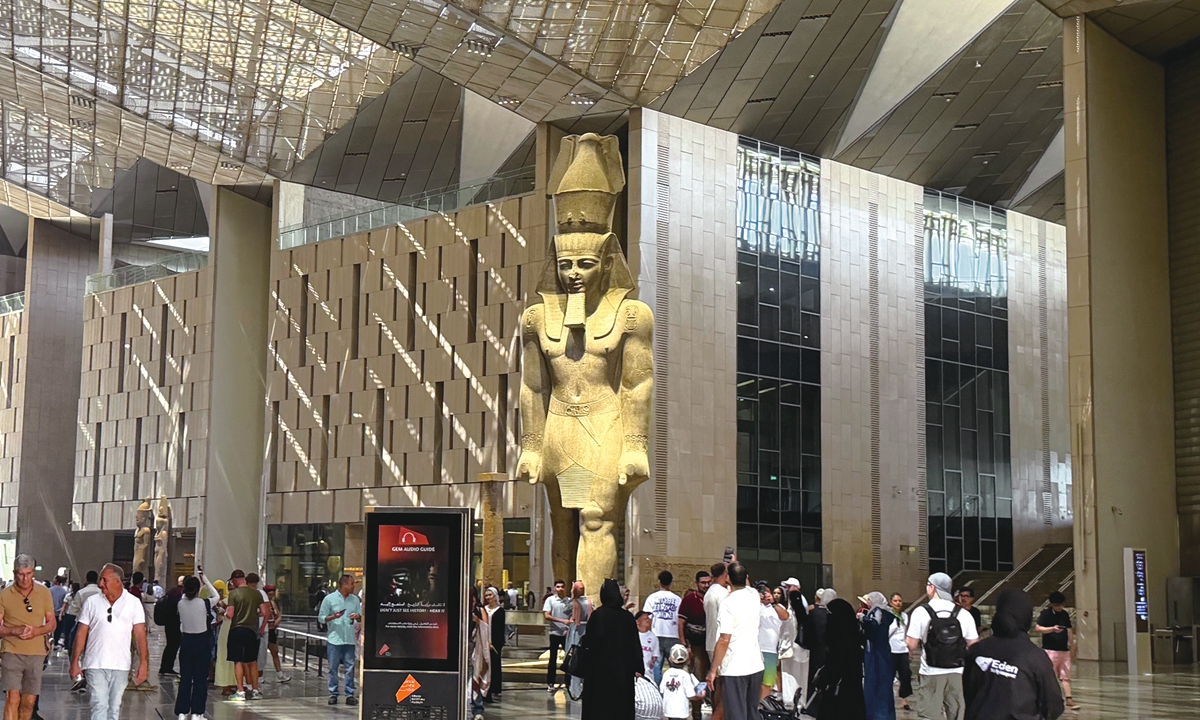
People visit the Grand Egyptian Museum in Cairo. Photo: Chen Qingqing/GT
Standing at the foot of the Giza Pyramids, the wind from the Nile sweeps across sand dunes that have stretched for thousands of years, reaching a modern museum that carries a new chapter for an ancient civilization: the Grand Egyptian Museum (GEM). On November 1, 2025, after more than two decades of construction and waiting, the world's largest museum dedicated to ancient Egyptian civilization officially opened its doors to the world.For Egyptians, the completion of the GEM means far more than the addition of another world-class tourist destination.
The museum houses and displays more than 57,000 ancient Egyptian artifacts, according to the website of the Egypt state information service. It now serves as an important platform for Egyptians to tell the story of their own civilization, protect their cultural heritage and showcase their history to the world, observers said.
For China, which also has a long and profound history, the museum offers a new perspective from which to observe and reflect on the inheritance of civilizations and exchanges and mutual learning between civilizations, according to observers.
'Let Egyptians tell the story of Egypt'
Inside the GEM, Egyptian tour guide Mohammed Helal, who uses the Chinese name Mu Mu and provides explanations in Chinese, told the Global Times on Monday that the museum is significant because it gives Egyptians a more complete platform to "let Egyptians tell the history of Egypt."
In his view, the GEM is a symbol of the growing cultural confidence of Egyptians. "In the past, it was often Europeans and Americans who told the story of Egypt. Now we have our own museum, and Egyptians can tell the story of their civilization to the world," Helal said.
Helal particularly highlighted the protection of cultural heritage and the issue of artifacts that have been taken abroad. He noted that the GEM sends a clear message to the world: Egypt has the ability and determination to protect its own cultural heritage. "Like China, Egypt has never given up on bringing its artifacts home," he said. In his view, this is also an important reason why the two ancient civilizations of China and Egypt can resonate with each other.
"Love" is a shared underlying value of the two civilizations, Helal said, while the pursuit of peace is also an important foundation for mutual understanding between the two peoples.
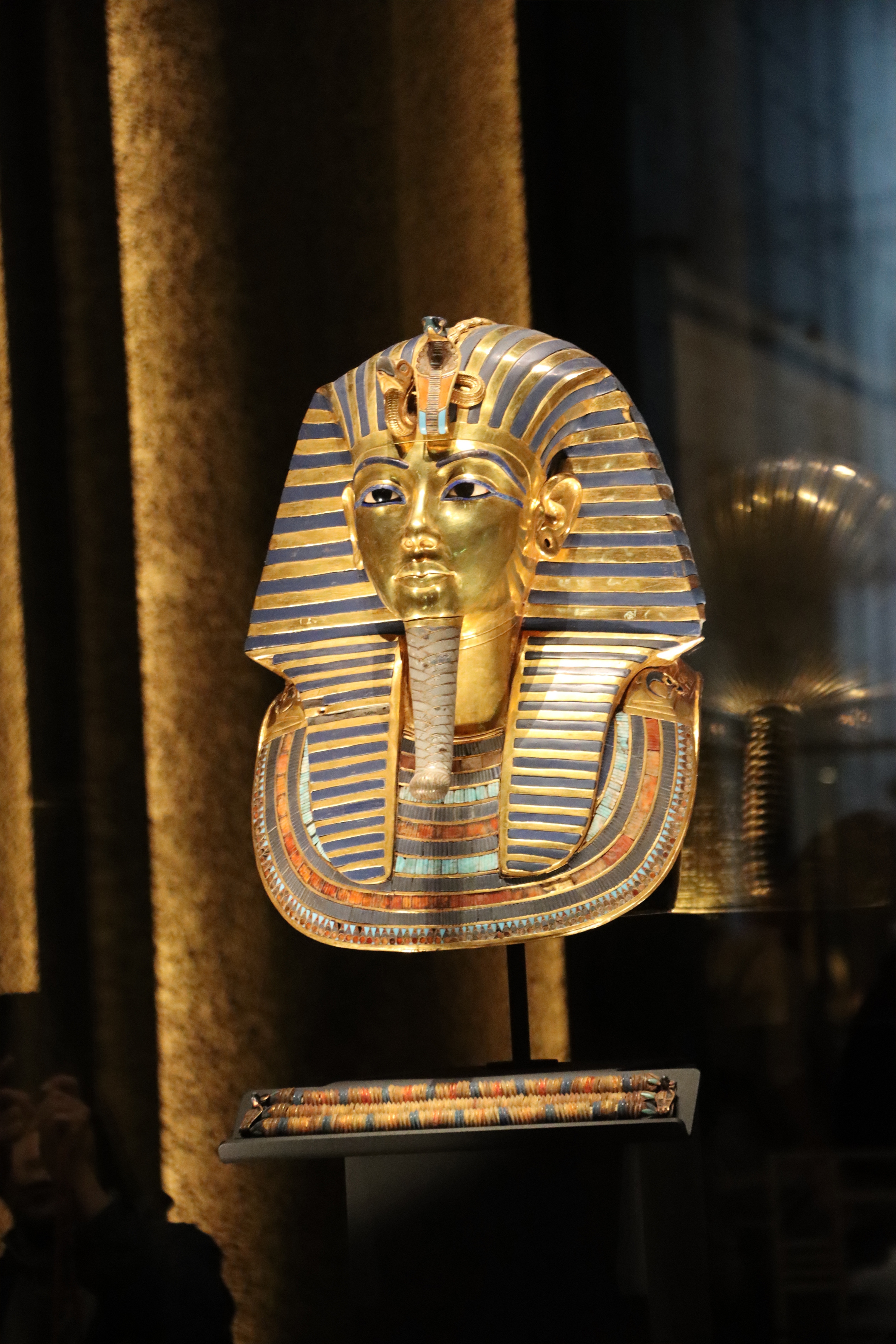
Tutankhamun's Gold Mask at the Grand Egyptian Museum Photo: VCG
Helal's remarks also point to the increasingly vibrant civilizational exchanges between China and Egypt in recent years.
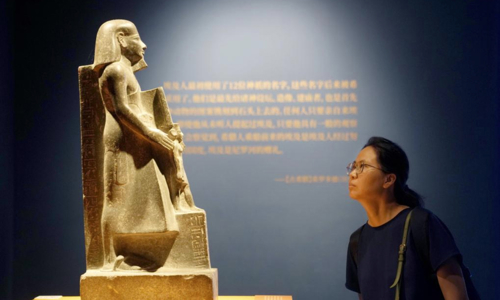
From an exhibition of ancient Egyptian civilization at the Shanghai Museum to joint archaeological work in Saqqara, and on to the growing number of Chinese tourists visiting Luxor, Aswan and Giza, ancient Egyptian civilization is reaching Chinese people through increasingly diverse channels.
At the same time, China's long-standing history and culture are becoming more familiar to Egyptians through museum exhibitions, archaeological cooperation, film and television productions, and people-to-people exchanges.
Such exchanges are not simply a matter of cultural "export" or "import," but more like two ancient civilizations reflecting each other across different points in history.
When Chinese people visit Egypt, they seek the secrets of civilizational continuity in the pyramids, temples and hieroglyphs. When Egyptians learn about China, they can also see, through the Great Wall, the Forbidden City, the Terracotta Warriors and China's cultural traditions that have continued for thousands of years, how an ancient civilization has maintained its vitality in modern times, Helal said.
Civilizations become more colorful through exchanges and richer through mutual learning.
"From this perspective, the GEM is not merely a museum housing ancient Egyptian artifacts, but also an important platform for Egypt to engage in dialogue with civilizations around the world," he said.
When Chinese visitors stand before the statue of Ramesses II, when Chinese archaeologists work alongside their Egyptian counterparts in Saqqara, and when exhibitions of ancient Egyptian civilization are held in Shanghai, the distance between the two civilizations is narrowed through concrete exchanges.
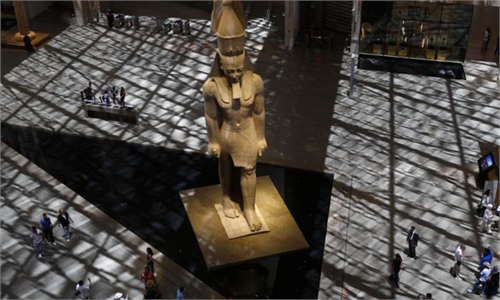
The GEM covers an area of about 490,000 square meters and has a main entrance hall of about 7,000 square meters, where a statue of King Ramesses II stands, according to the website of the Egypt state information service.
The museum houses more than 57,000 artifacts and includes 12 main exhibition halls, a temporary exhibition hall, the Tutankhamun galleries and a children's museum. The Tutankhamun galleries display more than 5,000 related artifacts. The museum is expected to attract about 5 million visitors annually.
Walking through the museum, visitors see not only gold and jewelry, stone sculptures and mummies, but also how a civilization recorded and preserved its history and tells its story to the world. And for Helal, such storytelling should also be a two-way process.
"We can learn from China, and China can learn about Egypt," he said, noting that the two ancient civilizations have many differences, but also many things in common.
Perhaps this is the most genuine meaning behind mutual learning between civilizations: not for one civilization to replace another, but for people to discover common historical memories and shared values through seeing and understanding each other.
From the pyramids to the GEM, ancient Egyptian civilization continues to engage in dialogue with the world across thousands of years. From the Shanghai Museum to the archaeological sites of Saqqara, the two ancient civilizations of China and Egypt are also moving toward each other in concrete and profound ways.
As the two meet again in the 21st century, what they are telling the world is no longer simply about their respective pasts. They are also addressing a question for the future: How can different civilizations achieve mutual enrichment through exchanges and mutual learning, and inject new vitality into the development of human civilization?
RELATED ARTICLES