China’s battery edge ‘expands into global standard-setting’ with solid-state push
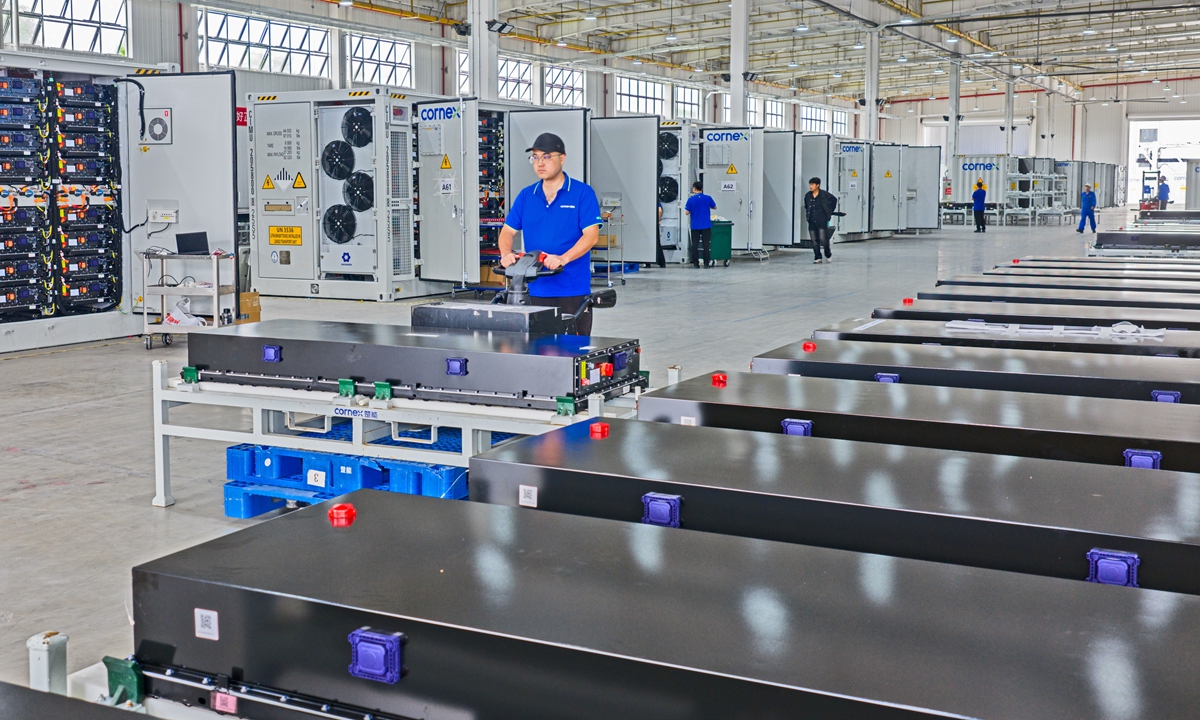
Workers inspect and test newly produced power batteries inside a plant in Yichang, Central China's Hubei Province, on September 22, 2025. File photo: VCG
Chinese experts said on Tuesday that the nation's strength in power batteries is expanding beyond manufacturing scale and market share into the shaping of rules for next-generation technologies.China's accumulated experience in solid-state battery research, testing and industrial development is now set to be incorporated into a broader framework of internationally recognized technical standards.
A China-led proposal on application guidelines, test items and conditions for solid-state lithium-ion batteries used to power electric vehicles has recently been approved as a new project by the International Electrotechnical Commission, marking the first time China has taken the lead in developing an international standard in the solid-state battery field, according to a statement released by China's State Administration for Market Regulation.
According to the statement, the standard is being developed under the leadership of experts from a leading Chinese new-energy battery company, with experts from France, South Korea, Japan and other countries also participating.
Industry observers said the move goes beyond a technical milestone, reflecting a broader shift in influence over the rules and standards shaping the future of the global automotive industry.
China's ability to take the lead in developing an international standard for solid-state batteries is underpinned by the technological, market and supply-chain strengths it has accumulated in the lithium-ion battery industry, Zhang Xiang, secretary-general of the International Intelligent Vehicle Engineering Association, told the Global Times on Tuesday.
Over the years, Chinese companies have accumulated extensive research and development (R&D), manufacturing and testing experience through successive generations of battery technologies, from lithium manganate and ternary lithium to lithium iron phosphate, Zhang said. This has provided a solid foundation for China to play a greater role in shaping technical rules for next-generation solid-state batteries.
China's leadership in developing this international standard also shows that its battery-sector strengths are extending from manufacturing scale and market share into technical standards and industry rules, Zhang said. Unified testing and evaluation methods could reduce discrepancies caused by different testing systems and provide clearer benchmarks for global R&D and commercialization.
According to the International Energy Agency's Global EV Outlook 2026, the concentration of both demand for and production of EVs and batteries in China has created a tightly clustered supply chain, all the way from critical mineral refining and component production to battery and EV manufacturing.
In 2025, China accounted for 70 percent of electric car production and over 80 percent of battery cell production, as well as about 85 percent of global production of cathode active material and more than 90 percent of production of anode active material used in electric car batteries, the report said.
Also, the participation of experts from France, South Korea, Japan, and other countries shows that the standard is being developed through international cooperation rather than by a single country acting alone, Zhang noted.
"A unified standard can help build broader technical consensus, reduce duplicated R&D and testing costs, and speed up technology validation and commercialization," he said.
Zhang added that China's role in leading the process should not be seen as creating new technological barriers, but as helping establish a common framework that can benefit the global solid-state battery industry.
RELATED ARTICLES