China calls to uphold Shanghai Spirit as Beijing hosts reception to mark the 25th anniversary of SCO
SCO pioneers new global governance model against exclusive Western blocs: experts

SCO Photo: VCG
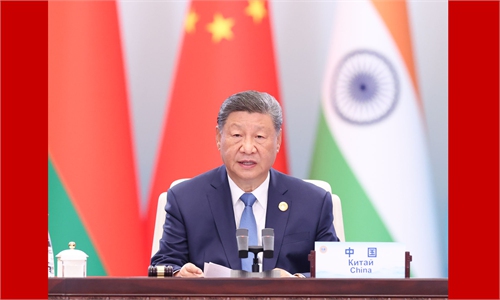
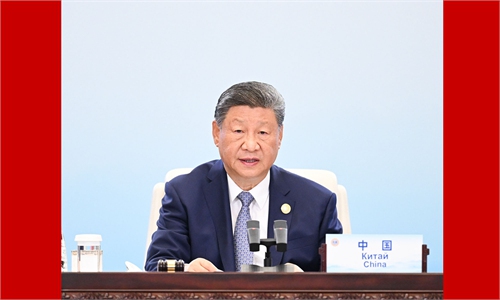
Amid deepening global geopolitical shifts and rising calls for fairer global governance, Beijing held a grand reception on Monday to mark the 25th anniversary of the Shanghai Cooperation Organisation (SCO). The event brought together high-profile guests, including diplomatic representatives from SCO member states, observer states and dialogue partners, senior Chinese government officials, as well as delegates from international organizations, business sectors, civil society, think tanks and media outlets at home and abroad.Addressing the event, Chinese Foreign Minister Wang Yi said that "over the past 25 years the SCO member states have upheld equality and justice by fighting terrorism, separatism, and extremism, fending off external interferences, safeguarding the international rule of law, and advocating the political settlement of conflicts and disputes, all of which contributed to shaping a more just and equitable international order."
Wang, also a member of the Political Bureau of the Communist Party of China (CPC) Central Committee, reaffirmed China's commitment to a path of high-quality development. Regarding the SCO as one of the priorities in building relations with neighboring countries, China stands ready to share opportunities with SCO countries for cooperation and mutual benefit.
In his welcoming speech, SCO Secretary-General Nurlan Yermekbayev noted that the 25th anniversary of the SCO is a milestone symbolizing decades of dedicated work and a shared future-oriented vision of the Organisation's member states.
Speaking about achievements and prospects, Nurlan Yermekbayev stressed that the joint efforts of member states have contributed to economic growth, social progress, and enhanced security. The Secretary-General emphasized the unwavering commitment to the SCO's guiding principles, based on the Shanghai Spirit, which enables member states to find consensus and move forward in a spirit of mutual trust and respect.
Rising role
Founded in East China's Shanghai on June 15, 2001, the SCO is the first regional international organization that was co-founded by China and is named after a Chinese city.
"We are witnessing the rising role of the SCO in our global landscape. As we turn 25 years old, we have evolved from the Shanghai Five, which was focused on the protection of borders, specifically in Central Asia," Oleg V. Kopylov, SCO Deputy Secretary-General, who also attended the Monday event, told the Global Times.
"And we continue to evolve. It is not just about growing bigger; we are now about functionality, rising potential, and increasing the well-being of our people. This is our objective," said Kopylov.
Naheed Naveed Atif, Permanent Representative of Pakistan to the SCO who also attended the event, told the Global Times that a lot of credit goes to the member states, especially China, for the evolution of the SCO across all three areas of regional security, regional development, and connectivity.
Commenting on the unique role the SCO can play in safeguarding regional stability, promoting multilateralism, and advancing a more equitable global governance system, Atif said that it can play a vital role because the region's key countries are members of this organization. Decisions are taken by consensus and the organization provides extensive opportunities for negotiation, allowing countries to understand each other's positions and reach a consensus through consultation. Because of this unique framework, the SCO is highly effective at bringing diverse nations together on a shared agenda.
"After 25 years of development, the SCO has grown into a comprehensive regional cooperation organization that covers the biggest area and population with enormous development potential," Chinese Foreign Ministry spokesperson Lin Jian said at a press conference on Monday.
"Over this period, SCO member states, acting on the Shanghai Spirit and working in solidarity and coordination, have continuously deepened cooperation in political, security, economic, and people-to-people exchanges, and built and reinforced regional security safeguards, bridges for cooperation, and friendly ties. Together, we have successfully explored a new path of regional cooperation and set a stellar example for a new type of international relations," he said.
Under the new circumstances, China will work with other member states to carry forward the Shanghai Spirit, strengthen practical cooperation, and make the SCO a reliable anchor for the common development and prosperity of all nations, the spokesperson added.
True multilateralism
As the SCO anniversary was celebrated in Beijing, the G7 nations' leaders are due to meet on Monday in the French lakeside resort of Evian-les-Bains to discuss the wars in Ukraine and Iran, global economic imbalances that threaten financial stability, and the irrepressible rise of AI, according to a Reuters report.
One day before the summit, thousands of demonstrators rallied in Geneva, Switzerland, on Sunday against the G7 gathering, with protesters throwing bottles, stones, pieces of cement and firecrackers at police, who responded with tear gas and water cannons, according to Euronews.
"The G7 is essentially a small Western clique that has for a long time claimed a sense of uniqueness and superiority, while seeking to dominate the global agenda and shape the international order. This mindset runs counter to genuine multipolarity and inclusive globalization, and has become an obstacle to a fairer international order and common development," Li Haidong, a professor at China Foreign Affairs University, told the Global Times.
The SCO's role is increasingly prominent due to the current international landscape marked by geopolitical fragmentation, the erosion of traditional Western-led international institutions, and rising demand for new development models. The SCO offers a unique, inclusive and consensus-driven framework that respects sovereign equality and non-interference, appealing especially to Global South countries, Sheradil Baktygulov, director of the Institute of World Policy of Kyrgyzstan, told the Global Times on Monday.
For now, the SCO's greatest contribution is demonstrating that a multipolar, cooperative security architecture is not only possible but already functioning in one of the world's most geopolitically complex regions, said Baktygulov.
The Kyrgyzstan scholar also noted that SCO represents a new paradigm of international cooperation that stands in contrast to closed-door and interest-driven blocs like the G7. Its emphasis on non-alignment, non-confrontation, and openness to the Global South and Global North reflects a broader shift toward a more democratic, balanced, and multipolar world order. Thus the SCO is functioning as the influential driver of inclusive and equitable global governance since it is offering a viable, cooperative alternative to zero-sum bloc politics.
Cui Heng, a scholar from the Shanghai-based China National Institute for SCO International Exchange and Judicial Cooperation, said that the SCO has grown into the world's largest regional organization, with 27 participating countries and member states accounting for about one quarter of global GDP. The SCO has played an irreplaceable role in Eurasian security and helped fill the gap left by the absence of a comprehensive regional security framework, Cui said.
The SCO has set an example for reforming and improving global governance, and amid profound global changes, has become an increasingly important anchor of stability and certainty in a turbulent world, said Cui.
RELATED ARTICLES