Xi to attend SCO Tianjin Summit, host relevant events
Organization an indispensable stabilizer in maintaining peace, devt: expert
By and Feng Fan Published: Aug 22, 2025 10:27 PM

SCO Photo: VCG
Chinese President Xi Jinping will attend the Shanghai Cooperation Organisation (SCO) Summit 2025, which will be held in Tianjin Municipality in North China on August 31 and September 1, and host relevant events. Xi will chair the 25th Meeting of the Council of Heads of State of the SCO and the "SCO Plus" Meeting, and deliver keynote speeches, the Chinese Foreign Ministry announced on Friday.
Analysts believe that the summit is a landmark event with long-term strategic significance. Over the past two decades, the SCO has emerged as a vital force in maintaining regional and global stability. Building on this foundation, the expanding and deepening cooperation among SCO member states further demonstrates the organization's vibrant vitality, they said.
During a press briefing on the summit's preparations on Friday morning, China's Assistant Foreign Minister Liu Bin said that the events in Tianjin mark China's fifth time hosting the SCO Summit, and it will be the largest one in scale since the establishment of the organization, according to Xinhua.
President Xi will convene with leaders from more than 20 countries and heads of 10 international organizations along the scenic banks of the Haihe River, according to the Chinese Foreign Ministry, which highlighted that the SCO Tianjin Summit stands as one of the most important head-of-state diplomacy and home-ground diplomacy events in China this year.
According to the Chinese Foreign Ministry, foreign leaders invited to attend the summit include Belarusian President Alexander Lukashenko, Indian Prime Minister Narendra Modi, Iran's President Masoud Pezeshkian, Pakistani Prime Minister Shahbaz Sharif, Russian President Vladimir Putin, Turkish President Recep Tayyip Erdogan, Indonesian President Prabowo Subianto, and Malaysian Prime Minister Anwar Ibrahim.
Additionally, the ministry announced that UN Secretary-General Antonio Guterres, SCO Secretary-General Nurlan Yermekbayev and ASEAN Secretary-General Kao Kim Hourn will participate as heads of international organizations and multilateral institutions, joining this momentous gathering, per Xinhua.
During the summit, President Xi will host a welcome banquet and bilateral events for participating leaders of countries and heads of international organizations, and engage in intensive bilateral activities to plan and advance bilateral relations between China and the participating nations, Liu said.
Since its establishment in 2001 with a focus on security cooperation, the SCO has expanded from six member states to 10 member states with two observer states and 14 dialogue partners, Xinhua reported.
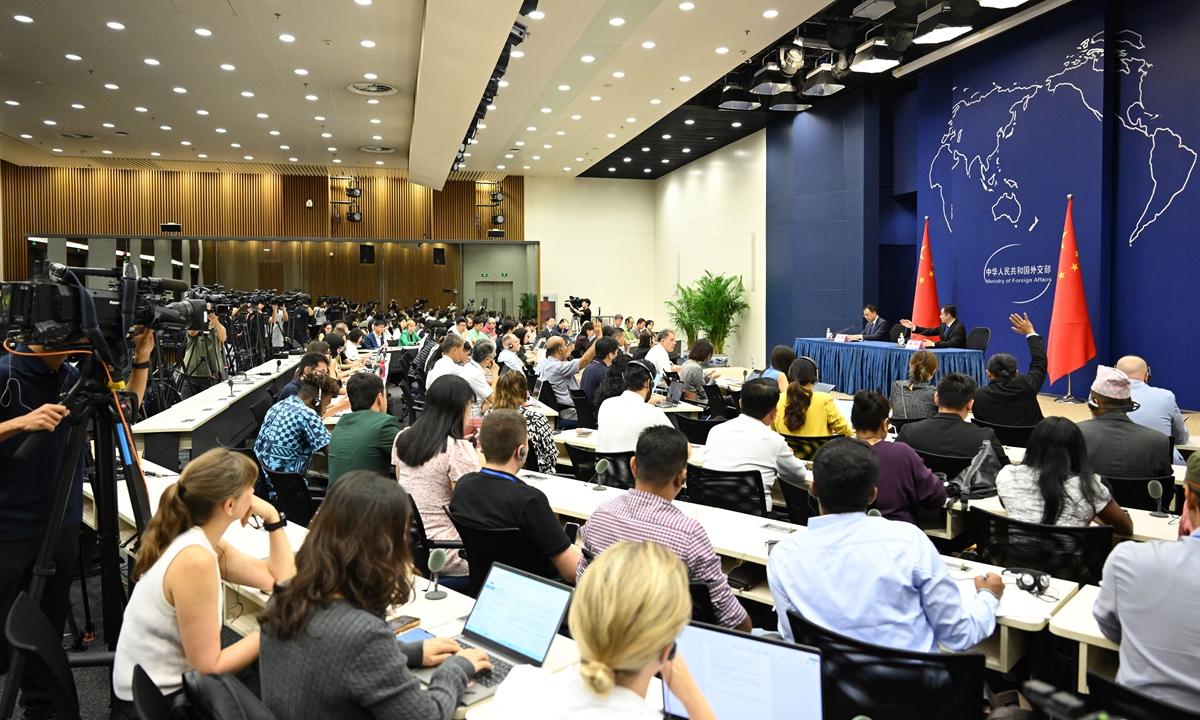
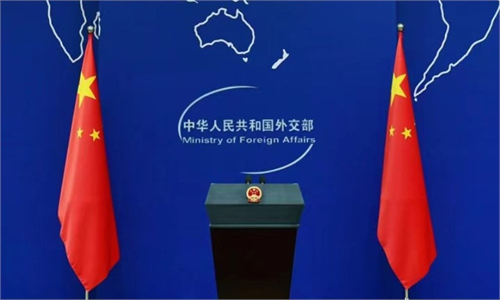
Picture shows a press conference held by Chinese Foreign Ministry in Beijing on August 22, 2025, introducing the preparations of the Shanghai Cooperation Organisation (SCO) Summit 2025, which will be held in Tianjin Municipality in North China on August 31 and September 1. Photo: cnsphoto
Drawing up a blueprint
According to China's Assistant Foreign Minister Liu Bin on Friday, leaders attending the summit are expected to review the successful experiences of the SCO, outline a blueprint for its future development, forge a consensus for cooperation within the "SCO family", and propel the organization toward the goal of building a closer community with a shared future.
In his keynote speeches at the above-mentioned two meetings, Xi will elaborate on China's new vision and propositions for the SCO in carrying forward the Shanghai Spirit, shouldering the mission of the times, and responding to the people's expectations, Liu said.
Xi will also announce new measures and initiatives by China to support high-quality development of the SCO and comprehensive cooperation, and propose new methods and pathways for the organization to constructively safeguard the post-WWII international order and improve the global governance system, Liu added.
According to the official, Xi will jointly sign and issue a declaration with leaders of other SCO member states, approve a development strategy of the SCO for the next 10 years, issue statements marking the 80th anniversary of the victory in the World Anti-Fascist War and the 80th founding anniversary of the United Nations, and adopt a series of outcome documents on strengthening security, economic, people-to-people and cultural cooperation.
Zhu Yongbiao, the executive director of the Research Center for the Belt and Road at Lanzhou University, told the Global Times on Friday that the Tianjin Summit is a landmark event of strategic significance, charting the course for the SCO's development priorities and focus over the next decade.
It will guide efforts in strengthening organizational structure, fostering internal unity, and advancing future cooperation, said the expert, noting the summit represents a strategic plan that builds on the SCO's current development while envisioning its broad prospects for the future.
According to Zhu, the future priorities of the SCO will center on deepening cooperation in both traditional and non-traditional security domains, including counter-terrorism, de-radicalization, and disaster prevention and mitigation.
Building upon the foundation of security collaboration, member states have substantial opportunities to expand partnerships in economic, scientific, technological, and humanitarian fields, said Zhu. Particularly, he singled out areas such as digital economy and outer space exploration.
Vladimir Norov, former foreign minister of Uzbekistan and former secretary general of the Shanghai Cooperation Organisation, told the Global Times that during his tenure as SCO Secretary-General from 2019 to 2021, he observed how the SCO established itself as a "multidimensional and dynamic platform for interaction."
"The SCO consistently strengthened its positions in three strategic areas — security, economy, and humanitarian-cultural cooperation," Norov said.
Data released by the General Administration of Customs on Wednesday showed that China's trade volume with fellow SCO members reached a record high in the first seven months of this year. China's total imports and exports with other SCO members reached 2.11 trillion yuan (about $295.58 billion), marking a 3-percent increase year-on-year.
In the next ten years, the SCO has a chance to create the foundations of a common economic space. These are not abstract plans, but practical steps: unification of customs rules, digitalization of trade, creation of "green corridors" for freight transportation, and harmonization of electronic transaction standards, Norov said.
By 2030, even a partially integrated SCO market can become a factor for economic self-sufficiency in Eurasia, he noted.
The SCO's collaboration continues to expand into more domains other than security, demonstrating strong vitality and immense development potential, Zhu said.
Indispensable stabilizer
The SCO has drawn widespread attention from world media. However, some Western media covered the gathering with bias and doubts, some analysts said.
Reuters said in a Friday report that the China-hosted meeting was "aimed at cementing Beijing's regional influence", while The Diplomat described the event as one "of high significance" as many members of the group have been "embroiled in war and conflicts, undermining the very fabric of SCO multilateralism."
The SCO plays an indispensable role as a stabilizer in maintaining regional peace and development, said Zhu.
The expert added that amid the turbulence across the Eurasian continent, the region encompassing SCO member states remains relatively stable overall, with frictions managed to within a controllable scope.
"The SCO member states have diverse historical, cultural, and religious backgrounds. Against this complex backdrop, it is remarkable that members can come together, resolve issues through communication, and achieve tangible results," Zhu said.
China aims to leverage the Tianjin Summit to forge political consensus with SCO member states, unleash cooperative momentum, amplify a unified voice, and undertake joint actions, Assistant Foreign Minister Liu Bin said during the press conference on Friday.
By harnessing the SCO's stability and resilience, it seeks to address the uncertainties and unpredictability of the international environment, creating a setting conducive to lasting peace, universal security, shared prosperity, openness, inclusivity, and harmonious friendship for the peoples of the region, Liu added.
According to Norov, the true strength of the SCO lies in its ability to turn diversity into complementarity.
Today the SCO covers over 60 percent of the Eurasian landmass and almost half of the world's population, which turns it into a truly global player, Norov said, "By strengthening trust, developing pragmatic cooperation, and ensuring real benefits for all member states, the Organization will remain sustainable and in demand in an increasingly complex and multipolar world."
In the long term, according to Norov, the main task of the SCO is to turn growth into a source of unity. "This requires more effective working mechanisms, enhanced institutional coordination, and the preservation of the spirit of equal consensus."
Li Yu contributed to this story
RELATED ARTICLES