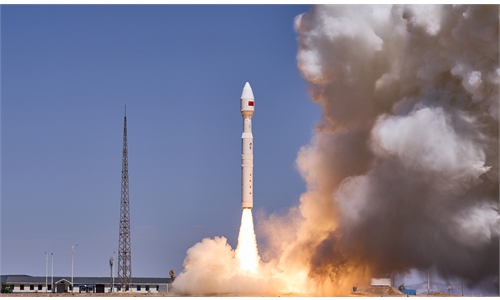
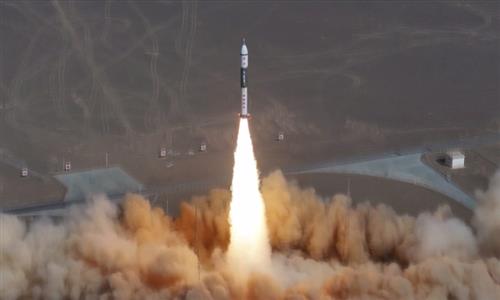
World’s first space computing cloud begins regular in-orbit services in China, putting the country at the forefront: head of the BUPT Tiansuan team
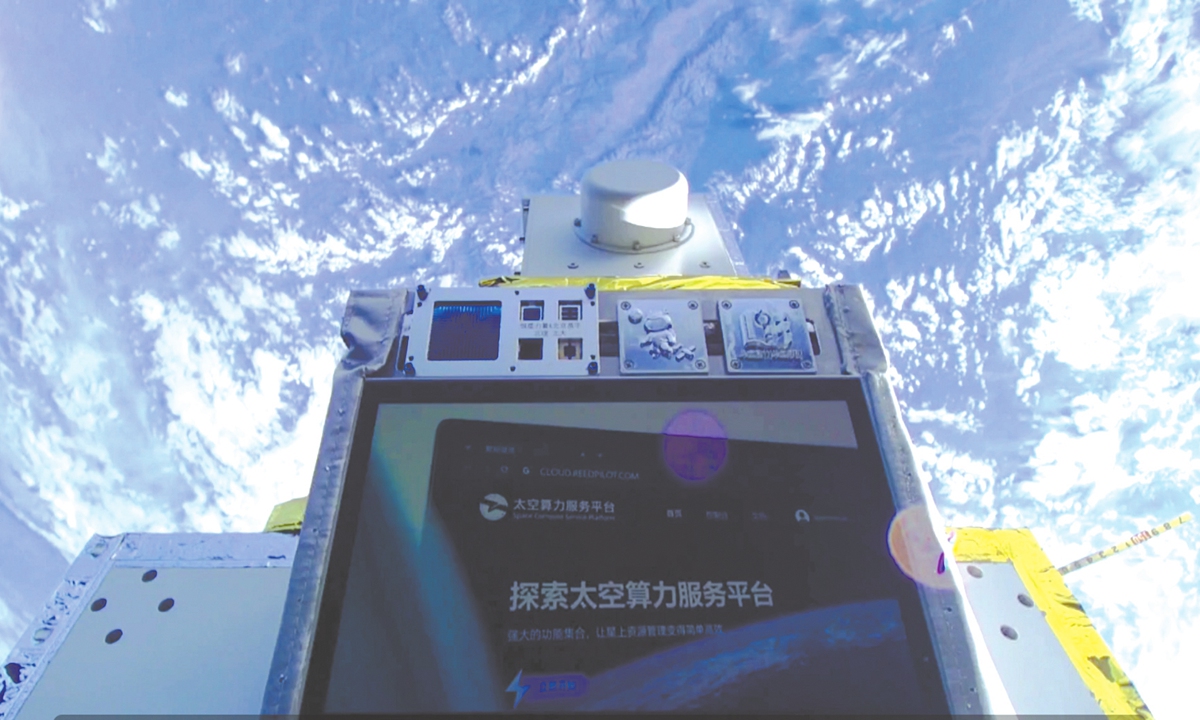
China's space computing cloud satellites in orbit Photo: Courtesy of Beijing University of Posts and Telecommunications
The world's first space computing cloud to offer in-orbit testing services, led by Beijing University of Posts and Telecommunications (BUPT), has officially begun providing regular in-orbit computing services, according to the BUPT.
The space computing cloud consists of an in-orbit computing service platform, a ground station service platform and an operations service platform. By integrating task orchestration, computing resource scheduling, data processing and service delivery across satellite platforms, space-based servers, ground stations and terrestrial data centers, it enables end-to-end automation of complex operations and provides users with computing services covering the entire lifecycle, from task application and deployment to operation, monitoring and result transmission.
In an exclusive interview with the Global Times, Wang Shangguang, a professor at the School of Computer Science at BUPT and head of the team, said that space computing is a strategic capability crucial to securing a leading position in next-generation space information infrastructure and strengthening technological self-reliance. Looking ahead, lunar and Mars exploration, as well as missions deeper into space, will all require the support of space-based computing, said Wang.
A space computing cloud provides users with computing power from satellites in space in the form of cloud services. It serves ground users as a supplement and extension of terrestrial computing, while also supporting users in space and interplanetary missions as an independent source of computing power beyond Earth.
The space computing cloud operates on the Tiansuan Constellation, an open-source space computing in-orbit test platform initiated by the BUPT in 2021 and the world's first space computing constellation, the Global Times learned from the university. To date, the constellation has deployed 16 low-Earth-orbit satellites and established seven ground stations, supporting in-orbit experiments by more than 60 organizations and several major national projects. It has also attracted researchers from more than 50 countries and regions to participate in building its ecosystem.
Space computing is a frontier field being explored worldwide, and China is starting from the same point as early movers such as the US, without a generational technology gap, according to Wang, noting "the launch of regular services by the space computing cloud puts China at the forefront of this emerging field."
Since entering in-orbit operation, the space computing cloud has completed hundreds of space computing tasks and served more than 100 users. Based on a domestically developed hardware and software ecosystem, it has achieved a large-model inference energy efficiency of 10 tokens per joule, according to Wang.
"This means that for every joule of energy consumed, the system can generate or process about 10 tokens during inference. The higher the figure, the greater the AI computing capability per unit of energy and the better the energy efficiency and practicality of in-orbit computing," Wang said.
Global technology competition is expanding beyond chips and AI into future infrastructure such as satellite internet, 6G and space computing, all of which require computing capabilities in space. Therefore, whoever takes the lead in developing independent and controllable space computing capabilities will be better positioned to gain an edge in the next round of technological and industrial competition, according to the BUPT.
The space computing cloud has already been applied in areas including in-orbit inference for marine computing, in-orbit verification of next-generation 6G core networks, location privacy protection for direct-to-device satellite connectivity, and distributed data storage services across satellites.
Looking forward, the BUPT Tiansuan team will work with its partners to continuously upgrade the space computing cloud and expand its in-orbit computing resources. It will provide more in-orbit testing services for integrated space-air-ground 6G, intelligent remote sensing and satellite internet, while supporting major national strategic needs and driving innovation and development in China's space economy, said the university.
RELATED ARTICLES