Beijing Stock Exchange, within five years, grows into vibrant, mature fundraising venue for Chinese SMEs

A concept photo of China's stock market Illustration: VCG
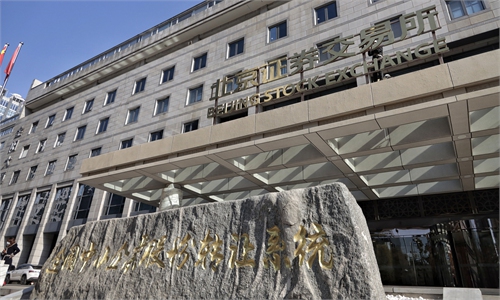
Five years after its founding, the Beijing Stock Exchange (BSE) has grown into a vibrant and mature fundraising venue for small and medium-sized Chinese firms, helping nurture industry leaders in high-end manufacturing, new energy, new materials, semiconductors and more.
As of Wednesday, the number of listed companies had grown more than fourfold, from 81 to 339, while total market capitalization had grown from less than 300 billion yuan at the outset to about 850 billion yuan, the exchange said in a statement sent to the Global Times on Wednesday, the fifth anniversary of its establishment.
The number of qualified investor accounts on the stock exchange has now topped 11 million, nearly triple the number at the time of the exchange's inauguration. More than 3,000 public funds trade on the market, and institutional investors' share of turnover has risen from 9 percent at launch to 24 percent, according to the statement.
As the BSE marks its fifth anniversary, analysts pointed out that the development of the exchange also shows China has formed a multi-tier capital market, with each board given a distinct position that channels capital into the country's high-tech and technological self-sufficiency drive.
While the Shanghai and Shenzhen exchanges take the larger, more mature issuers, the Beijing exchange is built for innovative small and medium-sized firms, with more than 60 percent of companies now listed on BSE being nationally recognized specialized and sophisticated "little giant" firms.
With backing from the capital market, some "little giant" listed companies have made breakthroughs in critical fields such as new materials and semiconductor testing equipment, helping to stabilize and strengthen China's high-tech industrial chains.
Industry insiders pointed out that the creation of the BSE has also given firms on the National Equities Exchange and Quotations - also known as China's New Third Board, which lets small and medium-sized companies raise funds and build a disclosure record before a full listing - a clear path upward.
"BSE companies come from the NEEQ innovation tier, putting into practice the logic of nurturing firms step by step: cultivate one, mature one, list one. That gives the pipeline of potential listings real room to grow, with ample capacity for further expansion," Yang Delong, chief economist at Shenzhen-based First Seafront Fund, told the Global Times on Wednesday.
With regard to earnings, the latest interim reports show that the 339 BSE companies posted combined first-half revenue of 138.57 billion yuan, or 409 million yuan on average, up 15.11 percent year-on-year. Combined net profit was 11.78 billion yuan, or 34.76 million yuan on average, up 17.58 percent. Of the total, 282 companies were in the black, meaning more than 80 percent of the listed companies turned a profit, according to a report by news portal Yicai.com on Wednesday.
The BSE said that in the next stage it will keep making the rules more inclusive and adaptable, and widen the listing path for small and medium-sized firms. On the financing side, it will raise both the quality and the innovative content of the company mix. On the investment side, it will expand the product lineup and do more to bring in medium- and long-term capital.
Five years on, industry insiders expected the BSE to play a bigger role in building a resilient fundraising ecosystem for small- and medium-sized Chinese companies. They predicted that more measures could be rolled out on both the financing and investment sides to draw in additional capital, improve liquidity and expand the board.
Global Times
RELATED ARTICLES