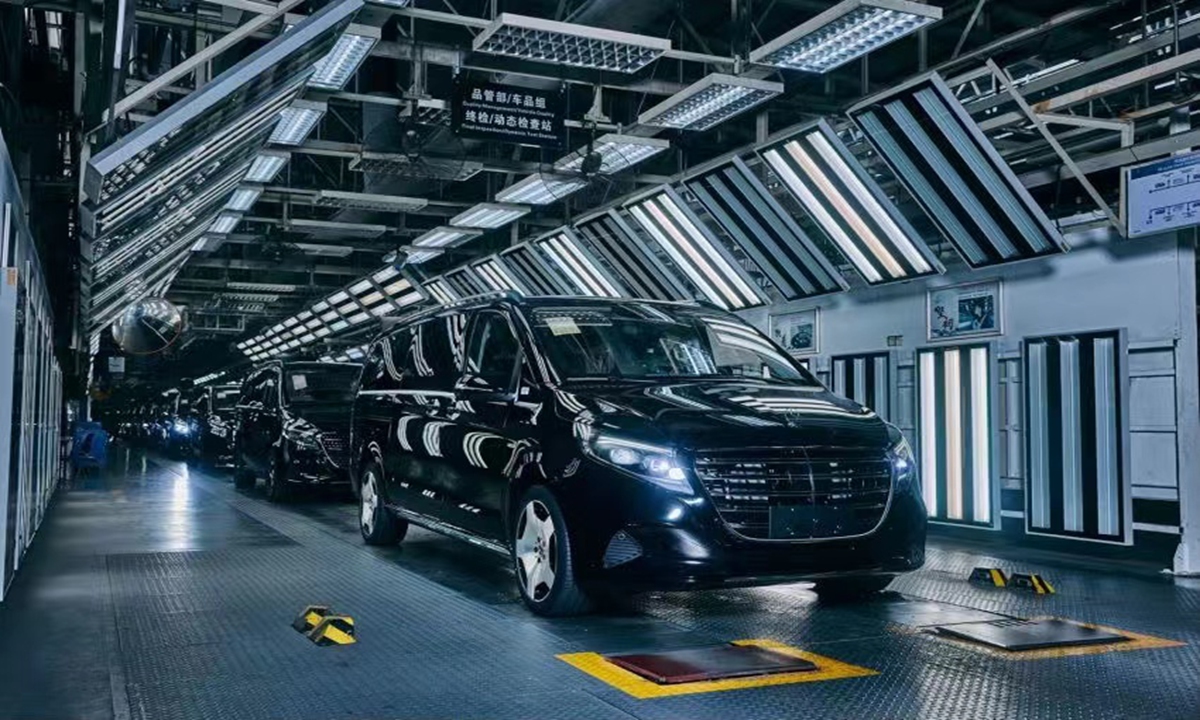
A view of a Mercedes-Benz factory in East China's Fujian Province. Photo: Courtesy of Mercedes-Benz
Germany's reported shift in its China trade policy stems from a mix of domestic industrial competition anxieties and a rising protectionist tide within the EU, yet blaming China for Germany's industrial pressure is utterly one-sided and will neither save Germany's industry nor that of Europe in general, Chinese analysts said on Wednesday after reports of Germany planning measures against China.
Germany is aiming for a "tougher China trade package" in the coming weeks to counter what it sees as "unfair Chinese trade practices," Bloomberg reported, citing German Finance Minister Lars Klingbeil.
Possible measures include requiring Chinese companies seeking access to the German or European market to enter joint ventures, imposing additional tariffs in areas such as hybrid vehicles, and giving preference to goods made in Germany or elsewhere in Europe through so-called Buy European strategies, according to Bloomberg.
Jian Junbo, director of the Center for China-Europe Relations at Fudan University's Institute of International Studies, told the Global Times on Wednesday that attributing Germany's industrial strains to China's "unfair trade practices" distorts the nature of the issue.
The fundamental reason lies in Germany's declining industrial competitiveness, rather than external competition. European industries have witnessed slower innovation and technological progress in recent years, while overly rigid industrial systems and stringent regulations have undermined operational efficiency, jointly eroding the vitality and competitiveness of local manufacturing sectors, Jian said.
Cui Hongjian, a professor at the Academy of Regional and Global Governance at Beijing Foreign Studies University, also told the Global Times on Wednesday that China's industrial competition is not to blame for Germany's manufacturing downturn.
The real blows to German corporate competitiveness come from soaring energy and production costs, compounded by high US tariffs on European goods, which have jointly dampened the profitability and global competitiveness of German enterprises, Cui said.
Chinese experts warned that trade barriers and protectionist policies are merely temporary fixes and that such restrictions will only severely backfire on Germany's domestic industries and undermine overall China-EU trade.
Higher tariffs and market barriers will push up production costs and product prices, reduce operational efficiency, weaken the global competitiveness of German multinational corporations, and ultimately drag down Germany's overall economic growth, Jian explained.
Addressing China-EU trade, Chinese Foreign Ministry spokesperson Lin Jian told a press conference on July 21 that China attaches high importance to the economic and trade differences between China and the EU, and believes that both sides can properly handle those differences through dialogue, consultation and policy interaction.
"Protectionism leads nowhere. Win-win cooperation is the right way forward," Lin said.
European companies are voting with their investments, demonstrating China's irreplaceable value as a market. According to the German Institute for Economic Research, Germany's new direct investment in China hit roughly 7 billion euros ($8.1 billion) in 2025, up more than 55 percent year-on-year and the highest level since 2021.
RELATED ARTICLES