Chinese, German officials vow to boost cooperation
Bilateral exchanges crucial for business success: German biz leader
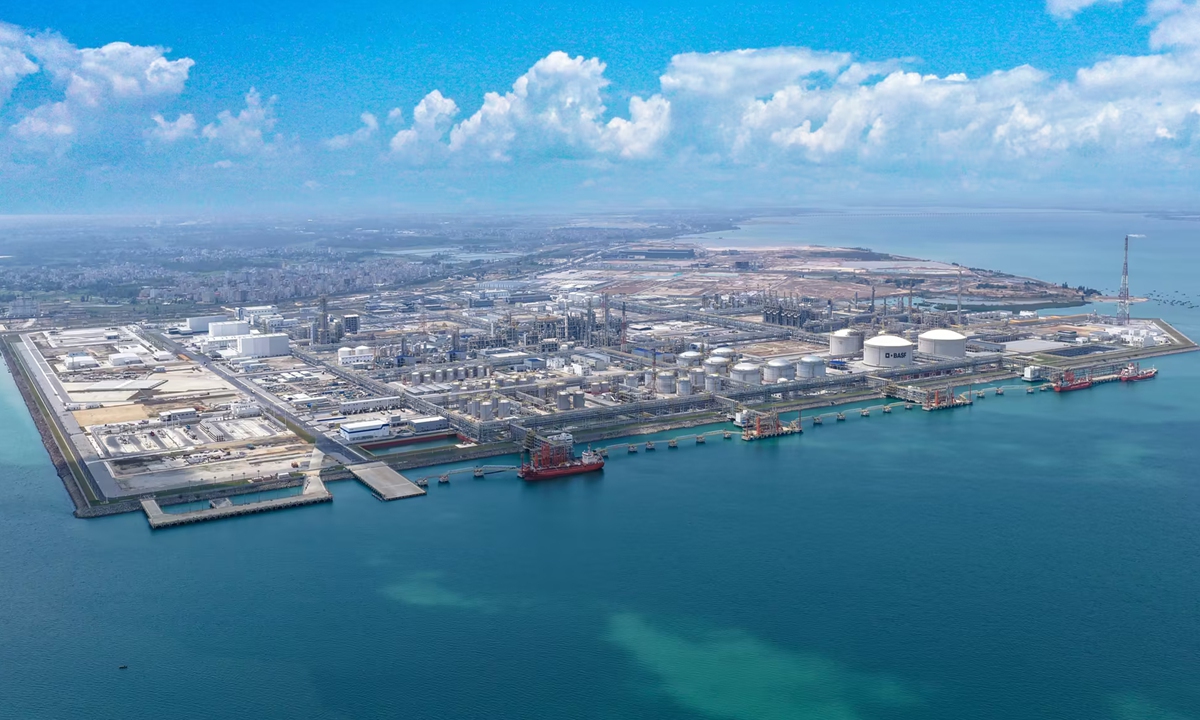
An aerial picture of BASF's Verbund site in Zhanjiang, South China's Guangdong Province Photo: Courtesy of BASF
Chinese Vice Premier He Lifeng met with German Economy and Energy Minister Katherina Reiche in Beijing on Wednesday, where the two sides exchanged views on issues such as deepening China-Germany economic and trade cooperation, according to the Xinhua News Agency.
He stated that China and Germany are important economic and trade partners, with a solid foundation, great potential, and strong complementarity in their economic and trade cooperation. He expressed hope that both sides would further consolidate traditional cooperation, explore potential in emerging fields, and promote the sustained and healthy development of bilateral economic and trade relations through high-level cooperation.
Reiche said Germany is a reliable economic and trade partner of China, adding that the German business community remains optimistic about China's economic outlook and innovation capabilities and will continue to deepen cooperation with China, according to Xinhua.
Also on Wednesday, Chinese Commerce Minister Wang Wentao met with Reiche in Beijing. During the meeting, Wang said that China and Germany should jointly support free trade and multilateralism, while pointing out that recent EU trade restrictions with "protectionist overtones" have seriously disrupted cooperation between Chinese and European companies, according to a news release from China's Ministry of Commerce (MOFCOM).
Wang said that as major manufacturing, export and trading nations, both China and Germany have benefited from economic globalization and should jointly support free trade and multilateralism, serving as advocates of openness and inclusiveness, practitioners of mutual benefit and win-win cooperation, and pioneers of innovation-driven development, according to the MOFCOM.
China is willing to strengthen dialogue and communication with Germany, expand the list of cooperation areas, narrow the list of differences, and jointly promote the steady and long-term development of China-EU economic and trade relations, Wang said.
Reiche said that China is Germany's largest trading partner and also one of the most important sources of foreign investment for the country. The German government supports free trade and opposes "decoupling and supply chain disruption," she said, according to the MOFCOM.
She added that Germany is willing to strengthen policy communication with China and build a rules-based, stable, balanced, trustworthy and future-oriented Germany-China economic and trade relationship, per the MOFCOM release.
The meeting came as German businesses continue to stress the importance of stable bilateral economic ties and practical cooperation with China.
Oliver Oehms, executive director and board member of the German Chamber of Commerce in China North & Northeast, told the Global Times that high-level bilateral exchanges remain "crucial" for German companies operating in China.
"Our member companies tell us that high-level bilateral exchanges are crucial for their business success in China," Oehms said, as Reiche leads a delegation of about 40 business executives on her first visit to China.
He noted that many German firms hope Berlin can help create a more supportive framework for partnerships with Chinese companies.
According to the German Chamber's May 2026 flash survey, which was released ahead of Reiche's visit, 51 percent of surveyed companies said that supporting partnerships with Chinese firms should be the German government's top priority in helping businesses succeed in China.
Oehms said that German companies continue to see strong cooperation potential in China.
"With their sustainable and safe products, German companies in China can make significant contributions to China's high-quality development across multiple sectors," he said. "We are observing an increasing number of partnerships between German and Chinese companies across industries that benefit both sides."
Recent findings from the European Union Chamber of Commerce in China also pointed to improving sentiment among European businesses operating in China. Jens Eskelund, president of the chamber, said on Wednesday that some European firms that were previously "in China for China" are now increasingly "in China for the world."
Eskelund also said that China has appeared "more stable compared to many other parts of the world" amid growing global volatility over the past year.
Jian Junbo, director of the Center for China-Europe Relations at Fudan University, told the Global Times that the two major manufacturing and export-oriented economies have built deep economic interdependence and highly complementary industrial chains over the years, noting that continued investment by German firms in China reflects the strong foundation of bilateral cooperation.
Jian noted that the visit is expected to involve discussions on issues such as trade balances. He said that German businesses tend to adopt a more pragmatic approach toward China than some European politicians who advocate "de-risking" and protectionist measures, largely because German firms place greater importance on the tangible benefits of cooperation with China.
Germany's trade with China reached 253 billion euros ($287 billion) in 2025, up about 2.7 percent from a year earlier, according to data previously released by Germany's Federal Statistical Office. China once again became Germany's largest trading partner in 2025, according to the Xinhua News Agency.
RELATED ARTICLES