IN-DEPTH / IN-DEPTH
GT investigates: Can military measures rein in spiraling US Treasury debt?
‘Imperial decline’
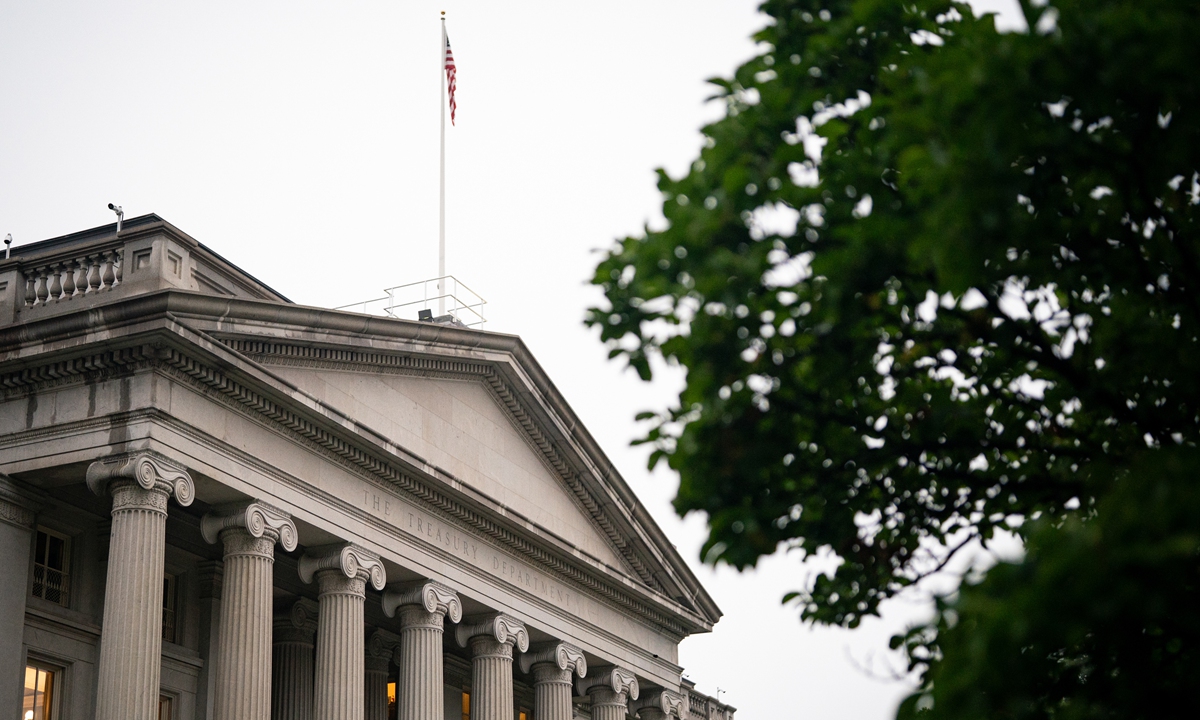
A view of the US Treasury building in Washington, the US Photo: VCG
On August 19, US federal government debt crossed an "ominous milestone," surpassing $40 trillion for the first time. That works out at an average of $359,000 for every US taxpayer. For decades, Washington has been able to keep issuing debt to cover its fiscal deficits by relying on dollar hegemony, with military power serving as a key pillar sustaining that hegemony.Yet the relentless expansion of US debt has pushed government interest payments above defense spending, while debt is steadily eroding the fiscal foundation of Washington's military hegemony. In the US, some have come to view the debt problem as a national security issue. Faced with this problem, US President Donald Trump recently hinted that military means could be used in response. Whether that would work, however, has been widely questioned.
$116,000 per American
US federal government debt reached the $39 trillion mark in March this year. Just five months later, it surpassed $40 trillion. According to Yahoo News and other media outlets, that means an average debt burden of about $116,000 for every American. The burden corresponding to each US taxpayer is even heavier, at more than $359,000 in federal debt.
This enormous debt consists of two parts: intragovernmental debt and debt held by the public. The latter refers to debt owed to investors outside the federal government, including individual investors as well as institutions such as banks and pension funds. According to data from the Washington-based advocacy group the Committee for a Responsible Federal Budget, debt held by the public has exceeded $32 trillion.
The pace at which US federal debt is growing accelerates. Looking back, US national debt first reached $1 trillion in 1981 and climbed to $20 trillion in 2017. In the nine years since 2017, the debt has more than doubled. The International Monetary Fund forecasts that US general government debt will reach $40.7 trillion in 2026, while nominal gross domestic product will stand at $32.4 trillion. On that basis, the US debt-to-GDP ratio will rise to 125.8 percent.
Why does US debt keep soaring? The Conversation and other media outlets have attributed it partly to the country's persistent inability to bring its budget deficits under effective control. This stems in part from distorted political incentives built into the system: Tackling the deficit requires cuts in public spending or tax increases, or both, yet political parties that take such steps are often punished by voters at the ballot box.
The policy preferences of the two US parties have compounded the problem. Republicans generally prioritize tax cuts without reducing government spending in tandem, while Democrats continue to expand social spending programs without raising enough revenue to cover their cost.
Tax cuts, wars, an aging population and massive crisis-response spending have collectively driven the continuing surge in US debt. According to Fortune, three rounds of tax cuts in 2001, 2017 and 2025 reduced federal revenue from an average of 19.1 percent of GDP to 16.7 percent, causing a cumulative revenue loss of as much as $11.1 trillion. Meanwhile, the wars in Iraq, Afghanistan and Iran increased US defense spending from 3.5 percent to 4.4 percent of GDP, adding another $3.9 trillion in expenditures. As the population aged, spending on Social Security, Medicare and Medicaid rose from 7.8 percent to 10.1 percent of GDP, an increase of $12.5 trillion. Other expenditures, including the response to the 2008 global financial crisis and the COVID-19 pandemic, added a further $5.2 trillion.
'Exorbitant privilege'
Measured in nominal terms, the outstanding stock of US federal government debt far exceeds that of other major economies, placing the country firmly at the top of the global rankings. Yet an apparent contradiction has persisted for years: Although the US continues to run twin fiscal and trade deficits, neither a major sell-off in its government bonds nor a collapse of the dollar has followed. Capital Group, a US financial services company, and other institutions and media outlets have attributed this situation primarily to the dollar's unique position as the world's leading reserve currency.
The dollar's status as the world's leading reserve currency can be traced to the Bretton Woods system established in 1944. That system made the dollar the anchor currency of the international monetary order, laying the foundation for its importance in global finance.
Even after the Bretton Woods system formally collapsed in 1971, the dollar retained its dominant position because of the enormous size and high liquidity of US financial markets, international confidence in the US and the country's relatively stable geopolitical environment.
Today, more than half of global trade and cross-border financial claims are denominated in dollars, and the dollar still accounts for as much as 58 percent of global foreign exchange reserves.
It is this unique position that has given the US what is known as an "exorbitant privilege." This privilege enables the US to borrow internationally at costs far below those faced by other countries and to exert extraordinary influence over global economic governance. It operates on several levels.
First, other countries have a structural demand for US Treasury securities, with foreign central banks and sovereign wealth funds continuing to purchase US government bonds. This stable source of demand helps hold down Treasury yields.
Second, when global economic uncertainty rises, investors often seek safety in dollar assets, further strengthening the dollar's purchasing power and keeping downward pressure on Treasury interest rates.
Finally, the dollar provides the US with significant monetary stability, allowing it to sustain long-term trade deficits without triggering a currency crisis, because foreign exporters frequently reinvest their dollar earnings in US assets. Together, these mechanisms have created a special arrangement that effectively separates US fiscal discipline from its borrowing costs.
Hegemony at stake
US military hegemony is also one of the pillars supporting the dollar's dominant position, or dollar hegemony. JPMorgan Chase CEO Jamie Dimon recently said the dollar's dominance depends on US military strength. If the US no longer possesses both the world's strongest military and its strongest economy in the future, he said, the dollar's status as the global reserve currency could face substantial risks.
Pierre Yared, a professor of international business at Columbia Business School, and Carolin Pflueger, an associate professor at the University of Chicago, made a similar argument in their co-authored paper, "Global Hegemony and Exorbitant Privilege." They argue that only a government with an exceptionally powerful military can ensure that its country is most likely to prevail in a conflict, thereby preserving the value of the assets it issues. The essay further noted that domestic turmoil in US financial markets, including repeated political battles over the debt ceiling, could gradually erode the country's low-cost borrowing advantage and ultimately pose a potential threat to national security.
Reality is already sounding the alarm. US interest payments on the national debt have now exceeded defense spending, potentially affecting the country's military capabilities. According to Fortune and South Korea's Hankyoreh, net interest spending on US government debt reached $970 billion last year and currently stands at about $1.2 trillion. The fiscal year 2026 National Defense Authorization Act authorized $901 billion in military spending, the Guardian reported.
Fortune cited a warning from a historian at the conservative Hoover Institution that when interest payments on the national debt exceed military spending, the US crosses a threshold beyond which it risks "ceasing to be a great power." This is because the debt burden reduces the funding available for national security, leaving a country increasingly vulnerable when confronted with military challenges. If policymakers fail to address the balance between debt-servicing costs and military expenditure, the US could lose its geopolitical dominance.
South Korea's Hankyoreh reported that US interest spending on the national debt exceeding defense expenditure signals that the clock of "imperial decline" is ticking. Citing US historian Paul Kennedy's classic theory, the report said that when an empire attempts to assume military and security obligations beyond what its national strength can sustain, "imperial overreach" accelerates its decline. One commonly used warning indicator for assessing the risk of such overstretch is whether interest spending on the national debt has exceeded defense expenditure. The US reached that point in 2024.
However, the fact that interest spending on the national debt has exceeded military expenditure is not, by itself, sufficient to conclude that the US is inevitably heading toward decline. Similar warnings were repeatedly voiced in the 1980s. In the 1990s, however, the information technology revolution significantly boosted US productivity, the dissolution of the Soviet Union created a more favorable domestic and external environment for the US, and the Clinton administration's fiscal consolidation through tax increases and spending cuts ultimately moved the federal budget into surplus. It was against this historical backdrop that the US consolidated its global hegemonic position.
As the US grapples with its debt problem, Trump raised the possibility of using the military for an "intervention" on August 21. He told reporters: "We have many types of intervention - that's one - the ultimate intervention is our military. If we have to use that, we will," The New York Times reported.
The remarks caused widespread confusion in international public opinion. Some analysts speculated that the White House might not directly use military means to intervene in the bond market, but could instead provoke geopolitical conflicts or manufacture tensions to stimulate demand for safe-haven assets. That could encourage capital to flow into US Treasuries, with the aim of lowering Treasury yields or stabilizing the bond market.
He Weiwen, executive council member of China Association of International Trade, told the Global Times that there had never been a case in history of a country using military means to intervene in its sovereign debt or creditworthiness.
He said certain military measures might produce a temporary effect in the short term, but could not fundamentally resolve the debt problem. More importantly, using military force to interfere in normal bond-market transactions would set a damaging precedent. The bond market is supposed to operate on the basis of professional judgment and market rules. Once military power is introduced, confidence in US debt would decline over the longer term.
RELATED ARTICLES