China, Egypt to build a more resilient industrial, supply-chain partnership: MOFCOM

This photo taken with a mobile phone on Aug. 30, 2026 shows a city view in Cairo, Egypt. Egypt is home to an ancient civilization that flourished along the Nile River. From the pyramids that have stood for millennia to its bustling modern cities, the ancient and the contemporary intertwine across the country, reflecting a civilization that has endured through the ages. (Xinhua/Cai Yang)
China and Egypt had recently reached broad consensus on deepening economic and trade cooperation and would work to build a more resilient industrial and supply-chain partnership, China's Ministry of Commerce (MOFCOM) said on Thursday. Meanwhile, an Egyptian expert told the Global Times that the relationship is increasingly moving beyond traditional trade toward joint manufacturing, industrial localization and deeper supply-chain integration.
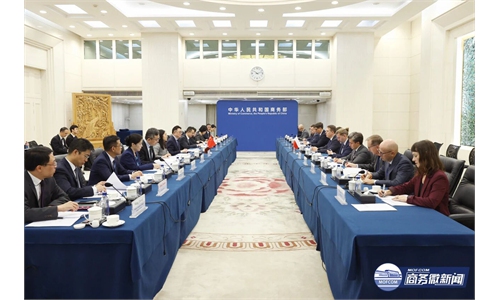
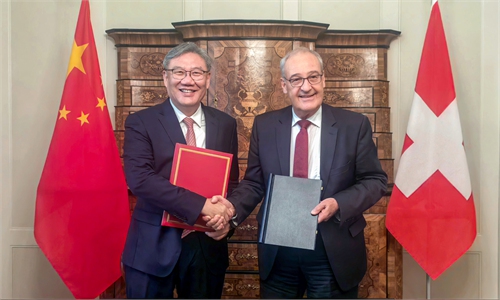
MOFCOM spokesperson Huang Ling said at a regular press conference that the ministry and relevant Egyptian authorities had signed two memorandums of understanding on strengthening industrial and supply-chain economic cooperation and on development cooperation for the Suez Economic and Trade Cooperation Zone. The two sides will further tap the potential of cooperation zones to drive investment and trade, she said.
The latest move comes as China-Egypt economic ties continue to expand. China has been Egypt's largest trading partner for 14 consecutive years. Bilateral trade reached a record $20.79 billion in 2025, while trade in the first seven months of 2026 rose 23.2 percent year-on-year to $13.75 billion, according to MOFCOM.
Investment cooperation has also deepened. China's new direct investment in Egypt reached $284 million in 2025, more than triple the previous year's level. The China-Egypt TEDA Suez Economic and Trade Cooperation Zone now hosts more than 200 companies and has created over 10,000 direct jobs, Huang noted.
Ahmed Abdellah Faris, a researcher in Chinese affairs and international relations at the Arab Center for Studies, noted that the most significant change in bilateral economic ties is their shift beyond traditional trade toward joint manufacturing, industrial localization and deeper supply-chain integration.
Faris said the shift directly serves Egypt's development priorities by helping expand domestic productive capacity and narrow its trade deficit. Chinese investment, he said, is increasingly contributing not only capital and production capacity, but also technology transfer, specialized training and the development of local supply chains.
"The model can be summarized as China manufacturing in Egypt, Egypt exporting from its territory to the world, and technology becoming localized within the national economy," Faris said. Egypt's geographic position and the Suez Canal give it the potential to become an important manufacturing and export base serving markets in Africa, the Middle East, and beyond, he added.
He also noted that cooperation is moving into higher-value sectors including artificial intelligence, telecommunications, data centers, cloud computing, renewable energy, electric vehicles, and batteries, creating more room for joint R&D, technology transfer and local production.
RELATED ARTICLES