China’s Arctic shipping enters new phase as opportunities rise while real-world challenges remain: Chinese analysts
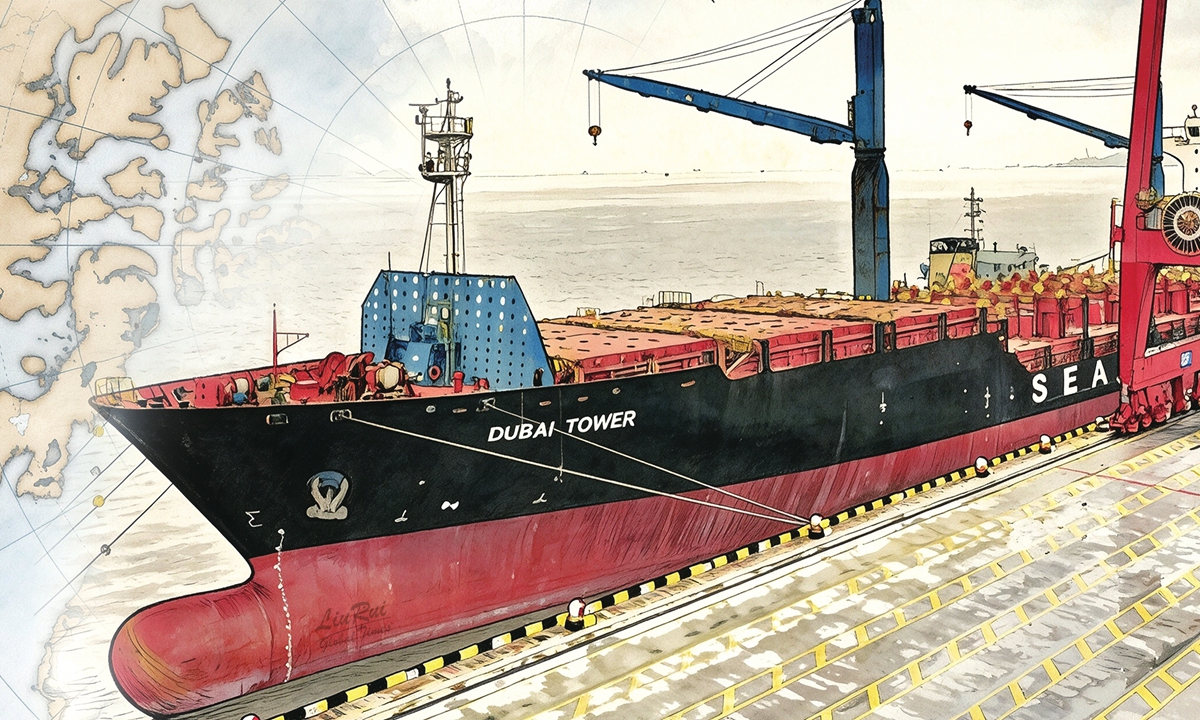
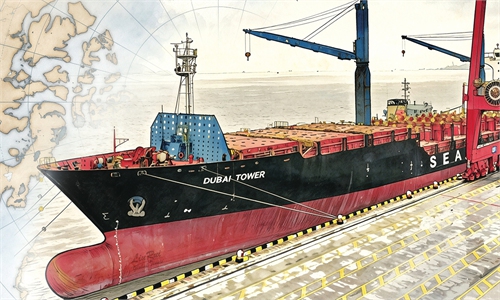
The China-Europe Arctic container express route enters regular weekly operations during the summer season in 2026. Illustration: Liu Rui/GT
China's Arctic shipping is entering a new stage of development this year, as multiple companies expand operations through the polar route. But industry insiders and experts told the Global Times that the change should not be interpreted as a replacement for established routes such as the Suez Canal. Instead, they said the Arctic corridor is moving into a phase in which its commercial viability, supply-chain resilience and role in global shipping governance are being tested.
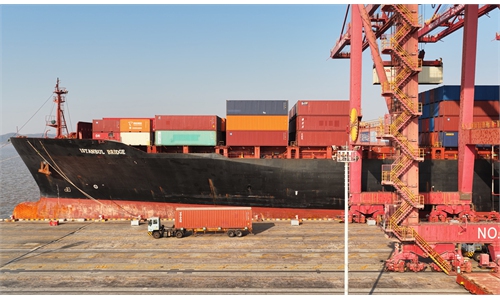
In August, Chinese shipper Sea Legend Shipping launched the country's first regular cargo service via the Arctic route. Since then, six Chinese shipping companies have planned 29 vessels to operate 44 Arctic voyages this year, the highest number since China's first Arctic voyage in 2013, according to industry sources.
The shift from one-off voyages to scheduled sailings has prompted fresh debate over whether the Arctic route could eventually emerge as a major international trade corridor.
The Arctic route refers to maritime paths used by vessels crossing the Arctic Circle and connecting major economic centers in East Asia, North America and Western Europe. It is the shortest maritime passage from East Asia to Europe or the Atlantic coast of North America.
Chen Feng, an adjunct researcher at the Polar Research Center at Guangdong University of Foreign Studies Nanguo Business School, told the Global Times that the types of vessels used in China's Arctic shipping have expanded to five categories, including multipurpose ships, semi-submersible vessels, LNG carriers, container ships and bulk carriers.
A key indicator of whether an Arctic route can move from experimental to commercial service is the ability to offer "weekly service," Chen said. Sea Legend's plan to sail one voyage per week after its August 15 maiden trip for a total of eight consecutive sailings suggests a degree of schedule stability, allowing shippers to book cargo and plan production and logistics in advance, the expert noted.
Zhao Long, director of the Institute for International Strategic and Security Studies at the Shanghai Institutes for International Studies, told the Global Times that this year's developments signal that Arctic shipping has moved beyond feasibility studies and into a stage of commercial model validation.
According to Zhao, several underlying conditions have attributed to the changes. "Climate change has reduced the overall extent and thickness of sea ice during the summer and autumn months. At the same time, advances in ice-class vessels, satellite remote sensing, ice forecasting and digital navigation have made Arctic operations more practical," he said.
Geopolitical risks in other major shipping corridors have also added to the appeal of route diversification, Zhao said, adding that disruptions and tensions in critical waterways such as the Red Sea, the Strait of Hormuz and the Suez Canal have strengthened international interest in alternative routes and greater supply-chain resilience.
"However, the value of the Arctic route is not to replace the traditional Suez Canal, but to add resilience to the global shipping network," Zhao added.
Still, experts said the Arctic route faces major real-world constraints. Ice conditions continue to be the most significant challenge. A Russian insurance company, AlfaStrakhovanie, disclosed in August that an oil tanker suffered serious hull damage while transiting the Arctic route under the escort of an icebreaker. The case highlighted that even with icebreaker support, ships in Arctic waters still face elevated risks of damage.
Chen said the Arctic remains ice-covered for much of the year, leaving only a limited navigation window. The Northeast Passage can be open for roughly 10 weeks a year, while the Northwest Passage is navigable for only about two weeks.
Infrastructure is another major limitation. Compared with mature international shipping lanes, Arctic routes still lack sufficient ports, resupply facilities, search-and-rescue capacity, pollution-response systems, communications networks and reliable ice information services.
Zhao said Arctic shipping sits at the intersection of climate, economics, national interests and international rules. Russia is a key coastal state along the Northeast Passage, Europe is the destination for much of the cargo, and China is an important participant in the development process.
For Arctic shipping to become truly commercial, Zhao said, it will require sustained cooperation among multiple parties.
Beyond transportation itself, experts say Arctic shipping could generate wider industrial demand, including for ice-class shipbuilding, satellite remote sensing, ice forecasting, marine information services, port development, insurance, search and rescue, and pollution control.
After more than a decade of experience, China has begun to develop a body of practical knowledge related to Arctic shipping. Experts said this experience could extend into these adjacent sectors. More broadly, Arctic shipping is also seen as a window for China's participation in the sustainable development of the Arctic and international cooperation.
"China plays the role of a participant, contributor and multilateral cooperation partner," expert said.
RELATED ARTICLES