Protectionist walls will not address US auto sector’s weakening competitiveness: Chinese expert on reported US lobbying to ban Chinese cars
By Published: Sep 04, 2026 04:20 PM

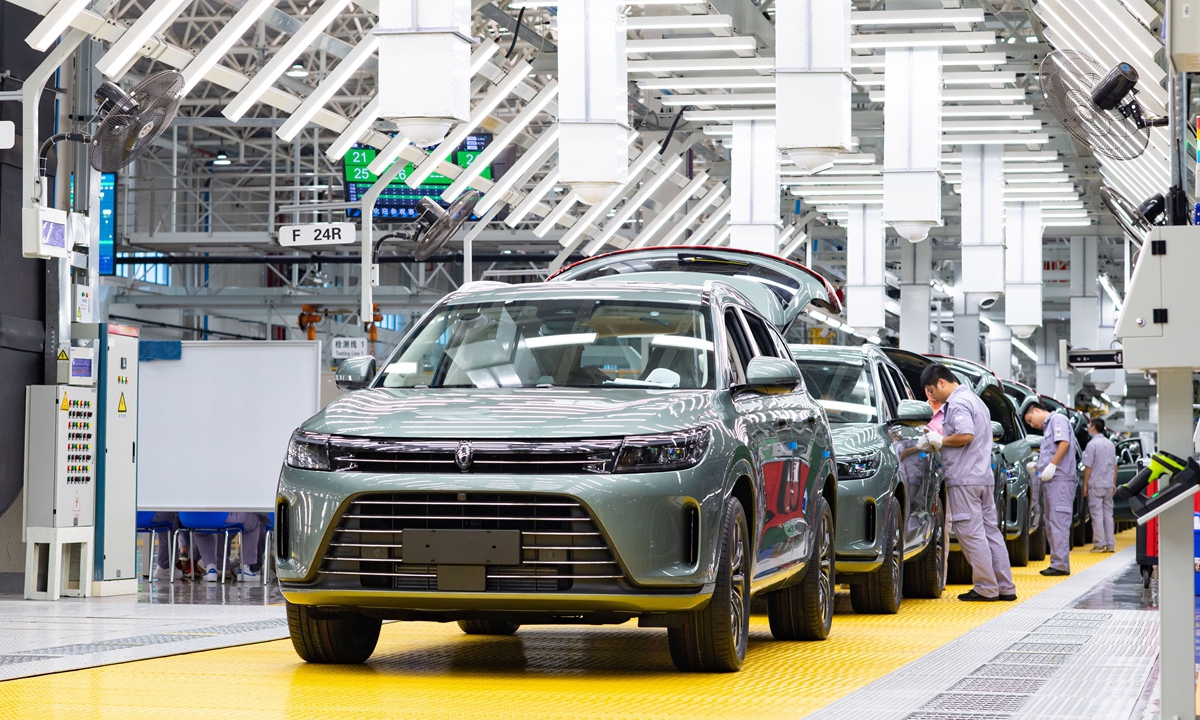
An NEV manufacturing line in Southwest China's Chongqing Municipality Photo: VCG
In the latest moves by the US auto industry to deny Chinese automakers market entry, a US auto industry lobby group is reportedly urging the US Congress to pass legislation barring Chinese vehicles before the end of the year. A Chinese expert said the move reflected intentions by some in the US auto industry to seek a safe harbor by erecting protectionist walls, warning that such a move will not address the issues of weakening competitiveness faced by US auto industry and will harm the interests of US consumers.
The Alliance for Automotive Innovation, which represents General Motors, Ford, Toyota, Volkswagen, Hyundai, Honda, Stellantis and other automakers, called for quick action from the US Congress to "enact a Chinese vehicle, software and hardware ban before adjourning this year and make this policy the law of the land," Reuters reported on Thursday local time.
The US industry lobby alleged that "Chinese automakers are dumping subsidized vehicles with connected software and hardware around the world" and highlighted the "scale and urgency of this threat" even as no Chinese automakers are allowed to sell cars in the US currently, according to Reuters.
The move is the latest episode in a multi-year US effort to deny Chinese automakers market entry, even as US automakers are allowed to sell their cars in the Chinese market and set up wholly owned plants.
In July, the US Senate Commerce Committee approved legislation to toughen a government ban on Chinese automakers entering the American market. But it still faces hurdles to winning final passage, Reuters reported.
"Faced with its own development dilemmas - the lack of internal momentum and the perception that external competition will undermine its own innovative capabilities - the US auto industry is seeking political asylum to avoid competition from Chinese automakers," Zhou Mi, a senior research fellow at the Chinese Academy of International Trade and Economic Cooperation, told the Global Times on Friday.
Such behavior, which runs against basic market norms, inevitably reduces choices for American consumers. Moreover, it further weakens the US auto market's development momentum and innovation drive, ultimately harming the US automotive industry's overall competitiveness which has long been on a downward trend despite various protectionist measures taken by the US government, Zhou pointed out.
In March, in response to moves by certain US senators to block Chinese automakers from the US market, the Chinese Embassy in Washington said that China's door has been open to global auto companies, but the US has "engaged in trade protectionism and set up obstacles including discriminatory subsidy policies to obstruct access to the US market by Chinese-made cars," Reuters reported.
Legislation that seeks to ban Chinese automakers "violates the principles of a market economy and fair competition, and is typical protectionism and economic coercion. China firmly opposes this," the embassy said.
Zhou, the Chinese analyst, said that excluding normal competition from Chinese products also undercuts market cooperation and supply chain collaboration, making them increasingly costly and fragile. "Under the current international trade environment, this also has a negative impact on the US' own development."
Zhou said the allegations of "subsidies" and "dumping" are subjective assumptions without any factual basis.
Despite the US setting up protectionist walls, global demand for Chinese cars, especially new-energy vehicles (NEVs), continues to grow. According to data from the China Association of Automobile Manufacturers released on August 12, China's auto exports maintained strong growth in July, with shipments exceeding 1 million units for a second consecutive month. For NEVs, 553,000 units were exported, up 150 percent year-on-year. NEVs accounted for more than half of China's total auto exports for a second consecutive month.
The People's Daily, in an August report, pointed out that the rise of China's NEV industry benefited from a unique institutional advantage, an unparalleled demand advantage, an irreplicable supply advantage and a continuous advantage in talent supply.
After reaching a certain scale in the early stages, Chinese automakers have been accelerating their product iteration. Annual research and development investment, production capacity, economies of scale, and the ability to grasp consumer demand, rather than dumping or government support, are the key reasons Chinese auto companies have won the hearts of global consumers, Zhou noted.
A report by the US-based think tank the Information Technology and Innovation Foundation, found that US automakers fell behind in adopting innovative production methods and that this slow response was a central cause of the industry's decline, not just cheaper labor abroad.
America's share of global vehicle production fell from 46 percent in 1965 to just 14.7 percent in 2022, according to the report.
RELATED ARTICLES