Ford’s preparations for Chinese automakers’ possible US entry in 5-10 years show cooperation, not protectionism, key to competitiveness: expert
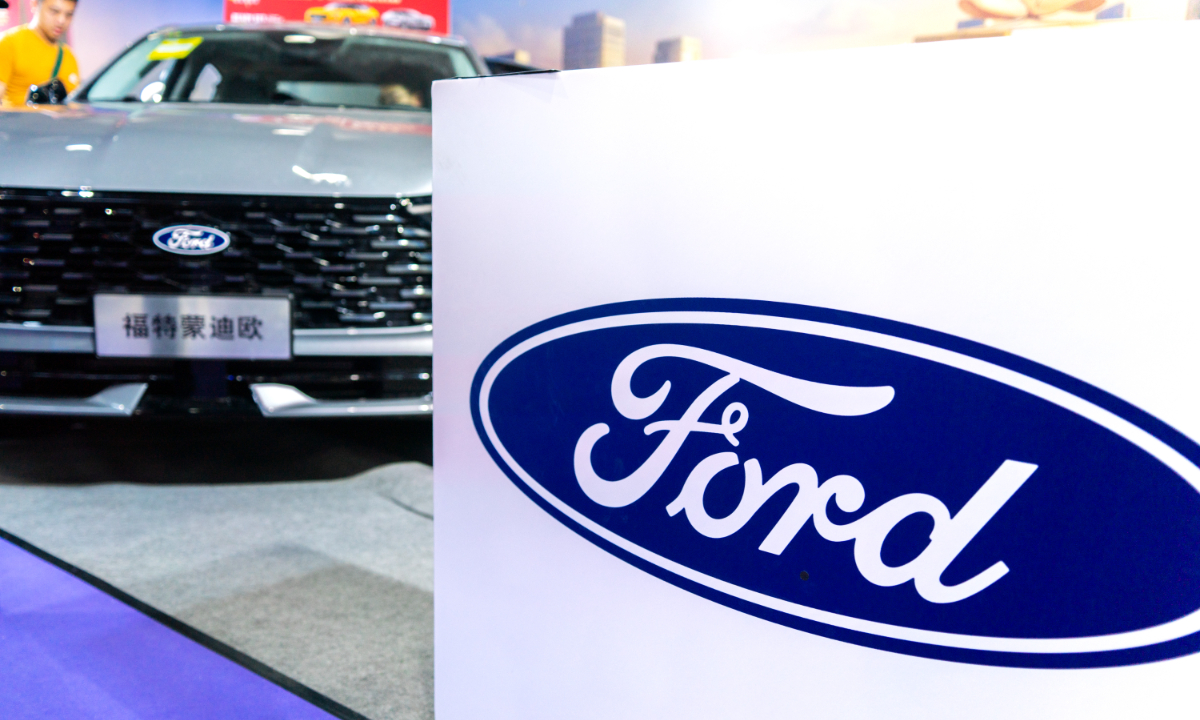
A Ford logo is displayed above the automaker’s booth at an international auto show in Guangzhou on May 1, 2026. Photo: VCG
Ford is preparing for the possibility that Chinese automakers could enter the US market within the next five to 10 years, CEO Jim Farley told employees, Reuters reported on Thursday. The assessment shows that even as Washington erects higher barriers, US automakers are preparing for competitive pressure that protectionist measures can delay but cannot eliminate, Chinese analysts said.
Ford’s warning shows that Washington’s escalating restrictions targeting China will not strengthen the long-term competitiveness of US automakers and could instead cause them to miss a critical window to accelerate their transition through fair competition and win-win cooperation, they added.
Farley and other senior Ford executives said during a question-and-answer session at an internal town hall that Chinese companies would be more likely to enter the US toward the later end of that timeframe, according to Reuters, which cited three people who viewed the meeting.
Ford leaders had previously warned that China was “on America’s doorstep,” but had not been as specific about the timeframe as they were at Thursday’s meeting, Reuters reported.
The fact that Ford is preparing for Chinese competition even within one of the world’s most heavily protected auto markets shows that US automakers do not believe administrative barriers can permanently insulate them from changes reshaping the global industry, He Weiwen, a senior fellow at the Center for China and Globalization, told the Global Times on Friday.
“China’s auto industry has built formidable advantages in scale, technology and supply-chain efficiency that global automakers can no longer afford to bypass, and that cannot be held back indefinitely by administrative barriers,” He said.
“Ford has come to recognize that, as a global automaker, it cannot remain competitive without both competing and working with Chinese companies – across key supply chains and in the US and other overseas markets,” the expert added.
Farley’s comments came as US lawmakers sought to further tighten restrictions on Chinese automakers. The Senate Commerce Committee last week approved legislation aimed at expanding the existing ban on Chinese automakers entering the American market, the world’s second-largest and most lucrative auto market, Reuters reported last week.
Chinese electric vehicles already face tariffs of about 100 percent, while US Commerce Department rules will further ban China-linked vehicle software from model year 2027 and hardware from model year 2030, Reuters reported on Thursday.
He said these measures would create greater obstacles for Chinese automakers seeking to enter the US market in the short term, but could ultimately widen US automakers’ structural disadvantages in EV costs, supply-chain efficiency and vehicle affordability.
“When US automakers – particularly global companies such as Ford – map out their investment and growth strategies, they look decades ahead. Washington’s policies, imposed in the name of so-called national security, are clearly neither grounded in market logic nor aligned with their long-term interests,” He said.
Ford faces a difficult challenge in developing affordable electric vehicles. Its latest financial results showed that the company’s US electric-vehicle sales fell 57.4 percent in the first half of 2026, while its EV and software division recorded a second-quarter loss of $919 million and is expected to lose about $4 billion in that segment for the full year, Reuters reported in a separate report on Tuesday.
Ford is developing a new family of affordable electric vehicles from the ground up, seeking to match the cost and production efficiency of Chinese competitors, Reuters reported on Thursday. The company plans to begin producing an electric pickup truck priced at about $30,000 at its Kentucky plant in 2027, according to Reuters on Tuesday.
Analysts warned that US government’s restrictions on Chinese automotive technology could disrupt US automakers’ global operations and drive up supply-chain costs, making cooperation the only viable path forward.
Ford could benefit from working with China by drawing on the country’s strengths in manufacturing scale, battery technology and supply-chain efficiency, He said, adding “Such ties could go beyond the sale of Chinese-brand vehicles in the US to include Chinese investment in local production, co-manufacturing and support in critical areas such as batteries.”
That model is already taking shape in Europe, where Ford competes directly with Chinese automakers but has partnered with Geely Auto as it seeks to cut costs, improve efficiency and revive its regional business.
In July, the two companies announced a joint venture at Ford’s Valencia plant in Spain, with Ford holding a 66 percent stake and Geely 34 percent. From 2028, Geely plans to build two electric sport utility vehicles at the facility, while the partners will develop a multi-energy crossover for the European market.
China authorities have also emphasized the potential for cooperation between the two countries’ automotive industries. On April 13, Chinese International Trade Representative and Vice Minister of Commerce Li Chenggang met Steven Croley, Ford’s Chief Policy Officer and General Counsel, in Beijing, according to the Ministry of Commerce.
Li said the Chinese and US automotive industries have complementary strengths and broad scope for cooperation, expressing hope that Ford would deepen its presence in China, strengthen exchanges with Chinese companies and provide more competitive products for Chinese and global markets. Croley said Ford attaches great importance to the Chinese market and its industrial and supply chains and is willing to explore new business opportunities with its partners.
RELATED ARTICLES