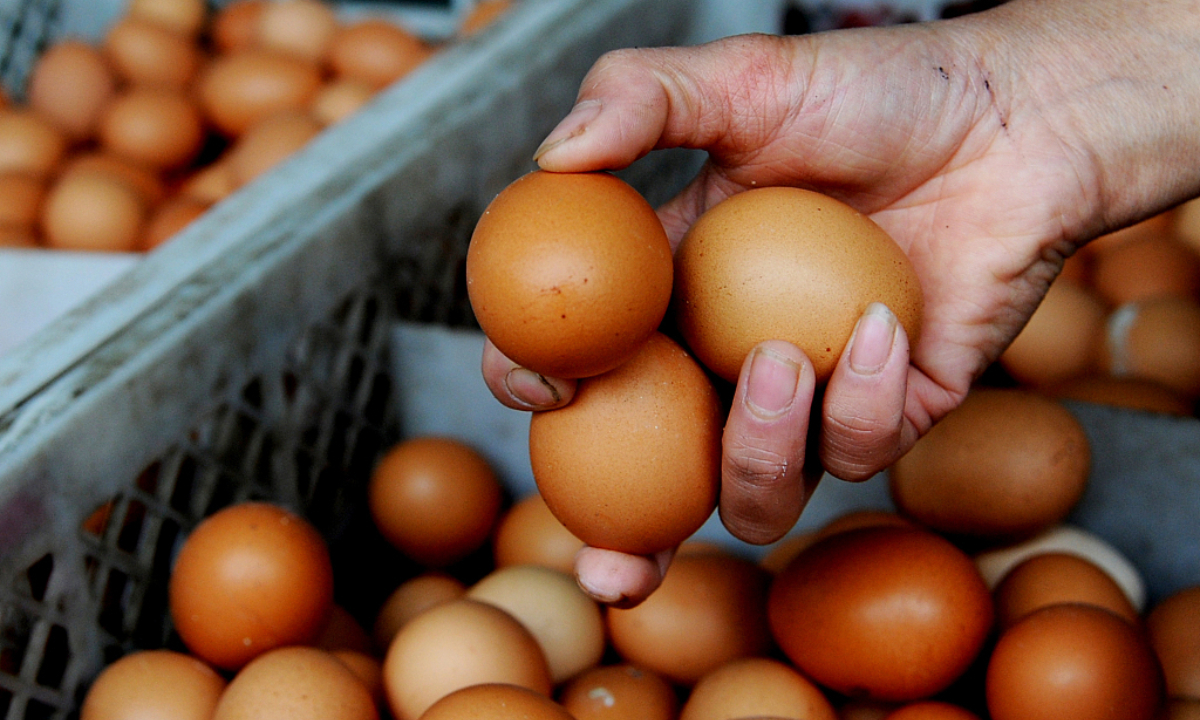
Eggs Photo: VCG
Editor's Note:
Currently, China's economy is steadily advancing along the path of high-quality development, even as domestic and international circumstances become increasingly complex. Some Western media, due to misunderstanding or bias, have repeatedly questioned or even distorted China's economic development. Accordingly, the Global Times launches the "Q&A on China's Economy" column to publish opinion pieces to present facts and clarify perceptions.
A recent New York Times report on egg prices in China used phrases such as "a 10-year high," "rocket eggs," and "especially painful" in an apparent attempt to convey to Western readers that "China has a real chicken-and-egg problem," and from there concluded that China's economy is in serious trouble. For those who have lived in China for a long time, however, whether people can afford eggs is hardly an issue. Yet for Western readers, this seemingly "sympathetic" narrative about the livelihoods of ordinary Chinese can be misleading.
According to data from China's Ministry of Agriculture and Rural Affairs, the average wholesale price of eggs nationwide reached 9.93 yuan ($1.38) per kilogram in the 29th week of 2026 (July 13-19), up 4.1 percent from the previous week and 42.3 percent year-on-year. In first-tier cities such as Beijing and Shanghai, the average retail price in late July was around 5 yuan per 500 grams, meaning each egg cost less than 1 yuan. The New York Times used phrases such as "especially painful" to portray rising egg prices as a "real chicken-and-egg problem" for ordinary Chinese consumers. Such a portrayal is far removed from the lived experience of most Chinese households. In fact, the issue has barely become a topic of discussion on Chinese social media.
So, have egg prices gone up? Yes. But no economic theory suggests that healthy economies require prices to only move downward or remain permanently stable. Like any commodity, eggs are subject to normal market cycles. China's current round of price increases reflects the combined effects of production cycles and seasonal factors. Egg prices in 2025 fell by 13.55 percent from the previous year, prompting many farmers to accelerate the culling of laying hens while sharply reducing flock replenishment, which has constrained supply this year. At the same time, the arrival of the hottest period of summer has temporarily reduced egg-laying rates. With supply tightening, restocking demand following the end of the rainy season in southern China, along with inventory-building ahead of the Mid-Autumn Festival, has further pushed prices higher. This is simply how markets work.
To assess the real impact of rising egg prices on Chinese households, one must also consider total production. China is the world's largest egg producer, with annual output reaching around 30 million tons. Per capita egg availability far exceeds more than twice the global average, and the country has over 1.3 billion laying hens. This highly market-oriented and decentralized production system allows price signals to quickly trigger supply-side adjustments. In that sense, "rocket eggs" exist more in media headlines than in the day-to-day experience of Chinese consumers.
Why, then, has The New York Times been so sensitive to egg prices? The answer may lie closer to home. The US has experienced severe egg price volatility for four consecutive years. In early 2022, the country suffered its worst recorded outbreak of avian influenza, severely disrupting supply chains. According to the US Bureau of Labor Statistics, the average price of a dozen grade A, large eggs reached $4.82 in January 2023, up nearly 150 percent year-on-year. From late 2024 to early 2025, another wave of avian influenza, combined with strong holiday demand, drove US wholesale egg prices to surge by 255 percent. Retail prices in some major cities climbed to as much as $10 per dozen, while the national average surpassed a record $6 per dozen. Several supermarket chains and warehouse clubs limited customers to purchasing just two or three cartons of low-priced eggs, which frequently sold out. American social media users even joked that the ability to afford fried eggs had become a new marker of social class.
Not long ago, The New York Times interpreted falling pork prices in China as evidence that consumers could no longer afford meat, calling it an "ominous sign" for the Chinese economy. Now that egg prices have risen, it claims "rocket eggs" are hurting Chinese consumers. Apparently, prices cannot go up, nor can they go down. This narrative simply repackages any temporary fluctuation in China's consumer prices as a political or economic crisis, manufacturing an atmosphere of alarm. As one Chinese internet user joked, "I got so scared by the headlines that I immediately bought two tea eggs to calm my nerves." The joke itself reflects the confidence of consumers in a mature market who take ordinary price fluctuations in stride.
Today's Chinese consumers enjoy an unprecedented range of choices across major e-commerce platforms, with products available at different price points, from different brands, channels and places of origin. The widespread use of community group buying and online grocery delivery has also made pricing highly transparent and shopping options abundant. At the same time, we have an increasingly wide variety of protein options to choose from. Chinese consumers may complain that eggs have become a few cents more expensive, but that is still a long way from "a real chicken-and-egg problem."
The rise and fall of egg prices is just one manifestation of global food inflation. Thanks to its massive production capacity, efficient distribution networks and highly flexible supply system, China has absorbed much of the external shock while keeping the food baskets of more than 1.4 billion people well supplied. Labeling the situation as "rocket eggs" may make for dramatic headlines, but it neither reflects the facts nor recognizes the resilience of China's market system and the adaptability of Chinese consumers. As for whether Chinese people can still "afford eggs," that is hardly something The New York Times needs to worry about from across the Pacific.