Who does the 14-country statement intend to intimidate? The Chinese people neither believe in fallacy nor fear evil forces: Global Times editorial
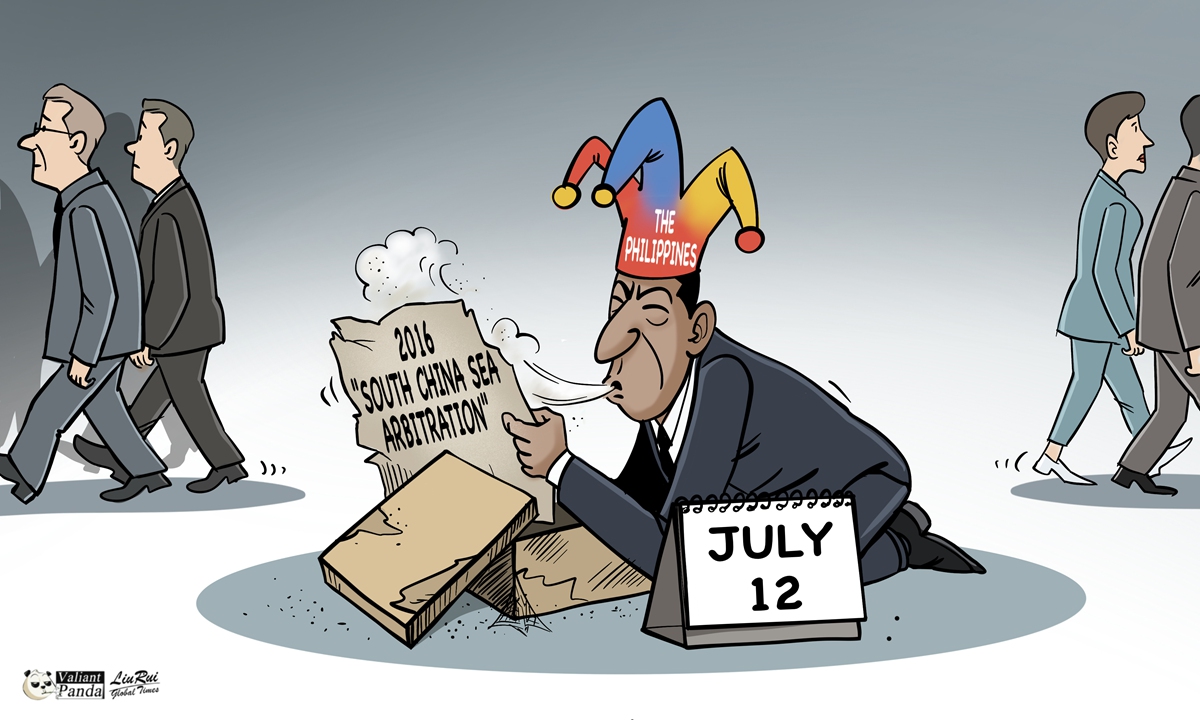
Nothing but hot air. Illustration: Liu Rui/GT
A piece of waste paper is ultimately just that - a piece of waste paper. Who does the 14-country statement intend to intimidate? The Chinese people do not believe in fallacy, nor are we afraid of evil forces. The Chinese people do not stir up trouble, and we are not cowards when confronted with it. The wheels of the great rejuvenation of the Chinese nation are rolling forward, and the determination of the Chinese people to safeguard their core interests is unshakeable. Any external force attempting to stir up trouble over the South China Sea issue is merely a mantis trying to stop a chariot and will ultimately be crushed.
On July 12, the US, the Philippines, Australia, Canada, Estonia, Germany, Italy, Japan, Latvia, Lithuania, New Zealand, Romania, Slovenia and the UK issued a so-called Joint Statement on the 10th anniversary of the Philippines-China South China Sea Arbitral Tribunal Award. We hereby reiterate that the so-called "award" is nothing more than an illegal, null and void piece of paper with no binding force. China neither accepts nor recognizes the so-called "award" and opposes and rejects any claims or actions based on it.
As for the attempts by relevant countries to disregard justice, collude with one another, and undermine China's sovereignty, security and development interests, we solemnly declare: The Chinese people do not believe in fallacy, nor are we afraid of evil forces. The Chinese people do not stir up trouble, and we are not cowards when confronted with it. Whether it was the Eight-Power Allied Forces or today's "14-country coalition," no foreign country should expect China to trade away its core interests, nor should anyone expect the Chinese people to swallow the bitter fruit of actions that harm China's sovereignty, security and development interests.
The so-called "South China Sea arbitration" is, in essence, a political farce that desecrates international law. On July 12, 2016, the so-called arbitral tribunal for the "South China Sea arbitration case," established at the unilateral request of the Philippines, fabricated a so-called "award" in an attempt to completely deny China's maritime rights and interests in the South China Sea. The essence of the arbitration initiated by the Philippines is the territorial sovereignty dispute between China and the Philippines over certain islands and reefs in the South China Sea, which falls outside the scope of the United Nations Convention on the Law of the Sea (UNCLOS). Among the five "arbitrators" on the tribunal, one was appointed by the Philippines, while the other four from Western countries were appointed by the then president of the International Tribunal for the Law of the Sea, who was a Japanese judge. This was tantamount to the Philippines setting up a "court" of its own and seeking support from countries outside the region in an attempt to seize its neighbor's yard. It can be described as a textbook case of distorting and abusing international law.
The lineup of the 14 countries that issued the "statement" this year to support the "arbitration" is absurd. All members of the "Five Eyes" alliance are included, along with seven European countries and Japan. Apart from the Philippines, none of the 14 countries is a claimant state in the South China Sea. What qualifications do they have to make irresponsible remarks about China's territorial sovereignty and maritime rights and interests in the South China Sea? Among ASEAN members, apart from the Philippines, not a single country has followed suit in commemorating the "anniversary" of the arbitration. What does this show? The intention of external forces to turn the South China Sea into a "powder keg" of Asia is plain for all to see. The fact that ASEAN has not issued any official document supporting the so-called arbitration over the past decade shows that the vast majority of its members have long abandoned that piece of waste paper.
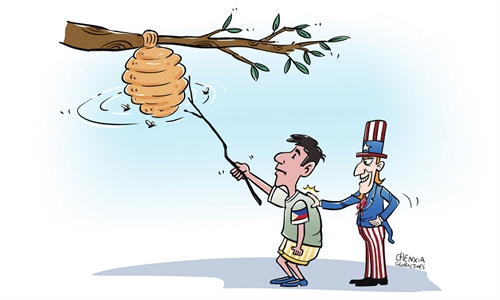
Certain Western countries have repeatedly brought up an illegal, invalid and non-binding piece of paper to make an issue of it. No one believes that this is truly about "standing up for the Philippines," and it runs entirely counter to their self-proclaimed commitment to "upholding a rules-based international order." Put simply, their real aim is nothing more than to continue stirring up trouble in the South China Sea and create obstacles to consultations on the Code of Conduct in the South China Sea (COC). They are more aware than anyone else that such arbitration award is essentially a piece of waste paper. However, what they truly care about is not the Philippines' claims, but rather using this so-called "arbitration" to create trouble and obstruct China's development. We advise these countries to abandon their outdated colonial mind-set; the South China Sea is not their backyard, and China is certainly not a target they can intimidate at will. Trying to scare today's China with a few warships and statements is nothing but a pipe dream.
If we follow the standards of the "ruling," many countries will lose their basis for claiming maritime rights over their islands and reefs. We must ask: Have the few countries that support the "ruling" voluntarily given up their corresponding maritime rights over their islands and reefs?
A piece of waste paper is ultimately just that - a piece of waste paper. It cannot change the objective fact that China has consistently upheld sovereignty over the South China Sea islands, nor can it alter China's firm resolve to uphold its sovereignty. Furthermore, it certainly cannot change the mainstream public opinion in regional countries that seeks peace and development.
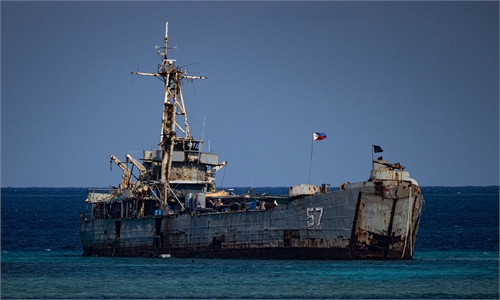
Ten years have not added any effectiveness to this piece of waste paper. Every provocation by the Philippines, whether it's the enactment of the so-called "Maritime Zones Act" or the "Philippine Archipelagic Sea Lanes Act" to engage in legal infringement, or the continuous creation of incidents and provocations in areas like Huangyan Dao, Ren'ai Jiao, Xianbin Jiao, and Tiexian Jiao, or the "Japan-Philippines maritime delimitation talks," has invariably met with a strong response from China. The actions of the China Coast Guard to lawfully intercept and drive away these provocations have become the norm in response to the Philippines' adventures in the South China Sea. Meanwhile, China's actions to uphold its sovereignty in the South China Sea have increasingly become normalized and institutionalized.
Over the course of 10 years, the sentiments of the people within the region have become clearer. China and ASEAN countries share extensive common interests; the South China Sea is a home for both sides, and the consensus to set aside differences and pursue common development is the cornerstone of maintaining regional stability. In ASEAN, the so-called "arbitration" has effectively turned into a "one-man show" for the Philippines. If the Philippines continues to treat the "ruling" as a "bargaining chip," it will only find itself increasingly at a disadvantage.
The year 2026 marks the fifth anniversary of the China-ASEAN Comprehensive Strategic Partnership and is a key year for advancing the COC. We advise the Philippines, as a member of ASEAN, to meet all parties halfway. The wheels of the great rejuvenation of the Chinese nation are rolling forward, and the determination of the Chinese people to safeguard their core interests is unshakeable. Any external force attempting to stir up trouble over the South China Sea issue is merely a mantis trying to stop a chariot and will ultimately be crushed.
RELATED ARTICLES