Chinese airlines double down on flying more Global South routes to bolster developing economies
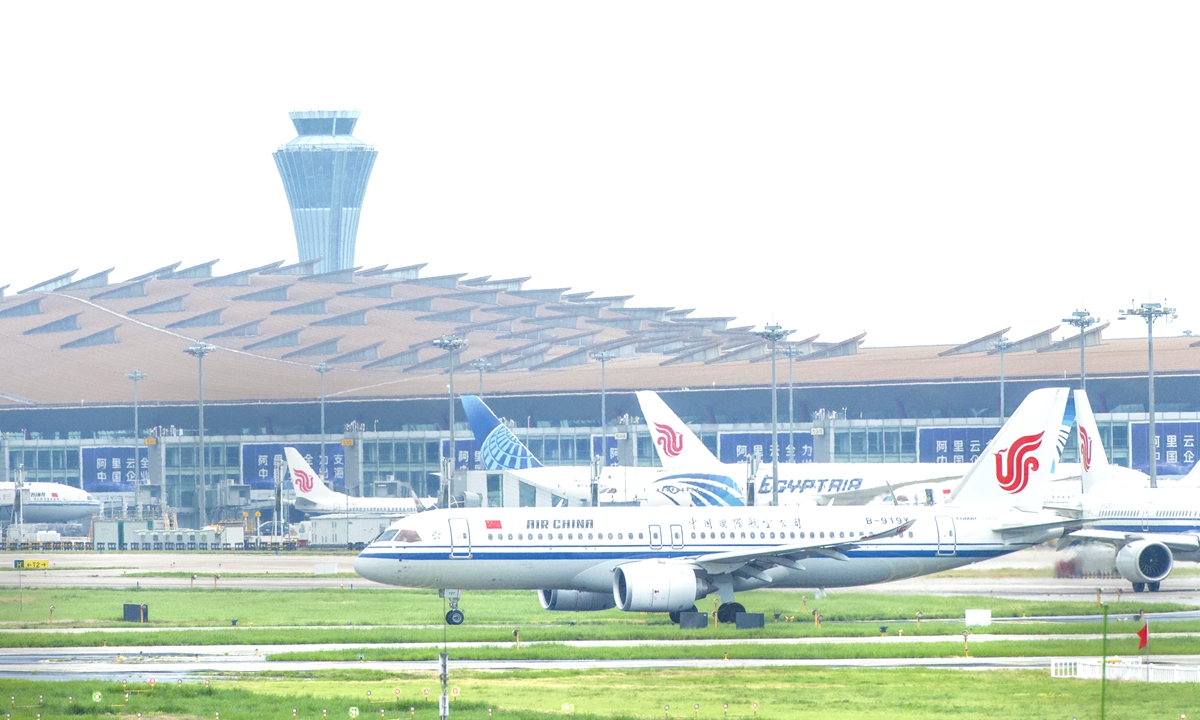
An Air China C919 aircraft taxis on the runway at Beijing Capital International Airport on August 12, 2026, preparing to fly from Beijing to Ulan Bator, Mongolia. Photo: VCG
Starting December 5, 2026, China Eastern Airlines will increase flights on its Shanghai Pudong-Auckland-Buenos Aires route, raising the weekly frequency from two to four round-trip flights.
On August 28, the Chengdu Tianfu-Addis Ababa route was launched, filling a gap for direct flights from Southwest China to Africa. Inbound cargo is expected to consist of African specialty products such as coffee, flowers, and fruits, while outbound cargo focuses on high-value-added products including new-energy vehicles, solar photovoltaic equipment, and lithium batteries.
These newly launched or expanded air routes mean more than a few additional flight connections. They represent a strategic realignment of China's aviation network toward emerging markets, as Chinese carriers increasingly look beyond traditional flight corridors to tap into the growing economic potential of the Global South countries.
The air-routes expansion reflects China's rising global supply chain role and its drive to help Global South economies integrate into the industrial chain, a Chinese expert said, adding that the transoceanic logistics links will enable efficient exchange of Chinese high-value goods with Latin American and African agricultural products - a win-win model fueling economic growth of the Global South countries.
Rising market demand
A reply from China Eastern Airlines on Thursday said that the Shanghai-Auckland-Buenos Aires route fills the gap in cargo connectivity from Shanghai to South America, while providing a stable import channel for South American seasonal fresh produce, beef, seafood, and other products to the Chinese market.
During the coming winter-spring season, it will actively promote interline cooperation in South America and enhance the timeliness and service quality of southbound export logistics, China Eastern Airlines said.
Meanwhile, Cathay Cargo is actively expanding flight routes to South America too. Frank Yau, head of Cargo Sales for Hong Kong & Greater Bay Area at Cathay Cargo, told the Global Times that while Cathay Cargo does not currently operate direct services to South America, it connects the region with Hong Kong through its own services to US gateways and onward connections provided by its airline partners.
Major imports from the South American region include fruits like cherries and seafood like salmon, Yau said.
Due to global geopolitical factors, Hong Kong exports may be affected to some extent, but imports remain on an upward trajectory, Yau said.
Behind the intensive expansion of air routes is China's increasingly prominent position in the global supply chain, which is injecting vitality into the all-cargo aircraft market. The expansion also represents China's efforts to help Global South countries better integrate into the global industrial chain, Hu Qimu, a professor at the Maritime Silk Road Institute of Huaqiao University, told the Global Times on Thursday.
By opening up transoceanic air arteries, China's high-value-added products and high-quality agricultural products from Latin America and Africa will be exchanged more efficiently, Hu noted, adding that it is mutually beneficial and win-win for both China and the Global South countries.
Expanding cargo fleet
The booming market demand is also supported by industry data. China launched 115 new international air cargo routes in the first eight months of 2026, adding 292 weekly round-trip flights, according to the China Federation of Logistics and Purchasing on Thursday.
In terms of flight routes distribution, among the new routes opened this year, 57 serve Asian destinations, 41 connect to Europe, 13 to North America, 3 to Africa, and 1 to South America. The cargo mix is dominated by cross-border e-commerce goods, high-end manufactured products, high-value-added items, electronics, and auto parts.
Industry experts note that China's international air cargo network is being steadily refined and strengthened, with continuously improving global connectivity. Asia remains the core battleground for flight route expansion, and the networks to Africa and North America are being progressively reinforced. Cargo sources now span multiple categories including fresh agricultural produce and high-end manufacturing, maintaining a rich and varied supply structure.
Airbus forecasted recently that global cargo throughput is expected to increase at a compound annual growth rate of 3.3 percent over the next two decades, while China's all-cargo aircraft fleet will expand by three times by 2044.
According to Airbus statistics, in 2025, more than 60 percent of China's civil aviation wide-body passenger planes were operated by Airbus' wide-body aircraft. The flights were conducted by 276 Airbus wide-body passenger jets, including the Airbus A330ceo, Airbus A330neo, and Airbus A350.
"While the global trade market is now experiencing a certain degree of volatility, we still believe that future demand for large wide-body freighters will remain strong. Our global market forecasts also indicate that, in the long run, growth in the cargo market is likely to sustain. Despite some short-term fluctuations, the cargo carriers have demonstrated great resilience, and they are well-positioned to weather global trade volatilities and geopolitical disruptions," Troy Wang, head of commercial at Airbus China, told the Global Times.
"We are optimistic about the resilience and development potential of China's entire industrial chain. Looking ahead, we believe that new growth drivers - such as AI advancements, semiconductor/chip growth, robotics, and automation - will inevitably create greater opportunities," Wang said.
As a member of the Global South, China always shares its development experiences without reservation and helps advance the development of Global South economies, Mao Ning, a spokesperson from the Ministry of Foreign Affairs, said recently.
By conducting fruitful cooperation in infrastructure, investment and technology, China has helped the Global South economies build up their own capacity for development. By opening up its market, China has helped the Global South countries expand exports of quality products to China. By providing accessible and affordable green products, China has helped the Global South countries improve resource allocation and accelerate industrial transformation and upgrading. All these prove that China and the Global South countries are partners in the pursuit of modernization, Mao said.
RELATED ARTICLES