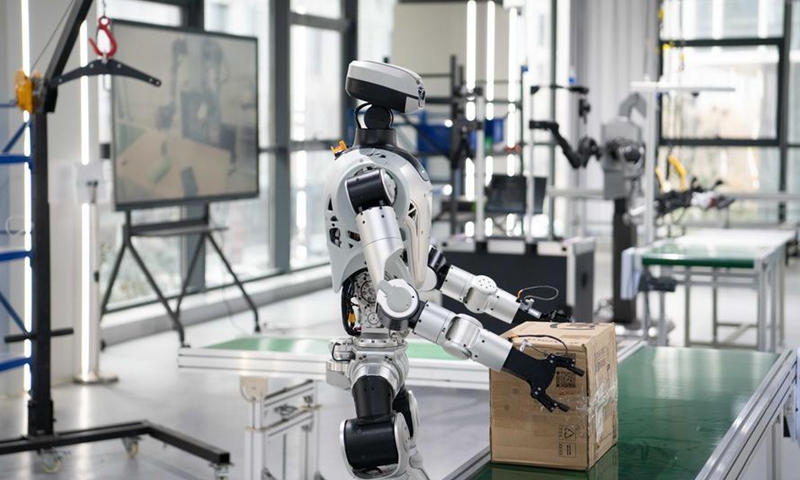
A humanoid robot conducts box-carrying training at a data collection pre-training center for humanoid robots in Hefei, East China's Anhui Province, on December 4, 2025. Photo: Xinhua
This year, artificial intelligence, robotics and innovative medicines - dubbed the "new new three" - are expected to emerge as new pillars of China's foreign trade. This shift from last year's "new three" of exports - namely electric vehicles, lithium batteries and photovoltaic products - is not merely a policy signal, but a precise positioning of China's next wave of export competitiveness.
Combined with my on-the-ground observations from the "Robot Valley" in Shenzhen, South China's Guangdong Province, the performance in this round of export upgrade has been particularly outstanding: everyday robotic products that people can readily encounter, such as robotic vacuum cleaners, lawn mowers, swimming-pool cleaning robots, and drones, are almost entirely produced in China. I believe this position is a direct reflection of the systemic, independently-driven innovation advantages that China has built in supply chains, hardware iteration, and real-world scenario feedback.
The export performance of the "new new three" products - taking embodied intelligence products as an example - profoundly demonstrates the depth and breadth of China's independent innovation. Embodied intelligence is not a simple single technology, but rather the ability to empower robots of various forms through a common technology foundation.
And the key reason why these embodied intelligence product categories have been able to rapidly capture global markets lies in the "half-hour complete supply chain" ecosystem in China, represented by Shenzhen. Research and development in this futuristic sector are a process of high-speed iteration. While the US industrial chain often requires a week or even longer to complete one round of communication and revision, suppliers of sensors, actuators, chips, dexterous hands and other components in Shenzhen can provide on-site support and solve problems on the spot. This feedback speed directly determines the pace of product iteration.
Meanwhile, there's a unique Huaqiangbei-style culture in Shenzhen, where certain stall precisely serves specific overseas customers and quickly feeds demands back upstream. This has been fully replicated in the robotics field, forming a closed-loop production system from components to downstream machines. The completeness of the supply chain and its response speed constitute the true moat that gives Chinese robots an overwhelming edge over overseas competitors. While the US may lead China in certain software areas, China's lead in hardware and supply chains is far greater than its disadvantage in software, and over a longer time horizon, this structural advantage will only become more pronounced.

Liu Shaoshan Photo: Courtesy of Liu Shaoshan
To sustain this export momentum, the development of robot standards is particularly important. Standardization is not merely a technical issue, but a strategic lever for converting China's supply-chain advantages into global rule-making advantages.
The robotics industry is currently still in an era with inconsistent standards, disparate interfaces, and non-uniform data formats among different manufacturers, resulting in high adaptation costs for users. If China can take the lead in promoting unified instruction sets, interface specifications, and data standards in the field of embodied intelligence, it will greatly lower the barriers to use for global customers and enable Chinese products to enter international markets more smoothly.
The world's first international standard for humanoid robot datasets, led by China, has recently been approved as an ISO project, marking an important step in China's competition for global rule-making power in the robotic sector. In the past, Chinese products - in their overseas expansion - were often hindered by "not conforming to Western-dominated standards." Now that industrial advantages have been established, if China can simultaneously lead global standard-setting, export barriers for humanoid robots will be significantly reduced.
Facing US bans and geopolitical pressure, Chinese companies have shown resilience; they demonstrate greater resilience through market logic and open cooperation. The US ban may cause short-term disruptions, especially for categories such as robotic vacuum cleaners and lawn mowers that account for a relatively high share of the US market. In the long run, however, outcomes will still be determined by cost-performance ratios. The core price range that ordinary US households can afford is often difficult for domestic US production to match, and transplanting supply chains to places like Vietnam also requires a long cycle. As a result, the market will ultimately favor products that offer the best value for money.
Meanwhile, Chinese companies have chosen to expand into emerging markets such as Europe and South America with an open attitude, winning trust through technology diffusion, open-source approaches, and cost-performance advantages rather than passively responding to isolation. Certain US politicians' protectionist policies may bring short-term benefits, yet they cannot alter the long-term logic of costs and efficiency. The true confidence of China's robotics industry stems precisely from its profound grasp of this market rule.
Overall, the export performance of the "new new three" products serve as a vivid illustration of China's independent innovation progressing from catching up to running alongside global leaders and even taking the lead in certain areas. The exceptional responsiveness of the supply chain, the rapid iteration of hardware, and the continuous refinement of application scenarios together form underlying capabilities that are difficult for bans to sever.
Looking ahead, overall robot penetration worldwide continues to rise rapidly, while humanoid robots in specialized scenarios are only just beginning to take off—leaving substantial room for further expansion by China's robotics industry. As long as China continues to strengthen its technological foundation, improve its standards system, and maintain open cooperation, it is fully capable of becoming not only the largest supplier in this round of global industrial transformation, but also a rule-maker and ecosystem leader. The story of China's "new new three" is only beginning to reach its climax.
The author is the director of the Embodied Intelligence Center at the Shenzhen Institute of Artificial Intelligence and Robotics.
RELATED ARTICLES