China will take resolute countermeasures if US insists on robot, inverter bans: MOFCOM
Chinese robots gain overseas popularity on cost, technology strengths despite blockade: expert
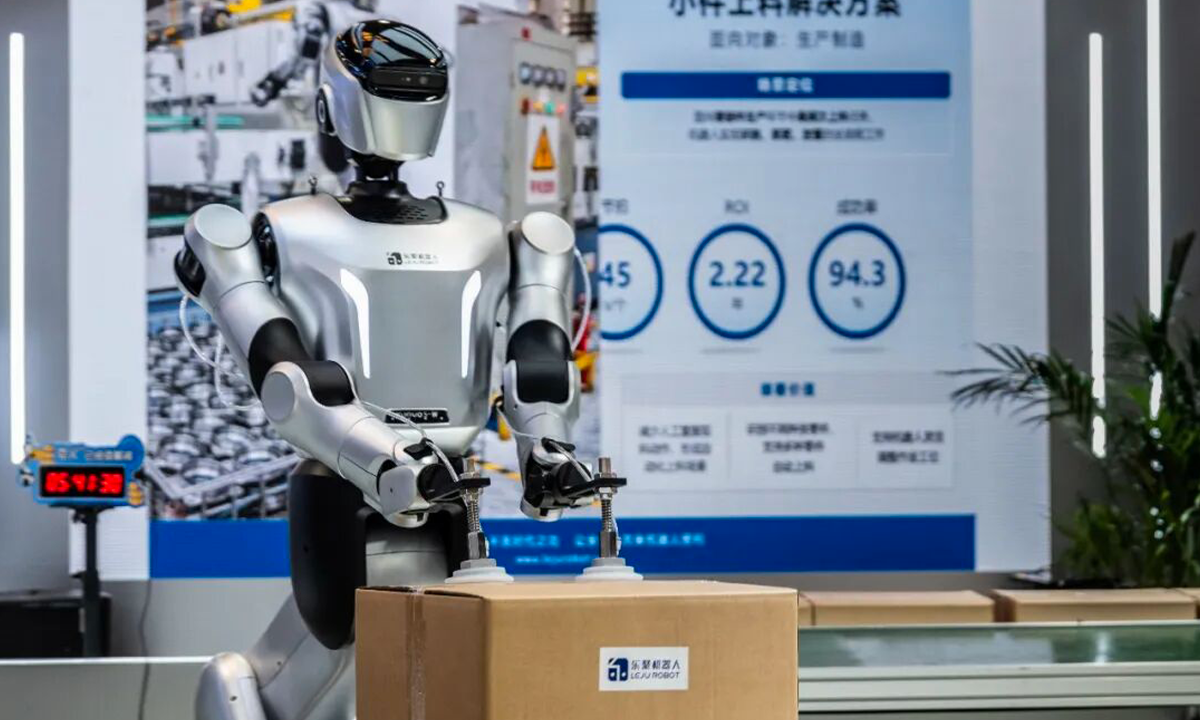
A robot is on display at the 2026 World Artificial Intelligence Conference. Photo: Wu Xue
The US has again erected market barriers against Chinese robotics products under the pretext of national security. China's Ministry of Commerce (MOFCOM) on Thursday urged Washington to immediately withdraw the measures, calling them discriminatory and aimed at suppressing Chinese companies and products.
China urges the US to immediately revoke the measures that added foreign-produced power inverters and advanced robotic equipment to the "Covered List," and stop such erroneous actions. If the US persists in going its own way, China will resolutely take countermeasures to safeguard its legitimate rights and interests, a MOFCOM spokesperson said.
The relevant measures by the US Federal Communications Commission (FCC), while ostensibly under the banner of "non-discrimination," are in essence discriminatory treatment and suppression targeting Chinese enterprises and products, the spokesperson said.
The spokesperson noted that this is not the first time the US FCC has taken similar actions; it has previously imposed restrictions on other Chinese goods on multiple occasions.
Robots and power inverters are normal international commodities, and all parties, including the US, benefit from trade in these products. The US side is generalizing the concept of national security, disregarding the strong calls from industries in both China and the US, and using administrative power to artificially interfere with normal commercial transactions and trade between enterprises. It continues to push for "decoupling and breaking supply chains." Such practices hurt others without benefiting itself, and constitute typical market distortion and unilateral bullying, the spokesperson noted.
Chen Jing, vice president of the Technology and Strategy Research Institute, told the Global Times that Washington's real intention is to use "national security" as a pretext for industrial protectionism and technological containment, seeking to disrupt the global expansion of China's robotics industry and preserve US dominance in high-end manufacturing.
Such anxiety and protectionism will not slow the development of Chinese robots, Chen said. Instead, the restrictions risk disrupting global supply chains while undermining the US' own economic interests and technological development.
As Washington moves to erect another barrier against Chinese robotics products under the banner of national security, Chinese robots are gaining wider recognition and entering more overseas markets, underscoring how political restrictions cannot reverse technological progress or global demand.
The BBC recently visited Geek+'s factory in Hefei, East China's Anhui Province, where fleets of robots are built and tested before being shipped to warehouses around the world.
Some of Britain's biggest retailers, including Tesco, Asda and Next, are already using the Chinese company's technology, the BBC reported on Thursday, highlighting the growing adoption of Chinese robotics solutions in the UK.
The report noted that Britain has struggled with weak productivity growth for more than a decade, while economists said that wider adoption of robotics will be essential for businesses to improve efficiency.
Meanwhile, Slovak President Peter Pellegrini expressed amazement at China's robotics achievements during a visit to a robot center in Beijing on Tuesday. He explored cutting-edge humanoid robots, watched a robot perform tai chi, and even played a friendly game of football with robots, according to Bastille Post.
Pellegrini noted that he would prioritize cooperation with China by promoting the application of Chinese technologies in Slovakia, and vowed to strengthen youth exchanges to enhance bilateral friendship, Bastille Post said.
US anxiety demonstrates that China has built systemic advantages in robot mass production, cost control and real-world applications, as reflected in the global expansion of companies such as Geek+, Chen said.
Unilateral bullying cannot stop Chinese robots from going global. Instead, it may accelerate overseas customers' shift away from US suppliers, ultimately harming US interests, he added.
Chinese robots are gaining global attention for their technological maturity, cost competitiveness and ability to perform in real-world scenarios, Chen said. China has built a full robotics chain spanning industrial logistics and consumer services.
Chinese companies benefit from deep supply chains, strong mass-production capacity, rapid iteration in complex settings such as e-commerce and manufacturing, and integrated hardware-software solutions that enable fast deployment and flexible adaptation, he added.
Market response offers the clearest evidence. According to the General Administration of Customs, China exported 11.32 billion yuan ($1.66 billion) worth of separately classified robots in the first quarter of 2026, with the products reaching 148 countries and regions.
By category, cleaning robots stood out. Newly assigned a separate customs code this year, exports stood at 7.75 billion yuan in the first quarter, accounting for 68.5 percent of China's total robot exports and becoming the sector's dominant export category. China's industrial robot exports reached 3.16 billion yuan in the first quarter, up 42 percent year-on-year.
In addition, China exported more than 10,000 intelligent bionic robots deeply integrated with artificial intelligence (AI) technologies in the first half of 2026, reaching more than 90 countries and regions, according to the Xinhua News Agency.
China is already the world's largest producer and consumer of robots, with complete domestic capabilities across key supply-chain segments such as reducers, servo motors and AI algorithms, while playing an active role in setting international standards, Chen said.
RELATED ARTICLES