Why ‘dragon-restaurant diplomacy’ struck a nerve with Western mainstream media?: Global Times editorial
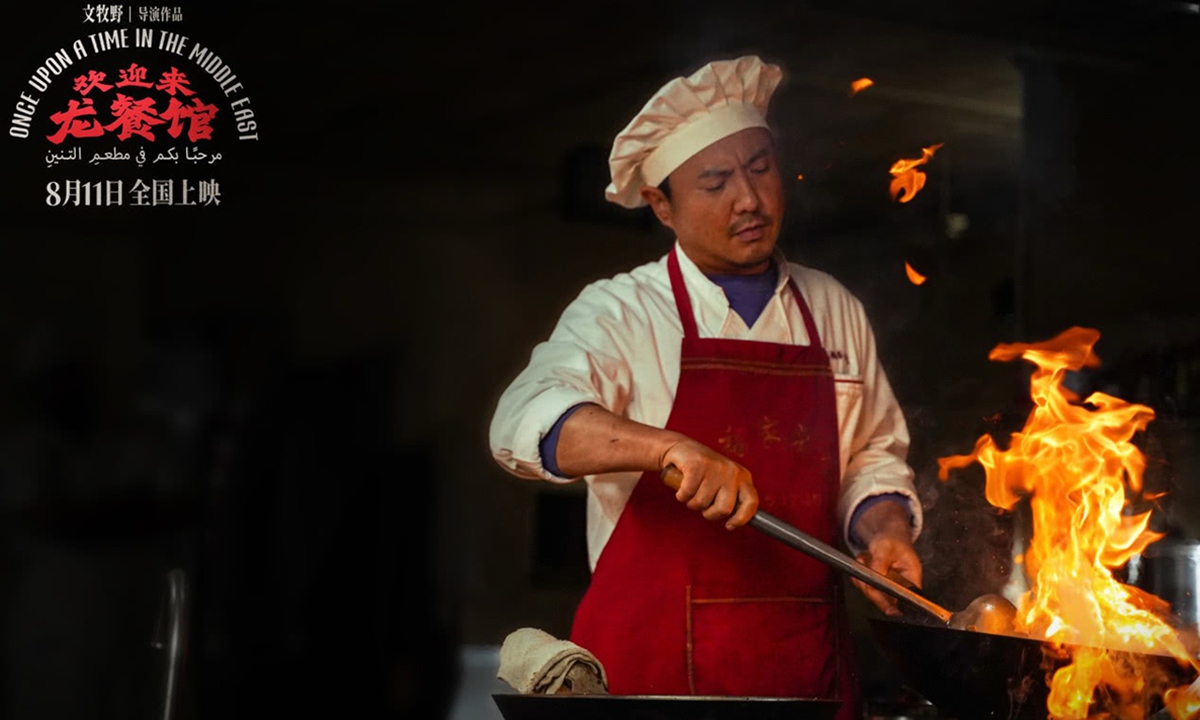
A still from the movie Once Upon a Time in the Middle East starring Shen Teng Photo: IC
The world has long grown tired of Western moralizing from on high. What most countries actually care about are very specific things: whether roads get built, ports get finished, power supply is stable, investment creates jobs, and trade delivers development. The reason Once Upon a Time in the Middle East has sparked such sustained discussion is precisely because it puts a way of dealing with the world familiar to Chinese people on full display before the world: first keep people alive, first make sure they have food to eat, first stop the shelling, and then talk about everything else.
As the film Once Upon a Time in the Middle East has set off a viewing frenzy, the long-established Western magazine The Economist recently coined the term "dragon-restaurant diplomacy" in an article, sparking considerable discussion. The piece feels strained and conflicted. It is steeped in ideological arrogance - arguing that "eat well and raise your children well" implies the "limits" of China's support for overseas partners. Notably, however, it also had to bow its head and admit that China's habit of making friends widely holds real appeal for "countries tired of overweening Westerners."
Objectively speaking, The Economist's account of "dragon-restaurant diplomacy," however sour-grapes in tone, does keenly capture what sets Chinese diplomacy apart from the Western style. It notes that China can keep cooperation with countries that are at odds with one another, is willing to ground economic cooperation in mutual needs, and rarely insists that partners first pass a political litmus test.
The article even pointed out that China's diplomacy "appeals more to other countries than trying to tariff or, worse, bomb them into submission. And investment dollars, when they materialize, beat morality lectures." Frankly, for The Economist to put those words on the page is already not easy. It can be read as a passive admission by Western mainstream media of the global draw of China's diplomacy.
For a long time, the Western public opinion field has treated the Western way of conducting international relations as the "universal default." Aid often comes with political strings; cooperation often comes with value judgments; disagreement is met with sanctions and pressure, and in extreme cases with direct military intervention. Western political elites have long assumed the right to define civilization, progress, and the "correct" path of development; they have assumed that other countries should first sit through a sermon before they are allowed to cooperate; and even after launching wars and wrecking a country, they still claim the moral high ground from which to judge whether others have taken on enough so-called "international responsibility." That sense of superiority, rooted in "Western-centrism," is off-putting.
The world has long grown tired of Western moralizing from on high. What most countries actually care about are very specific things: whether roads get built, ports get finished, power supply is stable, investment creates jobs, and trade delivers development. International cooperation should first and foremost serve national development and improve people's lives. As for what political system a country chooses and what development path it follows, that should be decided by its own people. Turning all cooperation into a test of values and treating every international issue as a choice between camps will only increase confrontation and reduce cooperation in the world.
Of course, a film is just an artistic expression and cannot be directly equated with foreign policy. But the reason Once Upon a Time in the Middle East has sparked such sustained discussion is precisely because it puts a way of dealing with the world familiar to Chinese people on full display before the world: first keep people alive, first make sure they have food to eat, first stop the shelling, and then talk about everything else. It does not promise to save the world, nor does it portray itself as a new "global policeman." It simply says that even in the worst of times, a restaurant, a hot meal, and a group of children are still worth protecting. For societies repeatedly scarred by war, poverty and moralizing lectures, simply being able to carry on with their lives is itself the greatest political achievement.
The appeal of China's cooperation with countries of the Global South is being demonstrated through the choices these countries are making for themselves. If this phenomenon can be explained away as "opportunism," "shrewdness" or "playing both sides," that merely shows an inability to understand the profound changes taking place in global politics. If the "dragon-restaurant diplomacy" means fewer bombings and sanctions and more cooperation and win-win; fewer condescending lectures and more equal treatment, then it is hardly surprising that it is winning the support of an increasing number of countries. Indeed, it may well be the direction in which the tide is turning. What truly struck a nerve with The Economist, perhaps, is not the film itself, but the increasingly evident abandonment of "Western-centrism" by the world.
The world does not need lofty arbiters of values. What it needs is practical ability to get things done. China's efforts to make friends around the world are aimed at promoting the common good of all mankind and a more just and equitable world, in which every country has the right to survive and develop in its own way.
We would also like to believe that a table where people can sit down and eat together is not necessarily more vulnerable than a military base; nor is a restaurant that remains open for business necessarily more superficial than a declaration of values. As for what The Economist has mocked that Once Upon a Time in the Middle East may never win an Oscar, as some Chinese netizens put it: who cares?
RELATED ARTICLES