China, Russia mull new rail links as rising trade fuels push for cross-border capacity
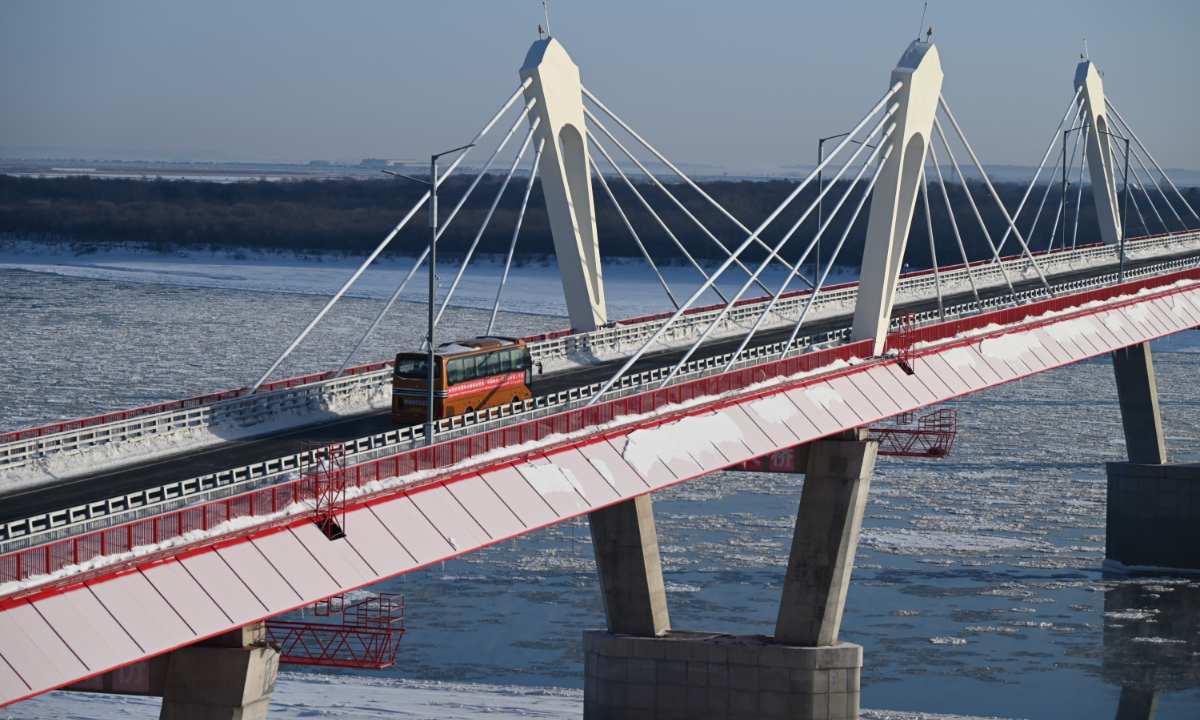
A passenger bus passes through the Heihe-Blagoveshchensk highway bridge between China and Russia, heading to the Kani-Kurgan-Heihe checkpoint from Heihe, Northeast China's Heilongjiang Province, on December 10, 2024. The checkpoint started cross-border passenger services on the day. Four buses operate daily in both directions, departing from Heihe and Blagoveshchensk. Photo: VCG
China and Russia are discussing new railway routes while expanding capacity at existing border crossings, according to Russian media reports citing Oleg Belozerov, CEO of state-owned Russian Railways, as growing bilateral trade drives demand for stronger cross-border transport links.
The move points to a broader push to ease transport bottlenecks and strengthen China-Russia logistics, analysts said. New rail links could improve year-round freight flows and better support expanding bilateral trade, particularly in the Russian Far East.
Belozerov said that all four existing railway crossings with China are operating efficiently, with current efforts focused on upgrading and expanding their capacity, Russia's Public News Service reported on Sunday, citing his interview with Russian newspaper Izvestia on the sidelines of the Eastern Economic Forum.
Discussions are not limited to increasing traffic on existing routes, as the two sides are also considering the prospects for building new railway lines, Belozerov noted. He predicted that railway freight between Russia and China would reach an all-time high in 2026, driven by growing demand for the transportation of raw materials and goods.
Zhang Hong, a research fellow at the Institute of Russian, Eastern European and Central Asian Studies at the Chinese Academy of Social Sciences, told the Global Times on Sunday that the push reflects a practical constraint emerging alongside expanding bilateral trade.
"One of the bottlenecks in China-Russia railway trade is still the cargo-handling and transshipment capacity at border crossings," Zhang said. Russia is seeking to expand exports to China, including agricultural and industrial products, while two-way trade flows are also growing, making stronger railway capacity an important infrastructure foundation for deeper bilateral economic and trade cooperation, he noted.
Bilateral freight traffic on the Russian railway network reached a record 114 million tons in the first seven months of 2026, up 6 percent year-on-year, while container traffic rose 12.5 percent to 2.1 million 20-foot equivalent units over the same period, according to Russian Railways.
Bilateral trade also remained strong. China-Russia trade reached $159.24 billion in the first seven months of 2026, up 26.3 percent year-on-year, data from China's General Administration of Customs showed. Chinese Ambassador to Russia Zhang Hanhui said in August that full-year trade was expected to reach another record high.The two countries have also moved to strengthen railway connectivity at the policy level. In a joint statement issued in May, both sides said that they would expand railway freight for bilateral trade and transit shipments to third countries, while strengthening infrastructure at railway border stations and connecting routes and building stable and sustainable railway logistics corridors.
The two countries signed an agreement that month on jointly building a second 1,435-millimeter-gauge main track on the Manzhouli-Zabaikalsk cross-border railway section, according to a list of cooperation documents released by China's Foreign Ministry.
Russia's Transport Ministry said that the project would increase the carrying capacity of the Zabaikalsk crossing by 11 million tons by 2030 and allow the exchange of nearly 50 pairs of trains per day.
Zhang said that China-Russia railway cooperation is increasingly focused on addressing infrastructure gaps in Russia's Far East and improving overall transport capacity.
"The standard-gauge track on the Russian side also reflects Moscow's greater flexibility in strengthening rail links with China," according to Zhang.
Compared with earlier projects that took years to advance, bilateral railway connectivity is now progressing faster, the ambassador said. "If carried forward, new rail projects would boost transshipment and cross-border freight capacity, while supporting the next stage of bilateral trade and economic cooperation."
Potential new crossings are also entering the planning stage. The 15th Five-Year Plan (2026-30) of Northeast China's Heilongjiang Province, which borders Russia, explicitly calls for advancing preliminary work on a proposed Heihe-Blagoveshchensk railway, alongside other cross-border infrastructure projects. The plan also calls for upgrading infrastructure and increasing capacity at key border railway ports, including Suifenhe and Tongjiang in Heilongjiang.
RELATED ARTICLES