China-Europe freight trains’ eastern corridor exceeds 5,000 trips this year, highlighting resilience of China’s foreign trade
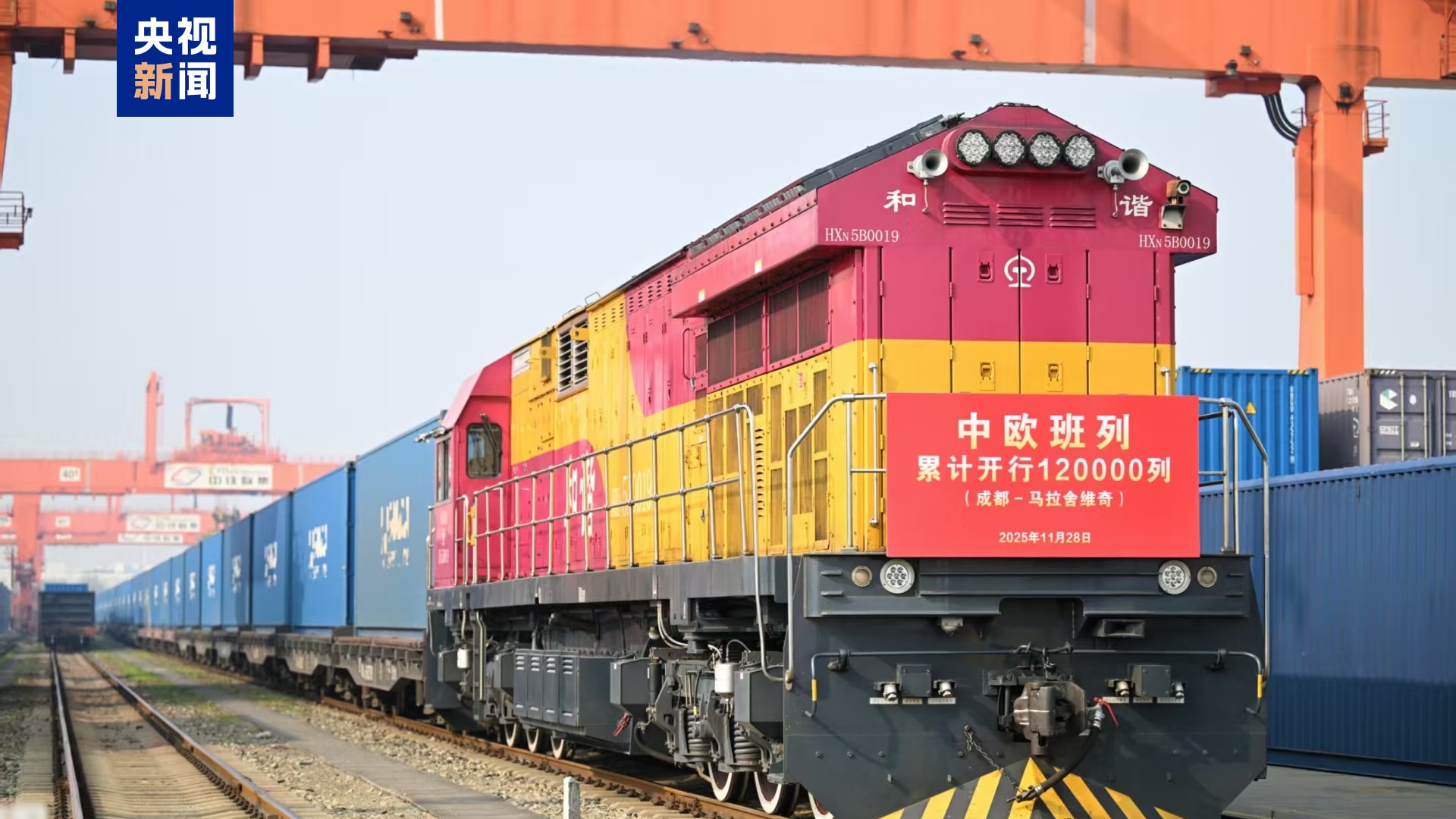
A China-Europe freight train leaves from Chengdu International Railway Port in Chengdu, Southwest China's Sichuan Province for Ma?aszewicze in Poland, on November 28, 2025. Photo: CCVT News
The number of China-Europe Railway Express services running via the eastern corridor has surpassed 5,000 this year, providing strong momentum for supporting China's high-standard opening-up, the Xinhua News Agency reported on Wednesday.
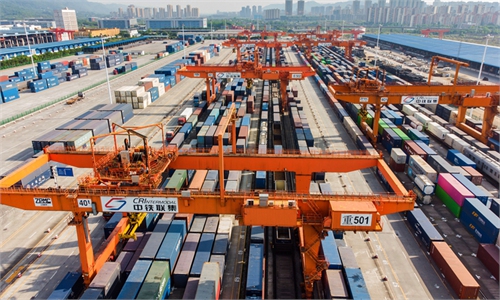
As a 60-car China-Europe cargo train carrying home appliances and digital products departed from the Manzhouli railway port, the corridor's total number of trips reached 5,166 so far this year, transporting more than 530,000 20-foot equivalent units (TEUs).
The eastern corridor - comprised of the Manzhouli, Suifenhe and Tongjiang railway ports - now handles more than 1,000 categories of goods, up significantly from when the service began operations. These include high value-added products such as computers, refrigerators and finished automobiles, according to Xinhua.
The network has expanded to 27 routes, covering 14 countries including Poland, Germany and the Netherlands, and connecting more than 60 domestic cities such as Changsha, Zhengzhou and Chengdu. It has effectively supported China's foreign trade in further integrating into global industrial and supply chains.
The sustained increase in train services along the eastern corridor shows that, despite rising trade protectionism, the route's operational importance continues to grow, highlighting the steady resilience of China's foreign trade, Song Ding, a research fellow at the China Development Institute, told the Global Times.
Song said that the corridor enhances connectivity between China and Europe by providing a stable land transport channel for high value-added goods. This helps reduce logistics uncertainties, reinforces the security and efficiency of supply chains, and supports the foreign trade performance of regions served by the network.
China Railway Harbin Bureau Group, the railway operator, has adopted multiple measures to increase operational efficiency, including giving priority to the scheduling of the freight trains, leveraging the "digital port" system, enhancing coordination with customs and border inspection authorities, and expanding the use of paperless clearance, the report said.
By optimizing the procedures for receiving broad-gauge trains and shortening inspection times, port logistics efficiency has been significantly improved. These measures have reduced the minimum customs clearance time for a single train to less than 30 minutes and lifted overall operational efficiency by nearly 10 percent.
Meanwhile, construction is accelerating on the capacity expansion project for the Jiamusi-Tongjiang railway, according to Xinhua. Upon completion, the Tongjiang railway port's throughput capacity is expected to increase threefold, further enhancing the corridor's capacity and supporting the China-Europe freight trains in moving toward higher-quality, more efficient and safer development.
The 258-kilometer project is a major upgrade to the trunk line that underpins Heilongjiang Province's northward opening-up corridor. Construction began on May 28 last year. It will cut passenger travel time between Jiamusi and Tongjiang from 265 minutes to 185 minutes, while boosting annual freight capacity from 18.84 million to 37.21 million tons. The expansion will ease capacity bottlenecks on the existing line and play an important role in supporting the Belt and Road Initiative (BRI).
As a cornerstone project of the BRI, China-Europe freight trains have evolved into an international logistics brand characterized by an extensive reach, driving force and influence, analysts said.
Since its launch, the service has expanded its operational network to 232 cities in 26 European countries and more than 100 cities across 11 Asian countries, completing nearly 120,000 journeys, Xinhua reported at the end of November.
By meeting strong demand in BRI partner countries and facilitating more balanced trade, the new corridor provides a stable and reliable channel for global commerce, Song said, adding that this will deliver essential momentum for sustaining a normal international trade order and supporting stable global growth.
RELATED ARTICLES