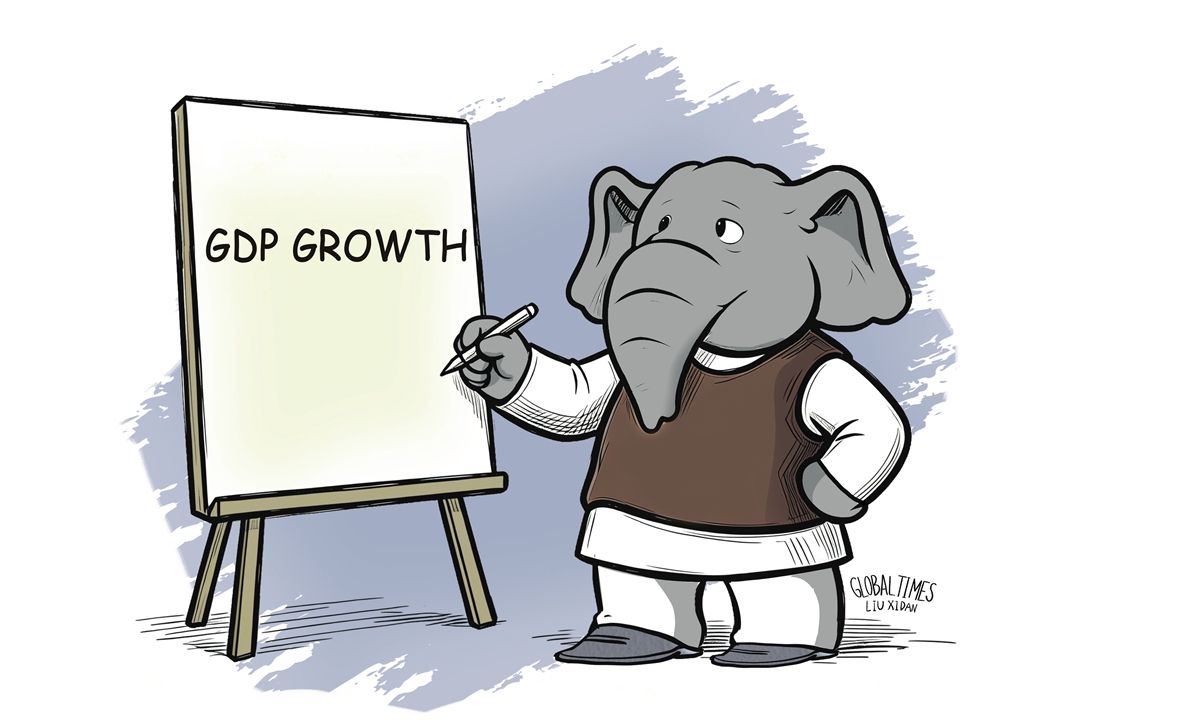
India GDP growth Illustration: Liu Xidan/GT
If India is growing so fast, why is its global ranking falling? Some will inquire.
India's economy is presenting an interesting contrast. GDP expanded 7.8 percent year-on-year in the April-June quarter, which is quite impressive according to global standards. Yet the country has slipped to the sixth place among the world's major economies, with GDP reaching about $3.92 trillion in the 2025-26 fiscal year. For a country seeking to become the world's third largest economy, the divergence is worth noting.
Is India's economic growth losing steam?
The apparent contradiction between its GDP growth rate and a lower global ranking is partly explained by how the size of the economy is measured. The 7.8 percent figure reflects real GDP growth, while the global ranking is based on nominal GDP in US dollar terms, with the value affected by movements in the Indian rupee against the dollar.
Fortune India reported in August that Indian minister of state for finance Pankaj Chaudhary, citing the IMF's April 2026 World Economic Outlook, put India's nominal GDP at about $3.92 trillion in the 2025-26 fiscal year, making it the world's sixth largest economy.
The lower ranking may be disappointing for some in India, but it does not mean that the economy is losing momentum. India's GDP ranking is based on nominal GDP converted to US dollars, so a weaker rupee can reduce the dollar value of the economy even when the country's real GDP is growing.
In December 2025, an official release said that India had overtaken Japan to become the world's fourth largest economy and was predicted to surpass Germany to become the third largest in 2030. The rupee's depreciation has weighed on the dollar-based ranking. But with real GDP growing 7.8 percent, India's underlying economic expansion remains strong.
Whether India ranks the fourth or sixth, one thing is increasingly clear: as its economy grows, its links with the global economy are becoming deeper and broader. That gives India greater weight in the global economy, while also making its own growth increasingly reliant on access to international markets, investment and supply chains. The relationship works both ways, and is unlikely to be significantly altered by short-term factors such as exchange-rate fluctuations.
India's 7.8 percent GDP growth has drawn skepticism in recent days over the methodology behind the figures and how sustainable the pace of growth could be. But a closer look at the components of growth is still useful. Official data shows that investment rose 11.9 percent, household consumption grew 7.1 percent and exports increased 12.0 percent. The fact that exports grew faster than both investment and consumption suggests that external economic links are becoming an increasingly important part of India's growth.
India's economy may be approaching a delicate point. At home, questions are being raised about the reliability of 7.8 percent growth; abroad, its global ranking has slipped. Yet beneath these debates lies a more important story: India's economy is becoming more deeply and extensively connected with the international economy, and those connections are increasingly feeding into growth through exports and supply chains.
If India wants to become the world's third largest economy, deeper engagement with the global economy will be part of that process. The 12 percent growth in exports is one sign that external demand is becoming a larger source of its growth.
However, at Indian economy's current scale, moving higher in the rankings is about more than simply expanding the domestic economy. It also depends on deeper integration into global supply chains, greater openness to trade and investment, and stronger manufacturing competitiveness. Together, these can support more durable growth by expanding exports and making the economy more resilient to exchange-rate fluctuations.
More open and mature engagement with the global economy would therefore strengthen not only India's growth but also its economic links with the rest of the world. The upcoming BRICS summit offers one platform for India to deepen those links with other emerging and developing economies.
India's lower position in the global GDP rankings does not necessarily mean less weight in the international economy. As its economy becomes larger and more closely connected with global markets, a broader role in advancing free trade and economic cooperation could help sustain India's meaningful growth.
The author is a reporter with the Global Times. bizopinion@globaltimes.com.cn
RELATED ARTICLES