China's power battery recycling ushers in comprehensive upgrade
Every retired battery gets a second life
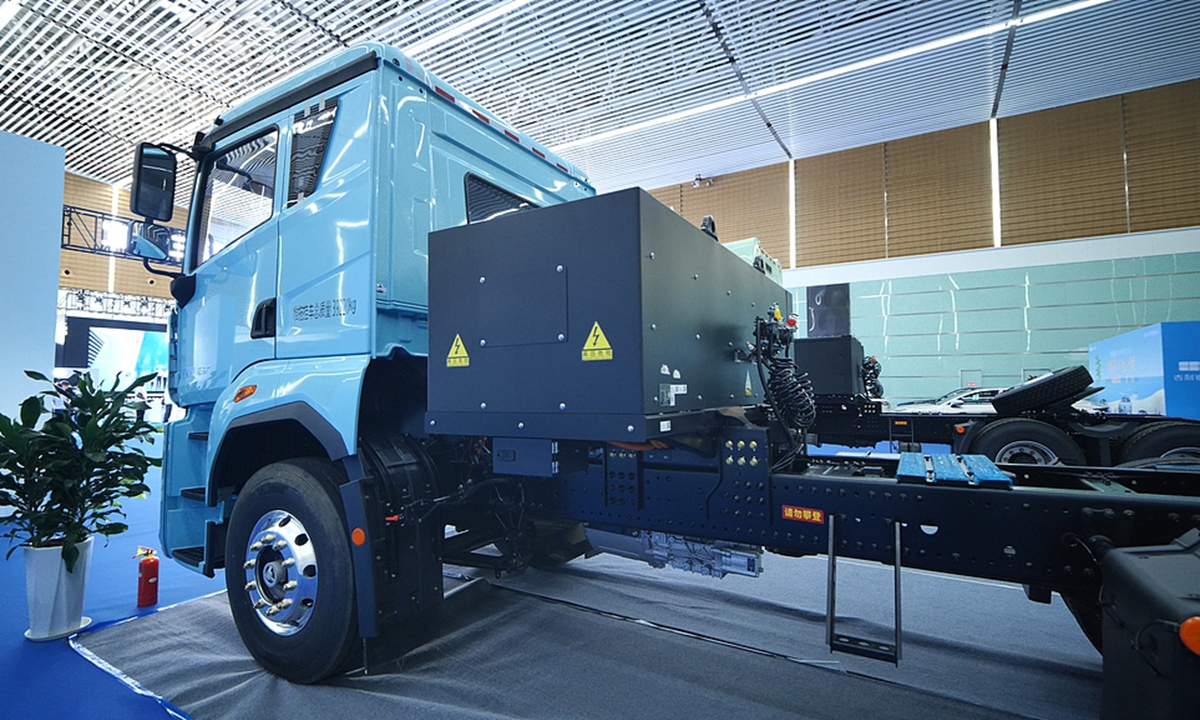
A new energy vehicle displayed at the 2026 World Power Battery Conference on September 3, 2026. Photo: VCG
China's power batteries will enter a stage of large-scale retirement during the 15th Five-Year Plan period (2026-30), making a comprehensive upgrade of recycling and reuse particularly important, an official with the Ministry of Industry and Information Technology (MIIT) said at the 2026 World Power Battery Conference held in Yibin, Southwest China's Sichuan Province, on Friday. As the country's NEV fleet keeps growing, the first generation of power batteries put on the market is now retiring in bulk.
China's comprehensive utilization of used power batteries exceeded 400,000 tons in 2025, and the volume generated in 2030 is expected to reach 1 million tons, data showed. That volume has pushed the sector, worth hundreds of billions of yuan, to a crossroads of transformation and upgrading.
Between late July and mid-August 2026, China rolled out a dense package of regulatory measures that has reshaped the industry. On July 30, the MIIT announced it had abolished and revised the standards on cascade utilization of used NEV power batteries set out in the 2024 policy, and would no longer operate the announcement-based management system for cascade utilization enterprises, removing all 100 previously listed firms from the compliance roster.
On August 15, Wang Shancheng, head of the Department of Resource Conservation and Environmental Protection at the National Development and Reform Commission (NDRC), said China will put in place by 2030 a full-chain, closed-loop management system for recycling solid waste from the "new three" products, strictly implement the scrapping of NEVs together with their batteries, and crack down on illegal recycling and dismantling. The country is also pressing ahead with the upgrading of its circular economy industries.
The adjustments mark a full shift in regulatory logic on retired batteries, from a resource-reuse orientation to a safety-and-quality orientation. With lithium supply ample and battery production costs down sharply, greater weight is now given to safety and compliance. As the NEV industry grows explosively, China's battery recycling policy is drawing attention on several fronts.
A higher bar across the chain
After nearly 30 years of effort, China has built the world's largest and most complete power battery industrial system, in which power batteries drive the integrated growth of new energy, new materials and other emerging industries, Wan Gang, a vice chairman of the 13th National Committee of the Chinese People's Political Consultative Conference and honorary president of the China Association for Science and Technology, said at the conference. Even so, the industry still faces contradictions and problems that must be tackled, he said.
Deep recycling of EV power batteries worldwide is an industrial opportunity rather than a "waste management challenge," according to a circular economy report published recently on the World Economic Forum (WEF) website, which said China currently has the world's largest battery recycling infrastructure. Citing World Resources Institute data, the report said retired EV power batteries worldwide could reach 20.5 million tons by 2040. As the global clean transport transition accelerates, systems supporting the circular economy are evolving quickly to match the scale of that shift, making battery recycling increasingly a strategic industrial activity, it said.
Mo Ke, a Chinese new energy industry veteran, told the Global Times that as domestic NEV ownership rises rapidly and large numbers of power batteries enter retirement, the recycling industry is undergoing a profound transformation, with the chain that treated cascade utilization as its core profit point now being restructured alongside the policy adjustment. Domestic recycling had taken two main paths, Mo said.
The first was cascade utilization of retired batteries, an important direction for the industry over the past several years. The second, for batteries unsuited to cascade use, was crushing and reducing them back into battery raw materials through special processes, with technically stronger firms able to turn out cathode materials along the way. With the policy adjustment, the industry is optimizing its chain layout and lifting overall operating efficiency, said Mo.
"This policy adjustment is not a one-size-fits-all ban on cascade utilization of retired power batteries," Mo said. Early policies encouraged cascade use because retired batteries often retain some capacity and therefore room for reuse. As the industry has developed, policy has been guided and adjusted in advance to consolidate safety responsibility and standardize market rules.
The new rules will have vehicles recycled together with their batteries, chiefly to smooth the channels through which batteries move and steer retired units back to automakers and major battery manufacturers, which understand their own products better and follow more standardized handling procedures. Batteries often retain application value once a vehicle reaches the end of its service life, and the regulatory thinking is largely about high standards for channels and technology, balancing commercial viability against safety and compliance.
Yu Haijun, director of the National and Local Joint Engineering Research Center for Recycling and Utilization of NEV Power Batteries, told the Global Times that the new recycling rules, coinciding with a concentrated wave of battery retirements, place fresh demands on companies along the chain.
First, capturing where products ultimately go rests on an all-scenario recycling network that reaches the point at which batteries are scrapped, and that network has to be built in multiple layers — the core of any commercial layout. Second, revising existing recycling technology routes has to be organized around full-lifecycle product positioning and design, updating recycling routes in step with each new generation of product technology, so that every new product reaches the market with a recycling solution already prepared for it, said Yu.
On the effect of the adjustment across the product chain, Yu said one of its priorities is to strengthen producer responsibility. That requires battery products to be matched to recycling technology at the front-end design stage, with particular readiness in green, low-carbon recycling. The core principle of the reverse product positioning method for which Brunp won the European Inventor Award has been fully put into practice at CATL and Brunp, he said, building a complete closed loop — a technology system and business model in which front-end design and back-end recycling are upgraded in step.
More than an environment issue
As China enters a large-scale scrapping cycle for NEVs, the rollout of policies on scrapping vehicles with their batteries and on full-lifecycle management is producing far-reaching governance effects. A German EV news outlet reported recently that China has begun enforcing mandatory full-lifecycle rules for power batteries, giving each battery a digital identity tracked on a national platform from production and use through to scrapping and recycling.
Automakers must build recycling service networks, provide technical information such as dismantling procedures, and ensure used batteries enter compliant channels; vehicles and batteries are in principle scrapped together, which secures standardized management across the whole process. Recyclers, meanwhile, face high thresholds on permits, environmental impact assessment and pollutant discharge, and nearly 30 national standards have further unified industry procedures.
The WEF report noted that once an EV power battery's charge and discharge capacity falls into a certain band below its original performance, it is no longer suitable for use in a vehicle but can still be applied in lower-intensity settings such as building support systems or renewable energy storage. Even so, as testing and certification costs continue to be adjusted, large-scale recycling infrastructure remains central to closing the resource loop.
The International Energy Agency estimates that by 2050 battery recycling could significantly reduce global demand for newly mined lithium and nickel and sharply cut demand for cobalt, with the market value of recycled energy transition minerals reaching an expected $200 billion that year. A WEF white paper on scaling circular supply chains found that integrating reverse logistics networks, recycling systems, material traceability and recycling infrastructure at the early planning, manufacturing and supply chain design stages delivers operating efficiency the industry rates highly.
At compliant facilities, recovery rates run as high as 99.6 percent for nickel, cobalt and manganese and 96.5 percent for lithium. The system lifts recovery of key raw materials such as lithium, nickel, cobalt and manganese while reducing dependence on external resources. Closing the loop on retired power batteries is therefore not only an environmental question but one of resource security, industrial competitiveness and long-term supply chain resilience.
China's solution
Against broad international attention, China's management policy on power battery recycling is seen as signaling to the world the resolve of its new energy industry to stay on a path of high-quality development.
The WEF report projects the global EV battery recycling market will approach $100 billion by 2034. As critical mineral supply systems are optimized and regulatory requirements broaden, end-of-life battery management is fast becoming a strategic core industrial capability. In June this year the EU launched a 1.5 billion euros EU Battery Booster support program, identifying circularity, material recovery and reuse as key to building a competitive and resilient battery industry, while Chinese carmakers including BYD and CATL integrated recycling deeply into their global operations long ago.
Germany's Focus magazine said China's EV industry is steadily entering a new stage of high-quality development, and that the standardized handling of millions of retired batteries is becoming a template for the global green transition. Digital identifiers track batteries effectively across their lifecycle and ensure they enter formal recycling channels efficiently. The advanced digital regulatory system that China has established has not only driven its own industrial upgrading but also offers a valuable Chinese example for battery recycling worldwide.
The German EV news outlet said the development of China's used power battery industry is both a positive environmental exploration and an important opportunity for the circular economy. China has a solid foundation in recycling technology and processing capacity, has kept refining its standardized recycling system since 2018, and now has hundreds of approved enterprises releasing green capacity and steadily raising the share of batteries handled by compliant facilities.
Mo said Chinese companies are actively benchmarking against high international standards, with batteries exported overseas strictly observing local regulations and fully implementing lifecycle responsibility. The domestic recycling industry has made marked progress overall, with continued technology breakthroughs at large compliant plants and an increasingly complete full-chain closed-loop system.
As regulation deepens and compliance improves, China's power battery industry is showing the world the vitality of the China solution through solid practice and a complete ecosystem, and moving toward a genuinely green and sustainable future for the sector, said Mo.
RELATED ARTICLES