More damaging than the ‘tractor spy’ narrative is the witch-hunt mentality: Global Times editorial
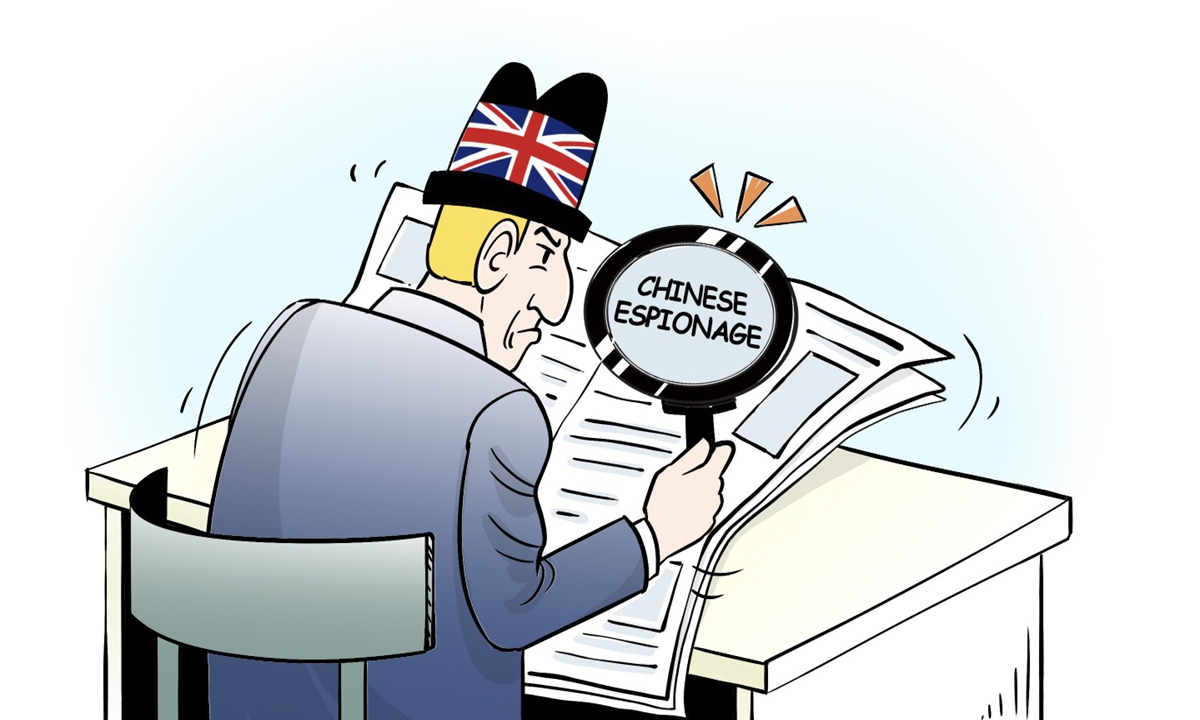
UK Illustration: Chen Xia/GT
Fridges have been called spies, routers spies, smart meters spies… now even tractors have joined the list. More alarming than the "tractor spy" narrative is the reflexive tendency to suspect espionage whenever a Chinese-funded company is seen. This inevitably brings to mind the witch hunts of European history.
The Telegraph recently reported another version of the "China espionage narrative" fabricated by British politicians. The so-called The Coalition on Secure Technology (CST), led by Labour MP Graeme Downie, claimed that China could use tractors and other connected agricultural machinery to "spy on" British farmers and "gain" intelligence on food security, arguing that "Chinese chips were now commonplace in farm machinery, including GPS-guided tractors, agricultural drones and automated irrigation systems."
Depicting tractors as "spy tools" may sound absurd, but it is far from accidental. As an informal think-tank-like group, CST has long focused on so-called "risks from Chinese technology." It has previously hyped claims that Chinese components in smart home appliances and electric vehicles could be "weaponized." Connectivity is a fundamental feature of the information society; if "potential hacking" or "possible data collection" is enough to presume something guilty, then all connected devices could be branded as spy tools - including those produced in the US and Europe themselves. By this logic, should the British throw all internet-connected devices into the River Thames? Such baseless accusations are not "security analysis," but rather a form of pre-judgment where targets are drawn first and arrows are shot later.
More alarming than the "tractor spy" narrative is the reflexive tendency to suspect espionage whenever a Chinese-funded company is seen. In recent years, this kind of anti-China paranoia has become an "assembly-line product" output in the UK. Allegations of so-called "Chinese agent" infiltration in the British Parliament have repeatedly surfaced; MI5 has issued multiple warnings suggesting that "recruiters" on job websites may be "Chinese intelligence officers"; even fridges have been called spies, routers spies, smart meters spies, mobile payment terminals spies, electric buses spies, wind turbines spies, and civilian drones spies - now even tractors have joined the list. Fabricating baseless "espionage cases" targeting China, maliciously smearing Chinese companies, and damaging their reputations has almost become a "routine task" for some UK intelligence agencies, as well as a tool for certain think tanks to pollute public perception and undermine China-UK relations.
This inevitably brings to mind the witch hunts that swept Europe from the late Middle Ages into the early modern period. Back then, an accusation alone - without a shred of evidence - was enough to send someone to the stake. Today, the attitude of some British politicians and think tanks toward China and "Made in China" carries more than a hint of the same "witch-hunt" mentality. The playbook is familiar: Normal technological cooperation and trade are portrayed as "infiltration" and "threats"; Chinese companies' market successes are rebranded as "strategic risks"; and even agricultural machinery is cast as a "potential spy."
Behind this mindset lies anxiety and unease over the West's eroding edge in its competition with China - and, ultimately, a lack of confidence in its own strengths. Economically, they seek cooperation with China's markets and supply chains; politically, however, they feel compelled to manufacture an "enemy" narrative to shore up consensus and deflect internal tensions. At home, this serves to mask deindustrialization, crumbling infrastructure, and social fragmentation; abroad, it aligns with certain geopolitical frameworks. The result is an attempt to use "witch hunts" to mask a lopsided psyche: China's development is automatically viewed as a "loss" for the West, cooperation is treated with suspicion as a "trap," and normal market competition is stigmatized as "China Shock 2.0."
It is not difficult to see what lies at the heart of this manipulation: blame-shifting and an attempt to evade reality. The result can only be harmful to both sides. For China, such accusations based on presumption of guilt damage not only the reputation of Chinese companies and citizens, but also translate into restricted market access, overstretched investment reviews, and obstruction of routine business activities. For the UK, meanwhile, hyping tractors as supposed spy tools not only erode bilateral trust, but also undermines Britain's own credibility as a rule-of-law nation and an open economy. In fact, whether removing Chinese-made surveillance cameras or excluding Chinese companies from 5G networks, every act of stigmatizing China comes at the cost of slowing Britain's own development and weakening its competitiveness. Ultimately, it is British taxpayers who foot the bill.
Historically, the witch-hunt frenzy eventually receded under the light of rationality brought by the Enlightenment, but the price Europe paid for that collective madness was immense. If some British politicians and think tanks continue to turn China into the target of a "witch hunt" campaign, what they will ultimately reap is more expensive equipment, a more closed market, a more divided society, and missed opportunities to cooperate for mutual benefit with the world's second-largest economy. The flames of a "witch hunt" will only burn those who light them; they will do nothing to help Britain overcome its own difficulties.
RELATED ARTICLES