Asia-Pacific media jointly tell the story of new opportunities for cooperation
By , Ding Yazhi and Li Jiayu Published: Sep 07, 2026 08:40 PM

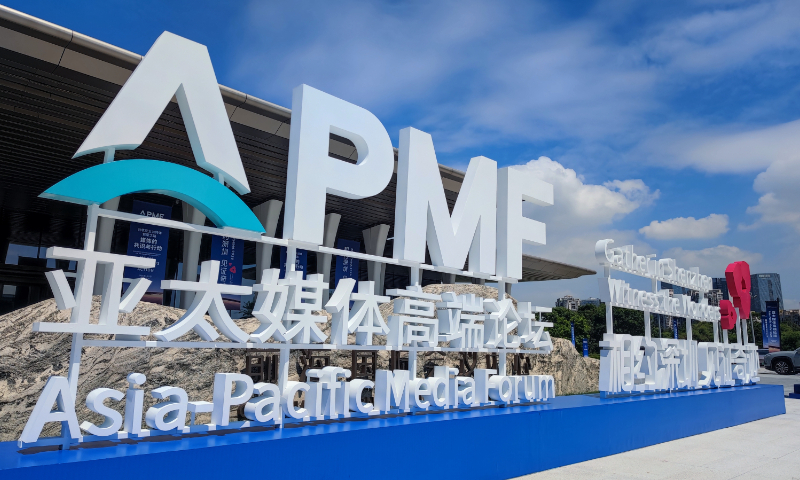
A photo taken on September 4, 2026 shows the logo of the Asia-Pacific Media Forum in Shenzhen, South China's Guangdong Province. Photo: VCG
"At 9 am, we made this decision in the car; by noon, the memorandum of understanding [MOU] had already been signed," Pakistani reporter Amjad Aziz Malik told the Global Times when recalling his experience in Shenzhen, South China's Guangdong Province, over the past two days.
While attending the Asia-Pacific Media Forum, he visited companies in Shenzhen along with a group of reporters. During their exchanges, he said an idea gradually took shape in his mind: to promote deeper exchanges between Pakistani and Shenzhen media. He had never expected that in less than a day - an MOU would be signed and sealed.
This year marks the APEC China Year, and the 33rd APEC Economic Leaders' Meeting will be held in Shenzhen in November. It was against this backdrop that the Asia-Pacific Media Forum was convened in Shenzhen on September 5, bringing together representatives from governments, media outlets, think tanks and international organizations to explore how media exchanges can advance regional cooperation and understanding.
Days before the forum opened, media professionals from various countries had already arrived in Shenzhen. They visited companies and industrial parks to observe the development of industries such as artificial intelligence (AI), robotics and new-energy vehicles (NEV). They moved through the city to see how it strikes a balance between innovation, industry and ecology. For these international journalists, what concerned them was not just "how fast China is developing?" What they truly wanted was an answer to a deeper question: How can a rapidly changing China be understood more accurately by the world?
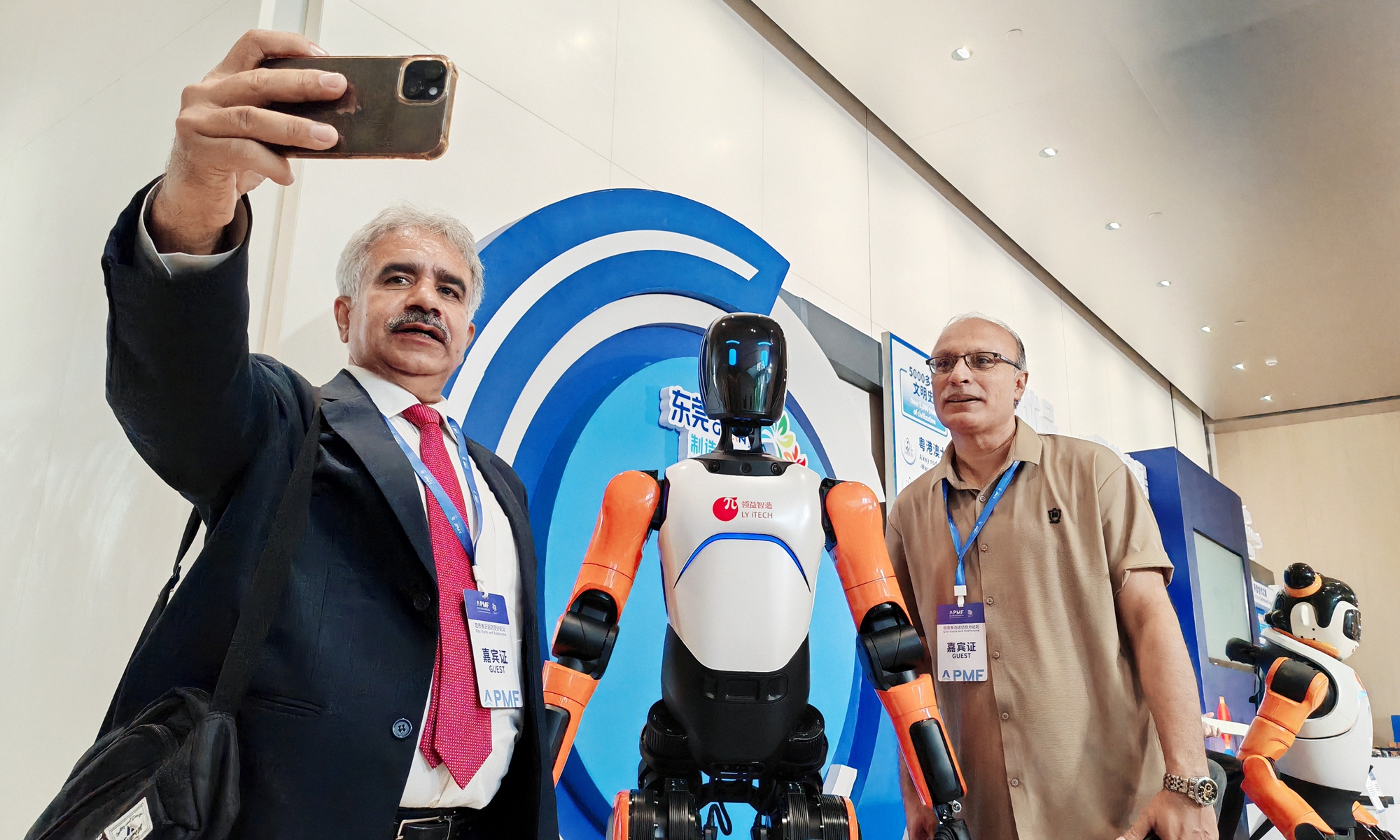
International guests take selfies with robots in Dongguan, South China's Guangdong Province, on September 3, 2026. Photo: Guan Kejiang/GT
'Astonishing development'
About 15 years ago, Heru Andriyanto, editor-in-chief of Indonesia's Jakarta Globe, made his first visit to Guangdong and toured Huawei's headquarters. He recalled that Shenzhen was already a vibrant city of innovation back then - yet what the outside world talked about most at the time was how the city had created its miracle through manufacturing. Fifteen years on, he set foot on this land once again. This time, he saw a Shenzhen reshaped by AI, robotics and innovative technologies.
At BYD's global headquarters in Shenzhen, Andriyanto stood before the NEV display area, his phone almost never leaving his hand. He got an up-close look at battery technology, autonomous driving, and the growth of the NEV industry chain. He said he hoped to share what he had seen with more readers.
"Compared with 15 years ago, the pace of development here is just astonishing," he said.
During their visits to various cities across Guangdong, foreign journalists gradually pieced together a more complete picture of China's innovation. In Foshan, they learned how digital twin technology is empowering the manufacturing industry. In Dongguan, they stepped into smart factories to observe how 5G is driving the upgrading of production processes. In Zhuhai, they explored the development of the green energy industry.
"The biggest change in recent years is that global attitudes toward China's technology and innovation are shifting," Rebecca Fannin, founder of Silicon Dragon Ventures, a US-based media and events platform, told the Global Times.
In the past, she said, skepticism was widespread abroad, but now China is widely recognized as a major competitor and challenger. China has developed an innovation system with its own distinctive characteristics, she said.
This shift has also been felt by journalists from other countries. Sitt Min Thar San, an editor at the Myanmar Herald, visited China for the first time.
"I had long heard that China's technology was highly advanced, but what I saw and heard on the ground still far exceeded my expectations," he told the Global Times.
In Shenzhen, he saw how AI has entered everyday life. Yet it was not technology alone that left the deepest impression on him. He said that in many places, industrialization tends to come at the expense of the ecological environment, whereas China, while developing industry, is also striving to balance ecological protection with economic growth. This, he said, left a profound impression on him.
Deepening media cooperation
Face-to-face exchanges, time and again, have shown that distance is more than a matter of geography - such exchanges have also become a starting point for greater understanding between different societies.
Donovan Martin, CEO and editor-in-chief of Canada's Daily Scrum News, made his fifth visit to China. Martin said that every time he comes to China, he hopes to experience things he never encountered before, to report the real stories, and to show readers the side of this country they don't know.
In his view, the value of a journalist lies in discovering new changes on the ground. This, he added, is precisely the significance of the Asia-Pacific Media Forum. At the forum, media representatives from different countries held discussions on media cooperation, regional development, and international communication.
Kostas Oikonomou, senior vice-president at CNN, noted that the Asia-Pacific region is brimming with vibrant economic dynamism, swept by waves of technological innovation, and adorned with a brilliant diversity of cultures, while also bringing together numerous countries with vastly different historical trajectories, perspectives, and media traditions. Such diversity, he said, should not be seen as an obstacle, but rather as a source of strength. Deepening dialogue with media circles in the Asia-Pacific region is therefore all the more valuable. Through dialogue, exchanges and cooperation, differences can be understood more clearly, he said.
Felix Alberto Paz Quiroz, general director of the Peruvian news agency Andina, said that in a region as diverse as the Asia-Pacific, communication cannot be mere information exchange - it must foster mutual understanding. The APEC forum has once again shown that dialogue and consensus are vital forces driving us forward, he said.
Sourabh Gupta, a senior fellow at the Institute for China-America Studies, said that many countries now recognize the value of China's technology, experience and expertise. As the globalization of Chinese enterprises enters a new stage, accurately documenting these changes and helping different societies understand one another has become a new task for the international media.
Tell the story together
At the Asia-Pacific Media Forum, a consensus gradually took shape: The future of Asia-Pacific cooperation requires not only industrial and economic connectivity, but also cognitive and cultural connectivity. And such connectivity begins, first and foremost, with real, firsthand contact. The visit to Guangdong gave media professionals from different countries the opportunity to step into the very places where China's development is unfolding. Through exchanges with companies, cities and fellow journalists, they came to a renewed understanding of the ever-closer ties between China and the Asia-Pacific.
In the past, China's story was more often told from a distance. Today, a growing number of international media outlets are coming to China - discovering change on the ground and exploring possibilities for cooperation through exchange.
During the forum, the Asia-Pacific Media Partnership Organizing Committee was launched, and documents on China-foreign media cooperation outcomes were exchanged. The Shenzhen Consensus of the Asia-Pacific Media Forum was released.
Shenzhen city also launched a media cooperation campaign at the event, focusing on technology sharing, joint content creation and talent cultivation.
Starting from Shenzhen, more authentic stories of China are being told, more shared opportunities for Asia-Pacific development are being discovered, and more cross-border cooperation is taking root.
RELATED ARTICLES