IN-DEPTH / IN-DEPTH
In Peru’s Andes mountains, a small boat opens a new route to better lives
By Published: Sep 07, 2026 10:17 PM

Editor's Note
Five years ago, China launched the Global Development Initiative, a people-centered call for inclusive, shared prosperity. Today that vision is visible in everyday lives across the Global South.
In a Tanzanian village, primary school children now enjoy daily "soy milk time" - a cup of fresh soy milk from local beans. Chinese agricultural cooperation has linked higher yields, farmer incomes and better child nutrition. In Peru's Andes, a small "warm-heart boat" powered by a Chinese company has shortened a day-and-a-half mountain trek to 40 minutes. In Cambodia, shrimp-farming techniques refined on Shanghai's Chongming Island are transforming rice fields in Takeo province, lifting both survival rates and household incomes.
These modest projects show how the Global Development Initiative reaches ordinary people. This week, we invite readers to follow the soybeans, the boat and the shrimp.
Boat operator Freyder Caldas Cierto arrived at the dock at midnight.
Half an hour earlier, Daniel Eugenio Masgo had contacted the social management team at the Chaglla Hydropower Station in Peru's Huánuco region. His son was suffering severe abdominal pain and might have appendicitis.
Cierto and a colleague set out just after midnight. At 12:30 am, they reached Vista Alegre, picked up the young man and returned to the station. A vehicle arranged by the social management team then took him to the health center in Cayumba.
The young man now works as a security guard for a contractor working with the project. Cierto still remembers the journey.
The boat was part of a free community service that has connected villages around the Chaglla Hydropower Station for more than a decade.
The service began in 2015. Since 2019, when the Chaglla Hydropower Station came under operation led by China Three Gorges Corp (CTG) and its subsidiary Hubei Energy Group, the operating team has maintained the free boat service for local residents' daily travel as part of its regular community work, providing boats, fuel, crew and safety equipment.
Over more than a decade, the boats have traveled about 140,000 kilometers and carried approximately 100,000 passengers, according to project figures. Some journeys that once took a day and a half can now be completed in roughly 40 minutes, the Global Times learned.
The Chaglla boat offers a small, concrete view of a broader form of China's clean energy cooperation with other countries: alongside building and operating major projects, Chinese companies are increasingly seeking to ensure that local communities share the benefits of development. It also illustrates the Global Development Initiative's emphasis on people-centered, inclusive and equitable, action-oriented development.
A small, busy boat
Every morning, 45-year-old Cierto rises at 5:30 am. After breakfast, he says a prayer and leaves the camp at about 6:30 am for the reservoir dock. The crew holds a safety briefing before departure. Four operators rotate shifts to keep the service running throughout the week.
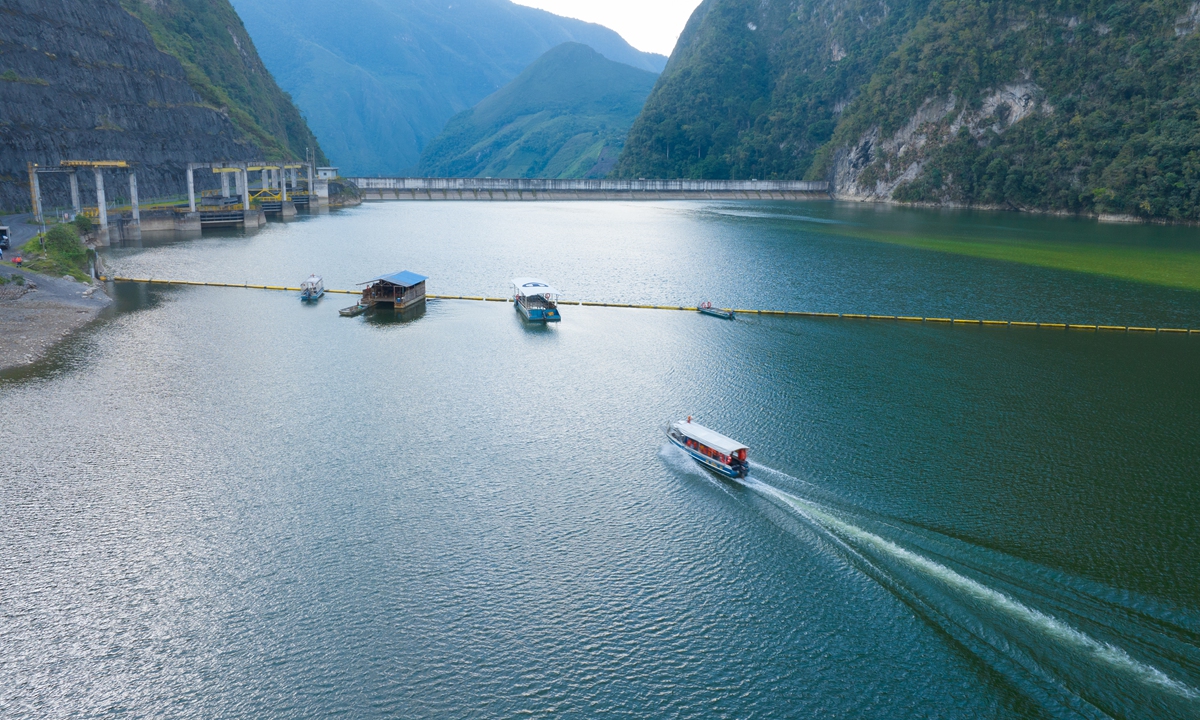
There are two fixed community trips each day, at 9 am and 3:30 pm. The regular run from the dam to Agua Nueva takes about 30 minutes one way. The boat carries residents from Agua Nueva, Santa Elena, Miraflores, Pucaplaya, Torre Jirca and Rinconada, as well as people from Huanchag, Huanipampa and Pampamarca who need to visit relatives, tend farms or transport agricultural products.
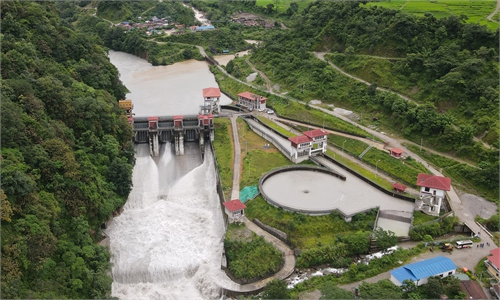
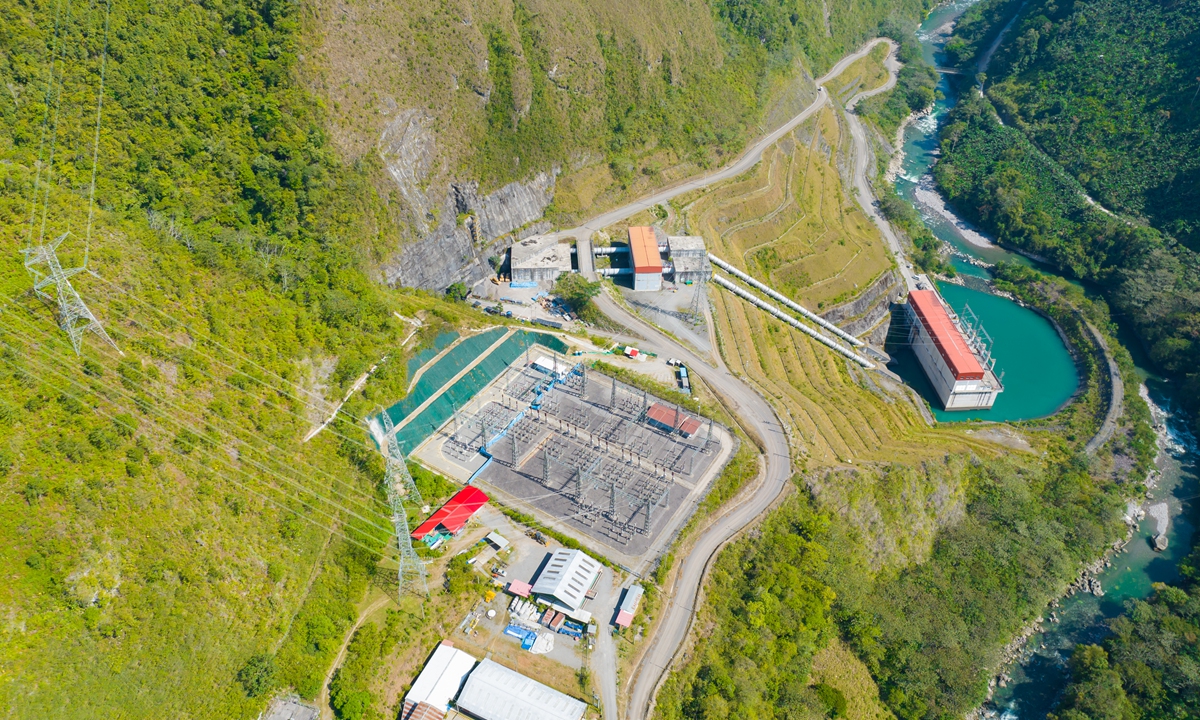
The Chaglla Hydropower Station stands on the Huallaga River in Peru's Huánuco region, deep in the eastern Andes. With an installed capacity of 456 megawatts, the station generates an average of about 2 billion kilowatt-hours of renewable electricity each year, feeding Peru's national grid.
The project company, Empresa de Generación Huallaga (EGH), is a subsidiary of CTG.
Cierto joined the Chaglla project in 2012, when construction teams still had to move materials and workers through areas without roads. He initially operated boats for the construction work. As the reservoir expanded, the boats began to serve another purpose: carrying the communities whose old routes had been submerged or cut off.
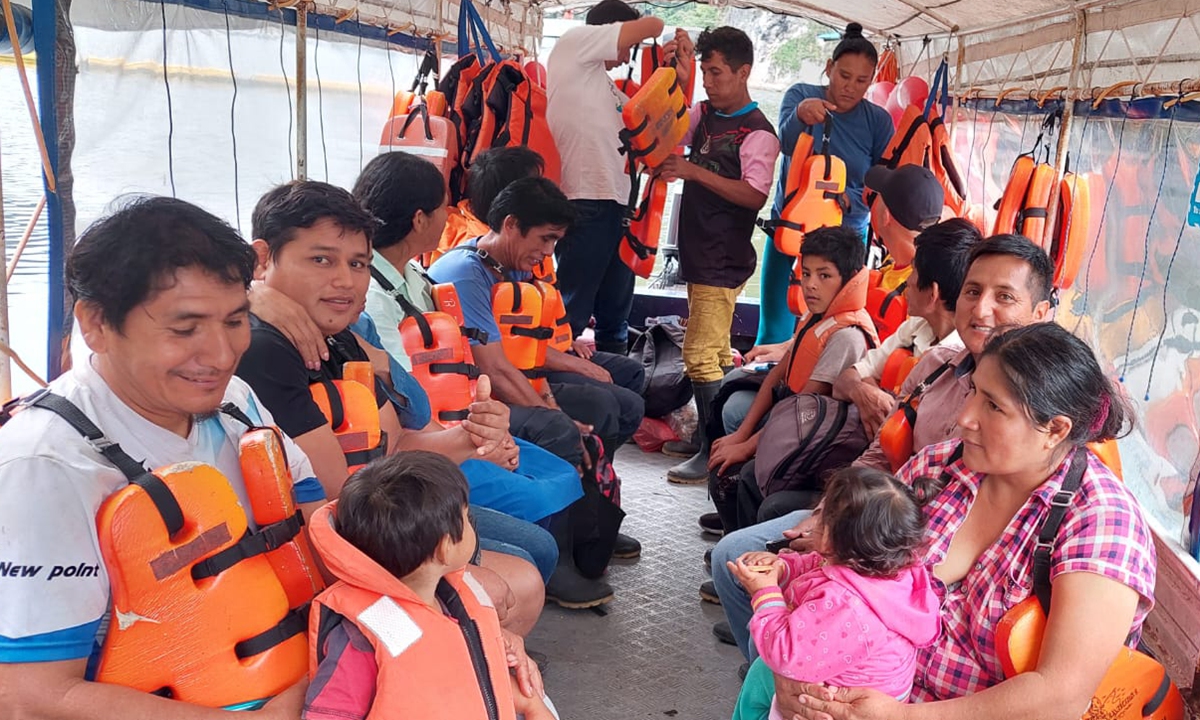
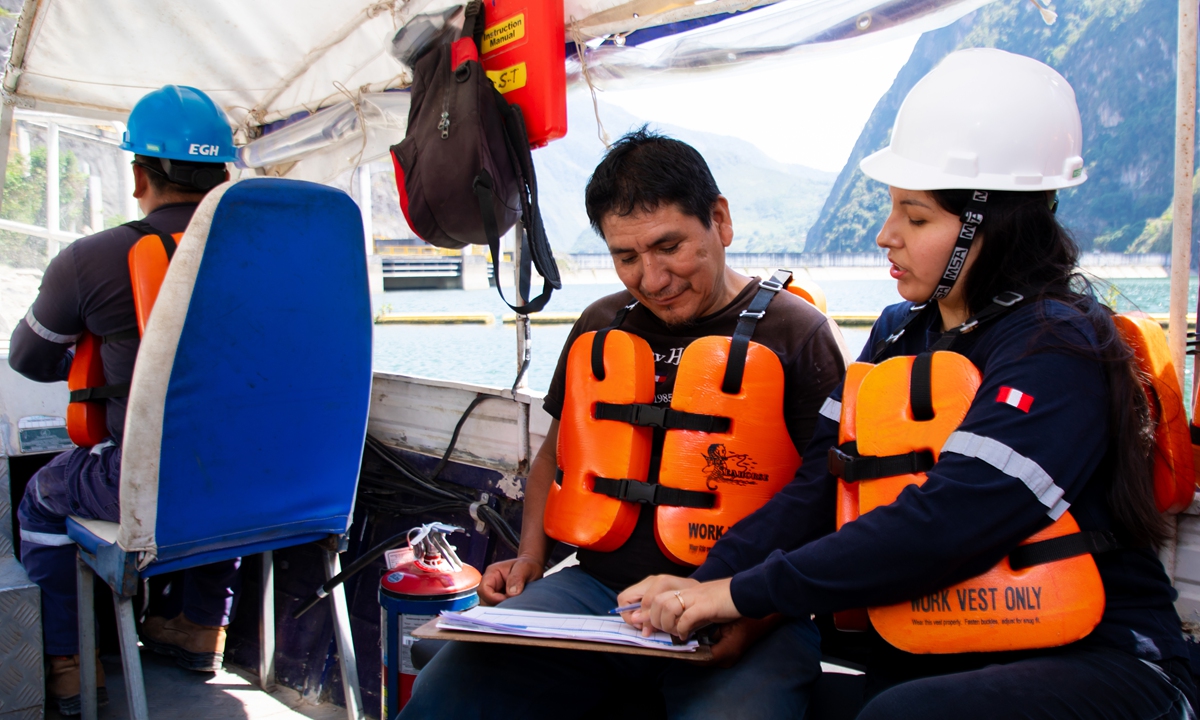
Passengers initially felt nervous about traveling on the water. The operators taught them how to use life jackets and paid particular attention to children.
Over time, the boat became part of the rhythm of community life. People no longer had to plan a trip around a difficult return journey or remain away from home for several days.
Juan Espinoza Lázaro, 48, makes a living from agriculture and fishing. He often travels to Agua Nueva to grow beans with his friend Yonel Escalante.
Lázaro remembers carrying coffee sacks weighing 30, 40 or even 50 kilograms on his back. He would walk until he found a mule or donkey to help transport the load, then continue toward the nearest town.
"Before, it was very difficult. Remembering those days is painful," he told the Global Times, adding that the hardships of that former life remain etched in his memory.
He recalled walking 13 to 15 hours to reach the nearest town, while people from Agua Nueva could spend 15 to 18 hours traveling to Cayumba. The route from Chulla or Pueblo Nuevo to Chaglla once took nearly seven hours.
Today, Lázaro can take the boat to Naranjal, which takes half an hour, walk an hour to the road and then go to Chaglla by car. The entire journey takes no more than three hours.
The community boat now carries farm produce, while another boat is used for livestock, including cows and pigs. During harvest periods, the boats may carry more than 100 sacks of beans a day, each weighing about 50 kilograms.
The service also carries teachers, health workers and relatives visiting family members. For residents, the boat is not simply a faster way to cross the reservoir. It makes it possible to go to a farm in the morning and return home in the afternoon, to seek medical care without losing several days, or to attend an important family gathering.
"I am very grateful to the Chinese management team because we still have work here. We have even improved the service by purchasing new engines - two 100-horsepower engines and one 60-horsepower engine. This allows us to provide better transport for all residents in the communities," Cierto said.
At first, the boat could carry only eight people. Now it can carry 40. "During the harvest season, we transport 100 50-kilogram sacks of beans a day. Over a week, that amounts to 500 to more than 600 sacks. I believe that in this way, we are also contributing to the development of the local communities," he said.
Friendship built around a reservoir
From the very beginning, the boat service was introduced in response to a practical problem created by the reservoir itself.
When the reservoir began filling in 2015, some routes used by nearby communities were submerged or cut off. Ren Jianhua, a Chinese project representative at the Chaglla project, told the Global Times that the transport needs of reservoir residents had been raised and given priority attention during the project's environmental impact assessment.
Ren said the project owner subsequently included free boat transport for local communities among its social and environmental commitments submitted to Peru's relevant authorities. The service was therefore established as a long-term arrangement closely linked to the project.
Today, the station provides the boats, docks, fuel, personnel and safety equipment. Local maritime authorities oversee navigation, while passengers are required to follow safety rules. The station also sets aside an annual budget for the service.
The project had also established channels through which residents could raise concerns and discuss practical needs. A Residents' Petition and Complaint Center receives requests, while a Community Residents' Monitoring Committee holds regular meetings with villagers, Ren said.
The relationship between the station and nearby communities has developed through daily cooperation. Since the Chinese operator took over, Chinese and Peruvian employees have worked together in operations, maintenance and community affairs. Ren said differences in language and culture had not prevented the teams from building trust.
For local residents, the station's presence is most visible in the changes around them. In 2024, the Chaglla project helped 11 villages build or repair more than 20 kilometers of rural roads.
It has also provided more than 500 direct and indirect jobs for local residents, alongside training and skills development, according to Hubei Energy.
Education and health have been part of the same effort. The station has supported adult literacy activities, children's reading programs and medical assistance. It has also responded to local disasters and helped maintain public facilities.
Environmental work is built into the operation as well. The station organizes water-surface cleaning, has helped establish fish ponds and participates in the protection of vegetation and rare orchids. According to company information, the station has removed more than 360 tons of floating waste since it began operations.
For Lázaro, the relationship is best understood through everyday cooperation.
"We work together like a family," Lázaro said. "Neighbors help one another and live together in harmony."
A short journey comes with a great change
The story of the Chaglla Hydropower Station in Peru shows how a clean energy project can support both a country's energy transition and the people living around it.
This is where the Global Development Initiative offers a broader lens.
China's international green energy cooperation has continued to expand. China had carried out a wide range of green energy cooperation projects with more than 100 countries and regions, bringing the benefits of clean energy technology to local communities, the Xinhua News Agency reported in March.
For instance, in Azerbaijan, a Chinese-built wind power plant completed in December 2025 is expected to generate nearly 1 billion kilowatt-hours of green electricity a year and reduce carbon dioxide emissions by about 400,000 tons annually. In Nauru, a photovoltaic project built by a Chinese company now generates enough electricity to meet the country's demand, according to Xinhua.
Erik Solheim, former UN under-secretary-general and former executive director of the UN Environment Programme, told the Global Times that China will play an increasingly important leading and supporting role in the global green transition, and one of China's most important contributions is sharing its advanced technologies and best practices with developing countries while actively promoting green investment.
"By helping other nations develop electric vehicles, solar power and other clean energy technologies, China not only supports their green transformation but also provides them with valuable opportunities to learn, catch up and even potentially surpass existing achievements," he said.
This Chinese solution offers an important reference for developing countries seeking modernization paths suited to their own national conditions, and injects strong momentum into global sustainable development, Solheim noted.
In Chaglla, the clearest symbol of that connection remains a small boat.
Every day, at 3:30 pm, passengers gather at the dock with bags, farm supplies and sometimes animals. The boat pulls away from the dam and heads toward Agua Nueva. Half an hour later, people step ashore and continue toward their homes.
The journey is short, but the change it represents is much greater.
Chen Zeyi and Cao Zhe contributed to this story
Five years ago, China launched the Global Development Initiative, a people-centered call for inclusive, shared prosperity. Today that vision is visible in everyday lives across the Global South.
In a Tanzanian village, primary school children now enjoy daily "soy milk time" - a cup of fresh soy milk from local beans. Chinese agricultural cooperation has linked higher yields, farmer incomes and better child nutrition. In Peru's Andes, a small "warm-heart boat" powered by a Chinese company has shortened a day-and-a-half mountain trek to 40 minutes. In Cambodia, shrimp-farming techniques refined on Shanghai's Chongming Island are transforming rice fields in Takeo province, lifting both survival rates and household incomes.
These modest projects show how the Global Development Initiative reaches ordinary people. This week, we invite readers to follow the soybeans, the boat and the shrimp.
A community boat crosses the Chaglla Reservoir near the Chaglla Hydropower Station. Photos on this page: Courtesy of Piero, Dallana and Sandra
Boat operator Freyder Caldas Cierto arrived at the dock at midnight.
Half an hour earlier, Daniel Eugenio Masgo had contacted the social management team at the Chaglla Hydropower Station in Peru's Huánuco region. His son was suffering severe abdominal pain and might have appendicitis.
Cierto and a colleague set out just after midnight. At 12:30 am, they reached Vista Alegre, picked up the young man and returned to the station. A vehicle arranged by the social management team then took him to the health center in Cayumba.
The young man now works as a security guard for a contractor working with the project. Cierto still remembers the journey.
The boat was part of a free community service that has connected villages around the Chaglla Hydropower Station for more than a decade.
The service began in 2015. Since 2019, when the Chaglla Hydropower Station came under operation led by China Three Gorges Corp (CTG) and its subsidiary Hubei Energy Group, the operating team has maintained the free boat service for local residents' daily travel as part of its regular community work, providing boats, fuel, crew and safety equipment.
Over more than a decade, the boats have traveled about 140,000 kilometers and carried approximately 100,000 passengers, according to project figures. Some journeys that once took a day and a half can now be completed in roughly 40 minutes, the Global Times learned.
The Chaglla boat offers a small, concrete view of a broader form of China's clean energy cooperation with other countries: alongside building and operating major projects, Chinese companies are increasingly seeking to ensure that local communities share the benefits of development. It also illustrates the Global Development Initiative's emphasis on people-centered, inclusive and equitable, action-oriented development.
A small, busy boat
Every morning, 45-year-old Cierto rises at 5:30 am. After breakfast, he says a prayer and leaves the camp at about 6:30 am for the reservoir dock. The crew holds a safety briefing before departure. Four operators rotate shifts to keep the service running throughout the week.
There are two fixed community trips each day, at 9 am and 3:30 pm. The regular run from the dam to Agua Nueva takes about 30 minutes one way. The boat carries residents from Agua Nueva, Santa Elena, Miraflores, Pucaplaya, Torre Jirca and Rinconada, as well as people from Huanchag, Huanipampa and Pampamarca who need to visit relatives, tend farms or transport agricultural products.
The Chaglla Hydropower Station stands on the Huallaga River in Peru's Huánuco region, deep in the eastern Andes. With an installed capacity of 456 megawatts, the station generates an average of about 2 billion kilowatt-hours of renewable electricity each year, feeding Peru's national grid.
The project company, Empresa de Generación Huallaga (EGH), is a subsidiary of CTG.
Cierto joined the Chaglla project in 2012, when construction teams still had to move materials and workers through areas without roads. He initially operated boats for the construction work. As the reservoir expanded, the boats began to serve another purpose: carrying the communities whose old routes had been submerged or cut off.
Passengers initially felt nervous about traveling on the water. The operators taught them how to use life jackets and paid particular attention to children.
Over time, the boat became part of the rhythm of community life. People no longer had to plan a trip around a difficult return journey or remain away from home for several days.
Juan Espinoza Lázaro, 48, makes a living from agriculture and fishing. He often travels to Agua Nueva to grow beans with his friend Yonel Escalante.
Lázaro remembers carrying coffee sacks weighing 30, 40 or even 50 kilograms on his back. He would walk until he found a mule or donkey to help transport the load, then continue toward the nearest town.
"Before, it was very difficult. Remembering those days is painful," he told the Global Times, adding that the hardships of that former life remain etched in his memory.
He recalled walking 13 to 15 hours to reach the nearest town, while people from Agua Nueva could spend 15 to 18 hours traveling to Cayumba. The route from Chulla or Pueblo Nuevo to Chaglla once took nearly seven hours.
Today, Lázaro can take the boat to Naranjal, which takes half an hour, walk an hour to the road and then go to Chaglla by car. The entire journey takes no more than three hours.
Residents, including children, travel aboard a community boat on the Chaglla Reservoir.
The difference is felt most clearly during the farming season. Beans provide relatively quick returns, but getting crops out of the mountains used to be a major obstacle.The community boat now carries farm produce, while another boat is used for livestock, including cows and pigs. During harvest periods, the boats may carry more than 100 sacks of beans a day, each weighing about 50 kilograms.
The service also carries teachers, health workers and relatives visiting family members. For residents, the boat is not simply a faster way to cross the reservoir. It makes it possible to go to a farm in the morning and return home in the afternoon, to seek medical care without losing several days, or to attend an important family gathering.
"I am very grateful to the Chinese management team because we still have work here. We have even improved the service by purchasing new engines - two 100-horsepower engines and one 60-horsepower engine. This allows us to provide better transport for all residents in the communities," Cierto said.
At first, the boat could carry only eight people. Now it can carry 40. "During the harvest season, we transport 100 50-kilogram sacks of beans a day. Over a week, that amounts to 500 to more than 600 sacks. I believe that in this way, we are also contributing to the development of the local communities," he said.
Friendship built around a reservoir
From the very beginning, the boat service was introduced in response to a practical problem created by the reservoir itself.
When the reservoir began filling in 2015, some routes used by nearby communities were submerged or cut off. Ren Jianhua, a Chinese project representative at the Chaglla project, told the Global Times that the transport needs of reservoir residents had been raised and given priority attention during the project's environmental impact assessment.
Ren said the project owner subsequently included free boat transport for local communities among its social and environmental commitments submitted to Peru's relevant authorities. The service was therefore established as a long-term arrangement closely linked to the project.
Today, the station provides the boats, docks, fuel, personnel and safety equipment. Local maritime authorities oversee navigation, while passengers are required to follow safety rules. The station also sets aside an annual budget for the service.
The project had also established channels through which residents could raise concerns and discuss practical needs. A Residents' Petition and Complaint Center receives requests, while a Community Residents' Monitoring Committee holds regular meetings with villagers, Ren said.
The relationship between the station and nearby communities has developed through daily cooperation. Since the Chinese operator took over, Chinese and Peruvian employees have worked together in operations, maintenance and community affairs. Ren said differences in language and culture had not prevented the teams from building trust.
For local residents, the station's presence is most visible in the changes around them. In 2024, the Chaglla project helped 11 villages build or repair more than 20 kilometers of rural roads.
Passengers and staff wear life jackets aboard a boat providing free community transport on the Chaglla Reservoir in Peru's Huánuco region.
It has also provided more than 500 direct and indirect jobs for local residents, alongside training and skills development, according to Hubei Energy.
Education and health have been part of the same effort. The station has supported adult literacy activities, children's reading programs and medical assistance. It has also responded to local disasters and helped maintain public facilities.
Environmental work is built into the operation as well. The station organizes water-surface cleaning, has helped establish fish ponds and participates in the protection of vegetation and rare orchids. According to company information, the station has removed more than 360 tons of floating waste since it began operations.
For Lázaro, the relationship is best understood through everyday cooperation.
"We work together like a family," Lázaro said. "Neighbors help one another and live together in harmony."
A short journey comes with a great change
The story of the Chaglla Hydropower Station in Peru shows how a clean energy project can support both a country's energy transition and the people living around it.
This is where the Global Development Initiative offers a broader lens.
China's international green energy cooperation has continued to expand. China had carried out a wide range of green energy cooperation projects with more than 100 countries and regions, bringing the benefits of clean energy technology to local communities, the Xinhua News Agency reported in March.
For instance, in Azerbaijan, a Chinese-built wind power plant completed in December 2025 is expected to generate nearly 1 billion kilowatt-hours of green electricity a year and reduce carbon dioxide emissions by about 400,000 tons annually. In Nauru, a photovoltaic project built by a Chinese company now generates enough electricity to meet the country's demand, according to Xinhua.
The Chaglla Hydropower Station is seen along the Huallaga River in Peru's Huánuco region.
This approach is consistent with the United Nations Sustainable Development Goal of ensuring access to affordable, reliable, sustainable and modern energy for all. This also shows that energy poverty is not solved by generation capacity alone. Power must reach households, schools, clinics and businesses, and projects must remain connected to the people who live around them.Erik Solheim, former UN under-secretary-general and former executive director of the UN Environment Programme, told the Global Times that China will play an increasingly important leading and supporting role in the global green transition, and one of China's most important contributions is sharing its advanced technologies and best practices with developing countries while actively promoting green investment.
"By helping other nations develop electric vehicles, solar power and other clean energy technologies, China not only supports their green transformation but also provides them with valuable opportunities to learn, catch up and even potentially surpass existing achievements," he said.
This Chinese solution offers an important reference for developing countries seeking modernization paths suited to their own national conditions, and injects strong momentum into global sustainable development, Solheim noted.
In Chaglla, the clearest symbol of that connection remains a small boat.
Every day, at 3:30 pm, passengers gather at the dock with bags, farm supplies and sometimes animals. The boat pulls away from the dam and heads toward Agua Nueva. Half an hour later, people step ashore and continue toward their homes.
The journey is short, but the change it represents is much greater.
Chen Zeyi and Cao Zhe contributed to this story
RELATED ARTICLES