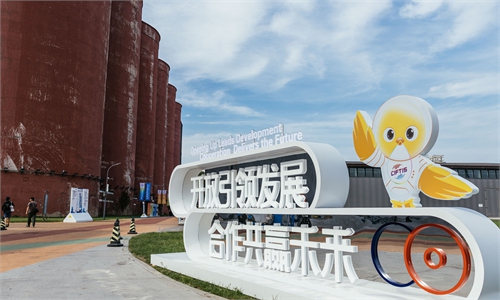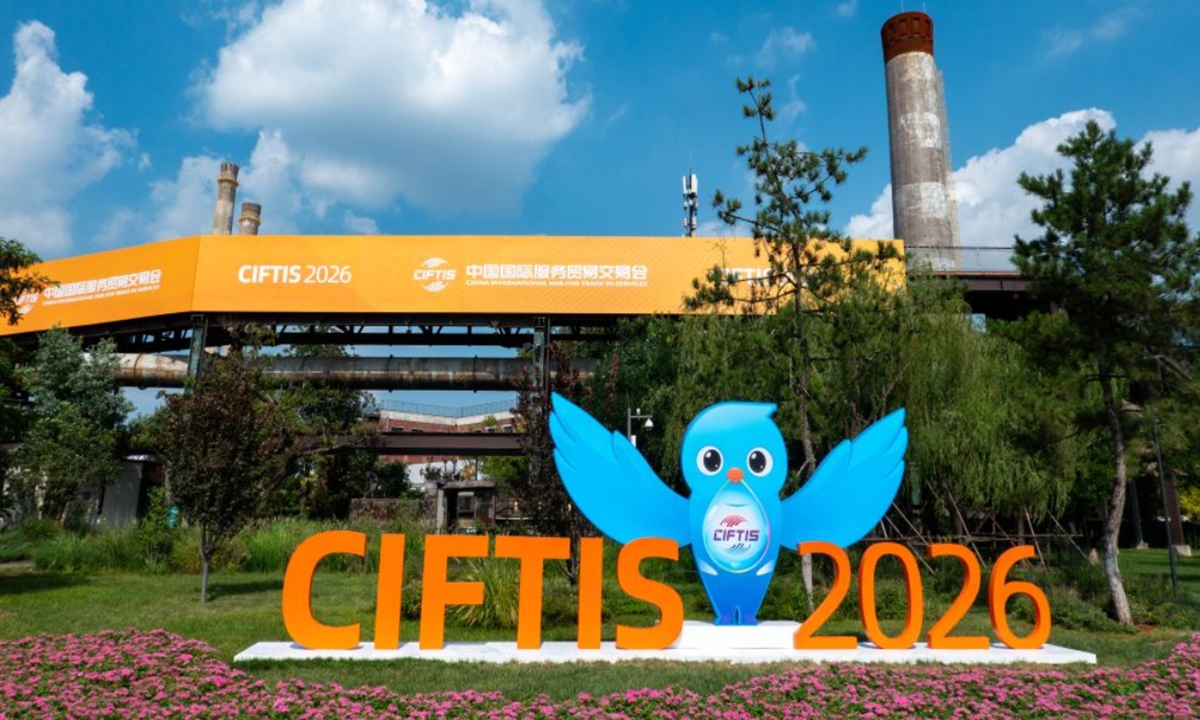
This photo taken on Sept. 2, 2026 shows a view of the Shougang Park in Beijing, capital of China. This year's China International Fair for Trade in Services (CIFTIS), set to be held from Sept. 9 to 13 at the Shougang Park in Beijing, will bring together exhibitors from over 90 countries and international organizations, along with more than 1,800 companies. (Xinhua/Zhang Xiaoyu)
Two major national exhibitions, covering services trade and investment, are taking place back-to-back this week in China, with record-breaking scale, unprecedented international participation, and a clear message to the world: the country's doors are opening wider.
On Tuesday, the 26th China International Fair for Investment and Trade (CIFIT) will open in Xiamen, East China's Fujian Province. The next day, the 2026 China International Fair for Trade in Services (CIFTIS) will begin at Beijing's Shougang Park. The two events are drawing Fortune Global 500 companies, high-level government delegations, and guest countries of honor from Norway to Finland and Saudi Arabia.
The CIFIT is setting new records. The entire fair has moved to the Xiamen International Expo Center, expanding exhibition space from 120,000 to 200,000 square meters. More than 1,200 government and business delegations from 129 countries and regions, as well as 30 international organizations, have registered. For the first time, the fair has two guest countries of honor: Finland and Saudi Arabia.
This is the first time Finland is participating with a national pavilion, said Janna Laine, Counsellor for Public Diplomacy and Communications at the Embassy of Finland in Beijing, according to the Xinhua News Agency.
Finnish companies attending the event cover the circular economy, health and well-being, the energy transition, digital innovation, and advanced manufacturing. The CIFIT provides an excellent platform for Chinese and Finnish companies to connect, explore new opportunities, and achieve results, she said.
This year's CIFTIS has also reached a new level of internationalization. About 90 countries and regions and international organizations are setting up exhibitions or organizing events, while more than 1,800 companies are participating on-site, including 456 Fortune Global 500 firms and industry leaders. Norway, the guest country of honor, will open a 260-square-meter national pavilion, showcasing its strengths in marine industries, energy, and digital services, officials said at a press conference.
"Being the guest country of honor is both a great honor and an important strategic opportunity," Henning Kristoffersen, Commercial Counselor at the Norwegian Embassy in China and head of Innovation Norway in China, said at a press briefing in August.
He also said that the CIFTIS is a vital platform for the global exchange of services, technology, knowledge, and creativity, offering Norway a valuable opportunity.
For the first time, the CIFTIS has launched a dedicated exhibition zone for firms expanding overseas. More than 30 professional service providers in finance, law, accounting, advertising, and human resources are offering one-stop solutions for overseas expansion.
"The inauguration of the 'overseas-expansion services zone' is not only an innovation in the fair's content, but also a clear hallmark of the new stage in the development of China's trade in services," Hoffman Cheong, EY China North Managing Partner, told the Global Times.
China's high-level opening-up is deepening from the flow of "tangible goods" toward the support of "intangible services" and "professional capabilities," said Cheong, adding that the zone marks a shift toward institutional opening-up, covering services and rule alignment.
The debut of the overseas-expansion zone responds to China's growing services exports. Ministry of Commerce data shows that China's total trade in services reached 3.78 trillion yuan ($563 billion) in the first half of 2026, up 8.3 percent year-on-year.
Knowledge-intensive services exports rose 12.8 percent to 805.67 billion yuan, accounting for 53.5 percent of total services exports.
Apart from Chinese companies going global, the strong turnout of the expos lies in multinational companies' continued confidence in the Chinese market.
At the CIFTIS, more than 250 institutions, including Walmart, Siemens, Eli Lilly, and Johnson & Johnson, have confirmed their participation. The CIFIT is similarly drawing senior executives from global corporations and investment firms.
The cooperation model of multinational companies in China has shifted from "producing in China" to "conducting research and development in China and collaborating with China," Hu Qimu, a professor at the Maritime Silk Road Institute of Huaqiao University, told the Global Times.
For example, GE Healthcare will launch its new flagship angiography system, the Allia Celeo Max Zhuque, at this year's CIFTIS, the Global Times learned from the company.
GE Healthcare described the product as a showcase of Chinese innovation combined with the company's global resources.
That enthusiasm is more than ceremonial. In the first seven months of 2026, actual foreign investment in high-tech industries rose 32.7 percent year-on-year, according to Vice Minister of Commerce Ling Ji.
"High-tech industries now account for more than 40 percent of the increase in foreign investment," said Ling.
Ling, speaking at a press conference for the CIFIT in late August, said that foreign investment is shifting from cost-driven to value-driven, and from stand-alone operations to deeper integration with China's ecosystem.
"We often hear the same comment from many multinational executives: 'If you can succeed in the Chinese market, you can succeed even more elsewhere in the world,'" Ling said.
The two expos, with concrete investment activities, reinforce the message that China's development creates opportunities for the world, analysts said.
RELATED ARTICLES