China’s foreign trade expands 17.6% in Jan-Aug
Import growth outpaces export growth for sixth consecutive month: GAC
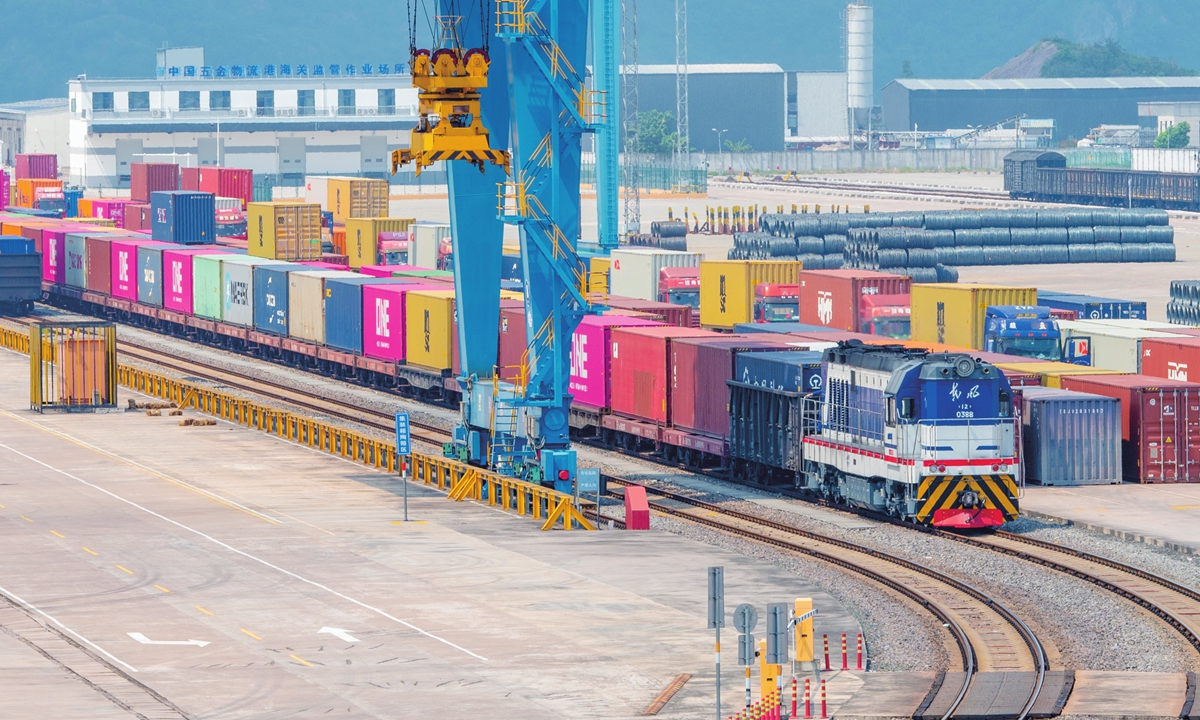
A sea-rail intermodal freight train loaded with hardware products departed from Yongkang East Station on September 8, 2026, bound for Ningbo-Zhoushan Port. Photo: VCG
In the first eight months, China's foreign trade expanded 17.6 percent to 34.78 trillion yuan ($5.13 trillion), sustaining a double-digit growth momentum and highlighting the country's resilience despite a sluggish global trade recovery and geopolitical conflicts disrupting global industrial and supply chains.
From January to August, exports reached 20.17 trillion yuan, up 14.6 percent year-on-year, while imports stood at 14.61 trillion yuan, rising 22 percent. In August alone, foreign trade grew 19.8 percent, with import growth outpacing export growth for the sixth consecutive month, data from China's General Administration of Customs (GAC) showed on Tuesday.
Lü Daliang, director of the GAC's Department of Statistics and Analysis, said that China's goods trade maintained steady growth momentum in August. In terms of scale, the country's foreign trade value exceeded 4.5 trillion yuan for three consecutive months. In terms of growth rate, both exports and imports have registered double-digit year-on-year growth for four straight months.
These figures, he noted, fully demonstrate the resilience of China's complete industrial system in underpinning foreign trade, as well as the strong impetus of technological innovation in boosting trade performance.
Meanwhile, as the year-on-year growth rate of imports has outpaced that of exports for six consecutive months, China's super-large market has provided and will continue to provide vast opportunities for exporters from all over the world, Chinese analysts noted.
Improved structure with AI boom
Due to the rapid development of the global artificial intelligence (AI) industry, China's integrated circuit (IC) imports and exports both registered year-on-year growth during the period. High-value-added products have become a key driver of China's foreign trade, underscoring the country's continued progress in manufacturing transformation and upgrading, Chinese experts said.
According to the GAC data, China's IC exports for the January-August period totaled $256.75 billion, up 103.9 percent year-on-year, while imports recorded an increase of 61.7 percent. Exports of automatic data processing equipment and their parts also surged 49.4 percent year-on-year.
"As advances in large language model technology and the development of AI agents accelerate, global demand for computing power and storage is expanding rapidly. This is driving growth across the overall IC market and, in turn, significantly boosting China's exports and imports of related products," Hu Qimu, a professor at the Maritime Silk Road Institute of Huaqiao University told the Global Times on Tuesday.
Xiang Ligang, a veteran telecom and tech policy observer, highlighted two major advantages in the country's IC industry.
"The first is strong infrastructure-building capacity: the continued expansion of domestic fabs in recent years has made the IC supply chain increasingly complete, laying a solid foundation for the sector's growth. The second is technological advancement: more advanced process technologies have lowered production costs and sharpened China's international competitiveness," Xiang told the Global Times.
The performance of the IC sector mirrors China's continuous upgrading of its foreign trade structure, with intelligent manufacturing accelerating its global expansion and high-value-added products now leading the country's export growth.
According to the official data, in the first eight months, exports of mechanical and electrical products reached 12.91 trillion yuan, up 21.9 percent, accounting for 64 percent of China's total exports during the period. This marked the 18th consecutive month of growth.
During the period, high-tech product exports surged 42.9 percent, while automobiles, industrial robots and ships saw exports jump 47.1 percent, 13 percent and 29.8 percent, respectively.
"Progress in the transformation and upgrading of domestic manufacturing continues to drive exports of new-energy vehicles and high-tech products," Feng Lin, executive director of research at Orient Golden Credit Rating, told the Global Times on Tuesday.
Hu said the figures reflect that emerging pillar industries have now reached a scale capable of supporting the national economy, with the international competitiveness of high-end manufacturing continuing to strengthen.
"Against the backdrop of intensifying trade protectionism and geopolitical disruptions that are challenging global supply chains, China continues to uphold the stability of global markets and the smooth functioning of industrial chains through its reliable supply capacity, marked by clear advantages in both quality and price, thereby making an important contribution to global economic growth," Hu noted.
Open market
The stellar performance of China's foreign trade also reflects the positive interplay between its vast domestic demand and its growing export strengths, analysts noted.
According to the GAC, China's imports of mechanical and electrical products rose 31.6 percent from January to August, while agricultural imports increased 6.6 percent. Meanwhile, the country recorded growth in both exports and imports with 112 countries and regions, up 17 from the same period last year.
"China remains committed to building a modern industrial system through open cooperation, and an increasing number of foreign-invested enterprises have been deeply integrated into China's industrial and innovation chains," Lü, the GAC official, said.
In the first eight months of this year, nearly 80,000 foreign-invested enterprises were engaged in foreign trade, and their import and export growth continued to outpace that of other types of business entities, according to Lü.
Some Western media outlets remain fixated on the issue of trade imbalances. For instance, The Wall Street Journal reported that "the surge in overseas shipments could fuel tensions over imbalances with trading partners."
Hu said that the trade surplus stems from industrial competitiveness and market mechanisms, not subsidies, noting that China has stepped up imports in its economic and trade exchanges with major surplus-source countries to promote more balanced bilateral trade, which is a reflection of its sense of responsibility as a major country.
On one hand, China's domestic industrial upgrading has driven up demand for imports of components, semiconductors, and energy and mineral resources. On the other hand, the country has continued to widen market access.
The GAC had said in July that during the 15th Five-Year Plan period (2026-30), it will work to make imports and exports more balanced, sign more trade cooperation agreements, and expand imports of advanced technology equipment, key components, energy and mineral resources, as well as quality agricultural products, while diversifying their sources. "These efforts aim to facilitate the export of quality global products to China, share the opportunities of China's vast market, and provide Chinese consumers with a wider range of choices," it noted.
Hu noted that some Western media outlets have repeatedly hyped the issue of trade imbalances, willfully ignoring the fact that China has been steadily expanding its imports and turning a blind eye to the reality that foreign-invested enterprises are reaping handsome profits in China and have become deeply integrated into its industrial chains.
Their aim is to repackage their own internal anxieties including the loss of industrial competitiveness and the rising costs of green transition into a "security threat" narrative, thereby lending credibility to protectionist policies. "This selective narrative, however, ultimately undermines global supply chain stability and the multilateral trading order," the expert warned.
China's central bank also pushed back against the narrative on global economic imbalances during the G20 meeting. Pan Gongsheng, governor of the People's Bank of China (PBC), said at the G20 Finance Ministers and Central Bank Governors Meeting held from August 31- September 1 in the US that trade frictions and protectionism weigh on the global economy by disrupting supply chains, fueling inflation and unsettling market expectations, the PBC said in a statement on September 2.
Pan noted that China has never deliberately pursued a trade surplus and remains committed to expanding domestic demand and advancing high-level opening-up. China will leverage its vast market to provide new opportunities for all parties and contribute to a new dynamic balance in the global economy, the official said.
RELATED ARTICLES