Robust trade, industrial upgrading anchor China's resilient economic growth
Chinese economy defies global headwinds with upgraded IMF growth outlook
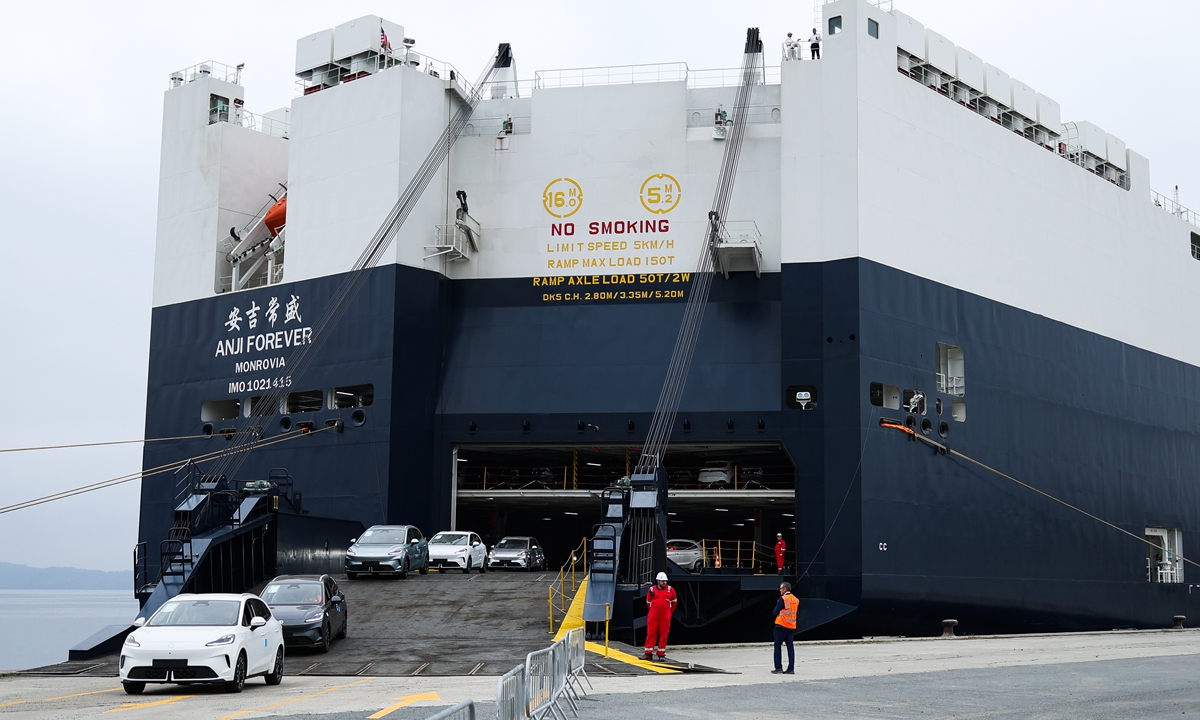
The SAIC Motor vessel during the official and institutional reception ceremony for the first car carrier belonging to the Chinese automotive giant SAIC Motor, on 9 July 2026, in Ferrol, A Coruna, Galicia, Spain. Photo: VCG
Amid continued shocks to the global economy from geopolitical conflicts, rising energy prices and trade fragmentation, the International Monetary Fund (IMF) on Wednesday local time lowered its 2026 global growth forecast to 3.0 percent, while raising China's growth forecast from 4.4 percent to 4.6 percent for 2026 and from 4.0 percent to 4.1 percent for 2027, one of the few major economies to receive an upward revision.
The contrast between the downgraded global outlook and the upgraded forecast for China has drawn widespread attention. China is set to release data on its economic performance in the first half of 2026 next week. Ahead of the release, a range of recently published indicators—including industrial production, port throughput, foreign trade and energy data—have pointed to an economy advancing despite mounting pressure while shifting toward new growth drivers.
Against a backdrop of rising global uncertainty, the resilience of the Chinese economy is not only laying a solid foundation for meeting the country's full-year development targets but also providing much-needed stability to the world economy, Chinese experts said.
Indicators underscore resilience
The IMF said China's economy expanded faster than expected in the first quarter of 2026, driven by front-loaded public infrastructure investment, a surge in high-tech manufacturing and stronger exports, even as domestic consumption remained soft.
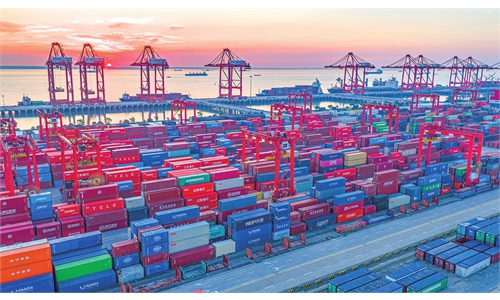
That resilience is visible at China's major ports, where rising container throughput points to sustained foreign-trade activity. In the first half of the year, the Port of Guangzhou handled 347 million tons of cargo and 14.16 million twenty-foot equivalent units (TEUs), ranking fifth and sixth globally, respectively. Guangzhou port authorities told the Global Times on Thursday that its foreign-trade cargo throughput rose 5.84 percent year-on-year, while foreign-trade container throughput increased 12.28 percent. During the same period, the Port of Tianjin recorded growth of more than 2 percent in cargo throughput and more than 6 percent in container throughput.
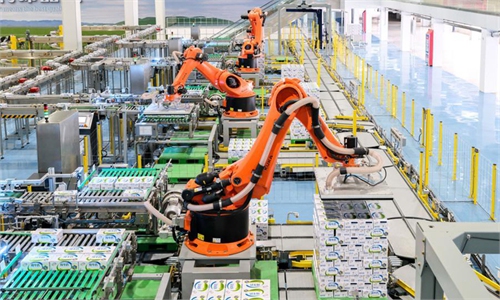
Behind the busy ports is a manufacturing sector increasingly driven by new technologies that are reshaping industrial demand. National Bureau of Statistics (NBS) data released on Thursday showed that China's PPI rose 4.1 percent year-on-year in June.
"Accelerated industrial upgrading has boosted demand in some sectors and driven prices higher," said Dong Lijuan, chief statistician at the NBS' Urban Division. As artificial intelligence (AI) applications expanded and the use of new materials and green technologies accelerated, prices in virtual-reality equipment manufacturing rose 8.4 percent month-on-month, while those for wearable smart devices increased 3.4 percent.
Bian Yongzu, a financial expert and executive deputy editor-in-chief of Modernization of Management magazine, said the broader PPI increase was mainly driven by mining prices, supported by seasonal coal demand and growing AI-related demand for metals such as copper and silver.
Robust energy supply capacity provides a solid foundation for stable economic growth. China's installed power capacity reached 4.01 billion kilowatts by the end of May, up 11 percent year-on-year, with non-fossil energy accounting for 62 percent, the National Energy Administration said in June.
Zhou Mi, a researcher at the Chinese Academy of International Trade and Economic Cooperation under the Ministry of Commerce, told the Global Times that the IMF's upward revision of China's growth forecast was first driven by the country's actual economic performance.
"Steady growth in China's trade has boosted confidence among various parties, as connecting with China means connecting with greater certainty. The first-quarter economic performance also shows that the Chinese government has the ability to achieve its annual growth target set at the beginning of the year. Meanwhile, China's strong innovation momentum is expected to create new growth potential and drive innovative development in international economic and trade cooperation," Zhou said.
Yu Xiang, an economic researcher at the Institute of American Studies under the Chinese Academy of Social Sciences, told the Global Times that China's economic resilience is reflected not only in its growth rate, but also in continued industrial upgrading, stronger innovation capabilities, and its ability to maintain stable production, trade and supply chains amid external shocks.
Providing certainty for global economy
In contrast to the upgrade for China, the IMF struck a less upbeat note on several other major economies. It lowered its 2026 growth forecast for the Eurozone from 1.1 percent in April to 0.9 percent and cut Japan's outlook by 0.1 percentage points to 0.6 percent. The forecast for the US was left unchanged at 2.3 percent.
The Associated Press noted that, despite headwinds from higher energy prices and the property downturn, China's economy was receiving "offsetting help from public works spending, a surge in high-tech manufacturing and booming exports."
Yu said the IMF's modest downgrade to its 2026 global growth forecast, along with cuts to the outlooks for several economies and regions, mainly reflected the impact of the Middle East conflict, which has driven up energy, food and transportation costs, intensified inflationary pressures and made it more difficult for central banks to ease monetary policy. Meanwhile, trade fragmentation, tariff-related headwinds, supply-chain restructuring and policy uncertainty continue to weigh on global investment and trade.
"China serves as a key stabilizer of global growth, provides vital support for global industrial and supply chains, and acts as an important source of global demand and structural transformation," Yu said.
"The resilience of China's high-tech manufacturing and exports supports the global technology cycle, manufacturing supply networks and goods supplies," Yu said. As China expands domestic demand, advances industrial upgrading, and develops green technologies and the digital economy, it is not only providing manufacturing capacity to the world but also creating new room for global trade, investment and technology diffusion, he said.
The World Bank on Tuesday released its latest China Economic Update in Beijing, saying that China's economic growth has remained resilient despite supply-demand imbalances and global energy supply disruptions.
The report noted that China's economy was supported by strong high-tech investment and exports in early 2026, adding that policy support, high-tech investment and buffers against global energy supply disruptions partly offset weaker domestic demand in the second quarter.
Standard Chartered said in its 2026 second-half global market outlook, released on June 30, that it remained bullish on China's technology and communication services sectors and recommended that global investors maintain an "overweight" position in Chinese equities.
"Chinese equities remain attractively valued," said Liang Dawei, general manager of the Wealth Solutions Department at Standard Chartered, adding that China is keeping pace with advances in artificial intelligence, while its renewable-energy transition and ample power capacity provide a key advantage in supporting energy-intensive data centers and competing in the global AI race.
At a time of slowing global growth, renewed inflationary pressure and mounting geopolitical risks, China's vast market, manufacturing strength and technological upgrading are providing much-needed certainty for global trade, investment and supply chains, Bian said.
RELATED ARTICLES