ARTS / CULTURE & LEISURE
AI joins the puzzle: Matching oracle bones and porcelain shards to reconstruct ancient history
AI accelerates research into oracle bones, ancient porcelain
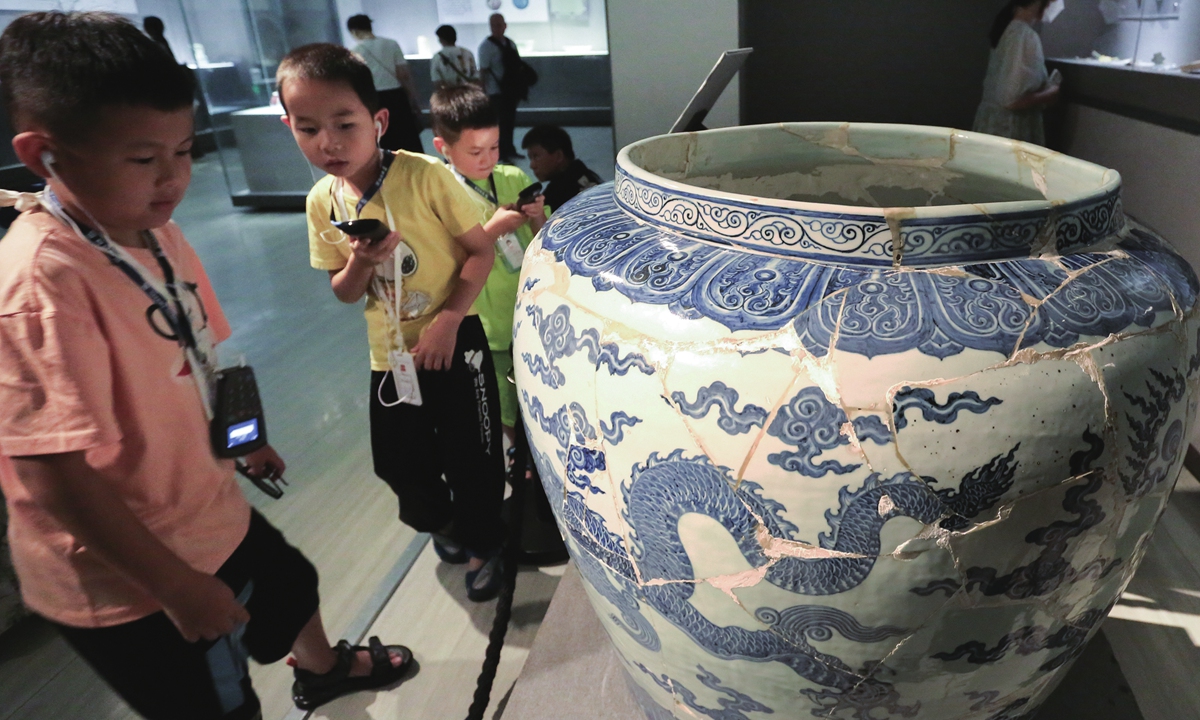
Children look at a fully restored Ming Dynasty "blue-and-white large dragon vat" at the China Ceramics Museum in Jingdezhen, Jiangxi Province, on July 11, 2024. Photos on this page: VCG
A record of a solar eclipse from the Shang Dynasty (c.1600BC-1046BC) has been discovered among a set of oracle bones that had been pieced together. "The inscription uses the extremely rare phrase 'eclipse of the sun,' referring specifically to a partial solar eclipse," Mo Bofeng, a professor at the Center for Oracle Bone Studies, Capital Normal University (CNU), told the Global Times on Monday.The discovery suggests that as early as the Shang Dynasty, ancient Chinese astronomers were able to distinguish among different types of solar eclipses, including total, annular and partial eclipses.
"This finding fundamentally changes our understanding of the level of astronomical observation achieved during the Shang Dynasty," Mo noted.
For decades, research of cultural relic fragments scattered across the passage of time have largely relied on painstaking manual comparison and reconstruction, a process that is both time-consuming and labor-intensive, while also carrying the risk of causing further damage to fragile artifacts.
Now, artificial intelligence (AI) is offering a new solution to the ancient puzzle of piecing cultural relics back together. From oracle bone fragments scattered around the world to millions of fragments of ancient porcelain unearthed in Jingdezhen, East China's Jiangxi Province, AI is accelerating efforts to restore fragmented traces of past civilizations, opening up new technological pathways for the preservation of cultural heritage.
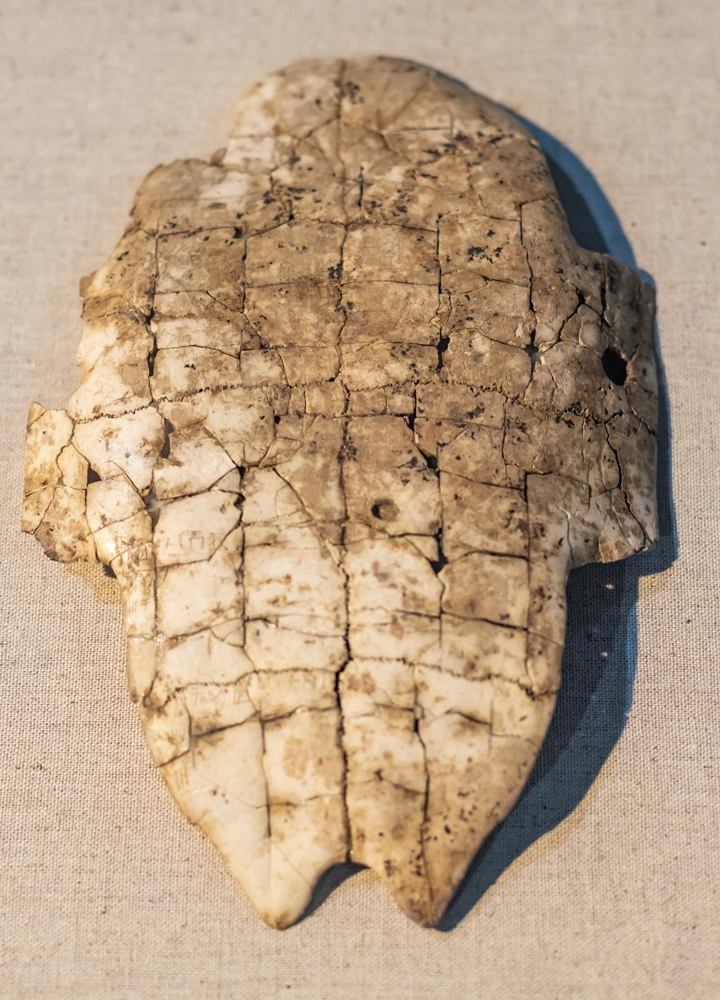
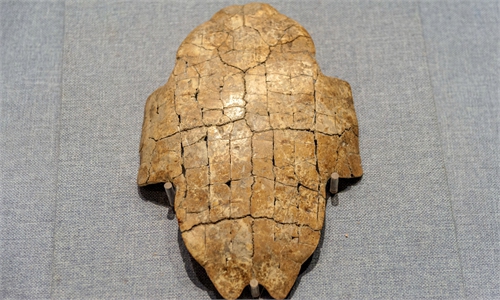
An oracle bone inscription from the Shang Dynasty Photos on this page: VCG
Complimentary approachOracle bone inscriptions, or Jiaguwen, are an ancient Chinese script inscribed on tortoise shells and animal bones. A primitive form of Chinese characters, they are the oldest fully-developed characters discovered in China to date.
There may be as many as 160,000 oracle bone fragments scattered around the world today. For human experts seeking to decipher the inscriptions on them, the first step is to "join" the fragments together, according to Mo. It's much like putting together a jigsaw puzzle. But unlike a normal puzzle, there is no reference picture, and the number of pieces is virtually limitless. You have to painstakingly piece together scattered fragments, bit by bit, to reconstruct the original, said the professor.
One of the challenges in the reconstruction process is the psychological strain caused by uncertainty, Mo said. "Unlike a jigsaw puzzle, where every piece has a matching counterpart somewhere in the box, most oracle bone fragments cannot be successfully joined with any other piece. Researchers therefore have to be prepared to invest enormous amounts of time and effort only to end up empty-handed."
In the past, the work relied entirely on scholars' experience and manual effort. "Comparing fragments one by one with the naked eye is extremely slow. Even top scholars in the field would consider it highly productive to 'join' several dozen fragments in a year," Mo said.
The center at CNU has already reconstructed more than 1,500 groups of oracle bone fragments, and the recent application of AI has further accelerated the process.
The AI-assisted approach to reconstructing oracle bone fragments is highly complementary to the methods used by human experts. Human researchers primarily start with the inscriptions themselves, using linguistic clues to predict which other fragments might fit together, he told the Global Times.
AI can reconstruct fragments based purely on distinctive features along their edges, something that is extremely difficult for humans to do, Mo said.
World's first database
Meanwhile at the Jingdezhen Imperial Kiln Institute, with AI-powered matching and genetic database archiving, technology could help bring porcelain fragments scattered for centuries back together.
Known as the "porcelain capital" of China, Jingdezhen has produced ceramics for over 1,700 years. Beneath the city's famed masterpieces lie layers of broken fragments several meters thick - flawed imperial ceramics and damaged folk products. To date, nearly 20 million shards have been unearthed from the city's deep archaeological deposits, the Xinhua News Agency reported.
The dragon vat is a renowned type of porcelain once produced exclusively for the imperial court at the imperial kilns in Jingdezhen. It takes its name from the cloud-and-dragon motifs painted on its walls. Such large-scale porcelain vessels were exceptionally difficult to fire and subject to stringent quality standards, with only five out of every 100 pieces deemed acceptable.
Under the regulations of the time, all rejected and defective pieces had to be smashed and buried on site to prevent them from entering the private market. In the 38 years since fragments of dragon vats were first discovered, cultural heritage workers have managed to restore only three complete vessels.
AI is helping with the most difficult aspect of the restoration process, identifying the correct shards from a massive collection for matching, said Weng Yanjun, director of the institute.
Beyond matching broken fragments, AI can also be used to identify decorative patterns and assist in drawing archaeological line illustrations. The institute is also working with Fudan University on research into an automated porcelain-fragment sorting system combining robots and AI, in an effort to address the labor-intensive nature of traditional sorting methods.
The data for AI intelligent matching comes from the world's first ancient ceramics database, established by the institute in collaboration with other renowned academies in 2022.
Based on 12,000 specimens from the 20 million porcelain fragments unearthed in Jingdezhen, the data encompasses shape, decoration, body material, glaze, color, firing marks and inscriptions, as well as extended information including comparable collections in major museums worldwide, relevant archaeological discoveries at home and abroad, and modern academic research findings, offering a platform for global researchers, Xinhua reported. AI has become a new partner in a painstaking process that has long depended on patience, experience and intuition. As algorithms learn to recognize patterns and match fragments, pieces of history could find their way back together sooner.
RELATED ARTICLES