Chinese expert warns political intervention harms US automakers’ competitiveness as US administration criticizes Ford over China ties
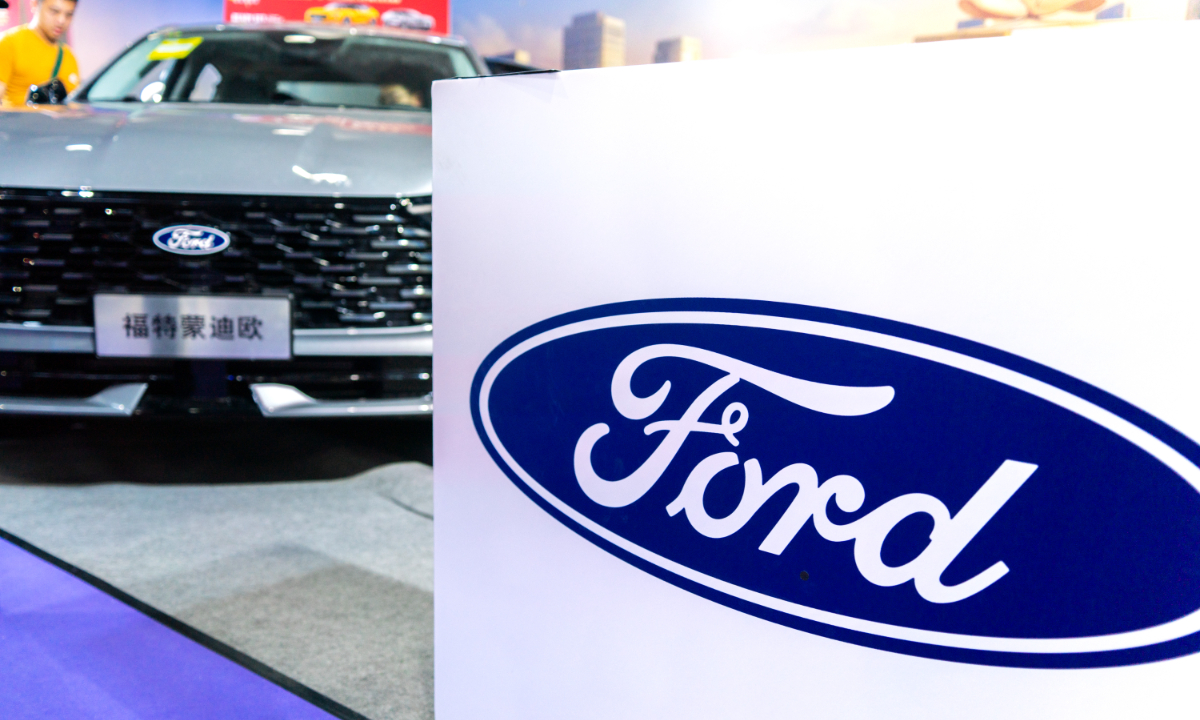
A Ford logo is displayed above the automaker's booth at an international auto show in Guangzhou on May 1, 2026. Photo: VCG
The US administration on Tuesday criticized Ford Motor over its ties with Chinese companies, with Washington's political intervention reaching deeper into technology licensing, supply chains and routine commercial cooperation between companies in the two countries. Analysts said the move could ultimately constrain US automakers themselves, which are under pressure to cut electrification costs and keep pace with a fast-changing global industry.
US Transportation Secretary Sean Duffy said in a letter to Ford CEO Jim Farley that the automaker's business relationships with CATL, Geely and BYD raised "profound concern," urging Ford to cut ties with major Chinese companies, Reuters reported.
Duffy claimed that the Department of Transportation (USDOT) was "deeply alarmed" by Ford's reliance on licensed CATL technology at its battery plant in Marshall, Michigan. He also criticized Ford for not planning to move production of the Lincoln Nautilus from China to the US until 2030, and questioned Farley's reported January proposal to facilitate Chinese joint ventures on US soil.
Ford pushed back, calling Duffy's letter "a wrongheaded attempt to capture headlines." In a statement, the company said that while other automakers were increasingly relying on imports of foreign-made vehicles, Ford was "doubling down on America." Ford said that its CATL deal is a limited technology-licensing and services agreement, not a joint venture. Ford owns and controls the Michigan plant and employs its workforce.
The partnerships cited by the USDOT head vary widely in form and geography, from technology licensing in the US to manufacturing cooperation in Europe and potential battery sourcing overseas. Treating them all as "national-security threats" stretches the security argument and risks politicizing routine business decisions, analysts said.
Rather than simply pointing to "reliance on China," the partnerships show Ford drawing on China's strengths in battery technology, supply-chain efficiency and product development to stay competitive in the US, Europe and other major markets, Zhang Xiang, secretary-general of the International Intelligent Vehicle Engineering Association, told the Global Times on Wednesday.
Ford's Michigan battery plant is Ford-owned but uses licensed lithium iron phosphate, or LFP, technology from CATL, as this battery type carries relatively lower costs.
Its cooperation with Geely is centered in Europe, where the two companies announced in July plans for a manufacturing joint venture at Ford's Valencia plant in Spain. Ford said the partnership would help maximize the plant's capacity and cut manufacturing costs amid fierce global competition and mounting cost pressures.
Ford has also held talks with BYD over batteries for hybrid vehicles, with one option involving the use of BYD batteries in markets outside the US, Reuters reported, saying a potential deal would give Ford access to cheaper batteries and advanced technology from one of China's largest electric-vehicle makers.
Such cooperation reflects both the global nature of the auto industry and Ford's need to strengthen its position in electrification. Zhang said. "Chinese battery makers such as CATL and BYD have built strong advantages in technology, scale and cost control, while Ford faces intense competition from Tesla and other automakers," he noted.
For Ford, working with globally competitive suppliers is a practical way to shorten development cycles and improve competitiveness, Zhang added.
Pressures are already evident in Ford's financial performance. Its fourth-quarter core profit fell about 50 percent to $1 billion, as higher-than-expected costs weighed on earnings. Nevertheless, CEO Jim Farley said that the automaker was cutting costs and working to produce more globally competitive models.
The strain is even more pronounced in Ford's EV business. Its electric-vehicle and software unit lost about $4.8 billion in 2025, and Ford expects another $4 billion to $4.5 billion in losses from the business this year.
As one of America's biggest automakers, Ford is deeply tied to the US manufacturing base, Zhang said. "Washington's push to revive domestic manufacturing is increasingly at odds with its efforts to restrict Ford's access to globally competitive technologies and supply chains."
If administrative restrictions make it harder for Ford to access advanced EV technologies and efficient supply-chain resources, they could weaken the company's competitiveness and, in turn, impact US auto manufacturing, jobs and industrial resilience, the expert warned.
Duffy's intervention comes amid a broader tightening of US restrictions on China's auto sector. Washington has maintained additional tariffs of 100 percent on Chinese EVs, while a US Commerce Department rule bars certain China-linked connected-vehicle software from model year 2027 and related hardware from model year 2030.
China has repeatedly rejected such measures. Responding to the US connected-vehicle restrictions, a Chinese Foreign Ministry spokesperson said previously that the restrictions lacked any factual basis, disrupts economic and commercial cooperation between companies, violates the principle of market economy and fair competition, and is typical protectionism and economic coercion.
RELATED ARTICLES