Chinese experts urge EU to drop unilateral coercive demands over so-called ‘trade imbalance,’ seek solution via equal consultation
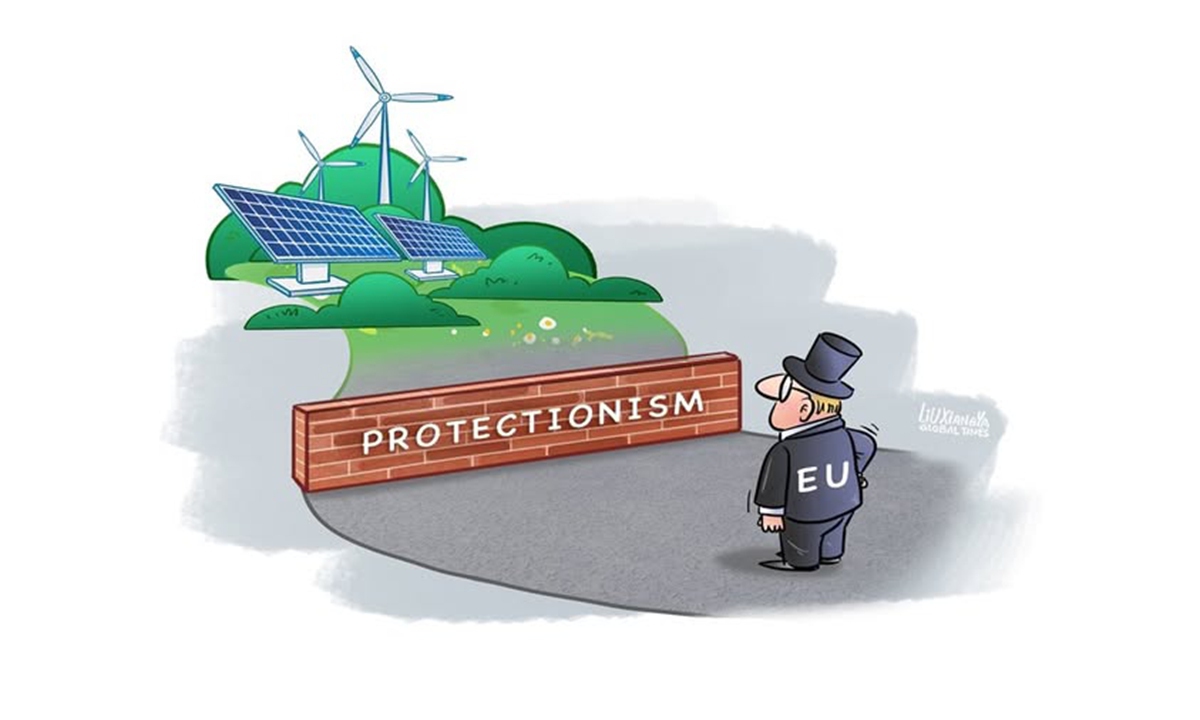
EU protectionism. Illustration: Liu Xiangya/GT
China-EU consultations must be conducted on the basis of equality, and wielding the big stick will not resolve the real problems facing a weakening European industry but will only damage China-EU mutual trust and undermine the possible outcomes of China-EU trade and investment consultation mechanism, Chinese experts said on Wednesday, urging the EU to objectively view the China-EU economic and trade relationship rather than shift the blame onto others.
The remarks came as the European Commission reportedly aims to seek commitments from China to work on tackling the so-called "trade imbalance" with the EU and for China to take some initial action by early October, citing European Trade Commissioner Maros Šefčovič.
Šefčovič said during an event organized by EU institutions that his priorities would be addressing the growing trade deficit, notably the surge of Chinese exports, removing barriers faced by the EU exports in China and securing clarity on Chinese exports of critical supplies, such as rare earths and legacy chips, Reuters reported on Tuesday.
"Equality is the precondition for China-EU negotiations. The EU's unilateral coercive demands will not help resolve the issues; on the contrary, they will seriously erode mutual trust between the two sides," Xin Hua, director of the Center for European Union Studies at Shanghai International Studies University, told the Global Times on Wednesday.
In June, China and the EU confirmed the official establishment of the China-EU trade and investment consultation mechanism as the two sides held the first meeting of the mechanism, according to a joint statement issued on June 30.
The two sides identified four initial workstreams under the mechanism, which include trade and investment balancing, export controls, intellectual property rights and WTO reform, the joint statement said.
Later, the two sides agreed to hold the second meeting of the China-EU trade and investment consultation mechanism this autumn, He Yadong, spokesperson for China's Ministry of Commerce, said at a regular press briefing in July.
China is willing to continue maintaining high-frequency communication with the EU, respect each other and work with the EU in the same direction, so as to explore practical and feasible solutions to each other's concerns in the economic and trade field, promote balanced and positive development of bilateral trade, and maintain the stability and balance of the key China-EU trading partnership, He Yadong said.
Citing the so-called "trade imbalance," the EU has recently rolled out a series of protectionist measures against China, including the EU's draft revision to its Cybersecurity Act and the proposed Industrial Accelerator Act.
"However, the EU's perception of the so-called 'imbalance' in China-EU trade, and the measures it has adopted and is seeking to adopt, are misguided. Far from genuinely 'rebalancing' bilateral trade, they will only aggravate economic and trade frictions between the two sides and even strain their overall relationship," Jian Junbo, director of the Center for China-Europe Relations at Fudan University's Institute of International Studies, told the Global Times.
The real solution lies in the EU enhancing the competitiveness of its own products. This requires Europe to demonstrate genuine resolve in pursuing technological innovation and channel more funding into enterprise R&D and innovation as well as talent cultivation, thereby maximizing the growth of its innovation capacity and boosting the competitiveness of its enterprises, Jian said.
Now that China has become the world's manufacturing hub, the more pragmatic course for Europe is to resolve differences and frictions through dialogue and consultation, keep China-EU economic and trade ties on a stable and healthy track, and deepen the interlocking of their industrial and supply chains so as to deliver shared prosperity, Jian said.
RELATED ARTICLES