China rejects US claim of AI distillation, blasting Washington for pursuing AI tech hegemony and computing power monopoly
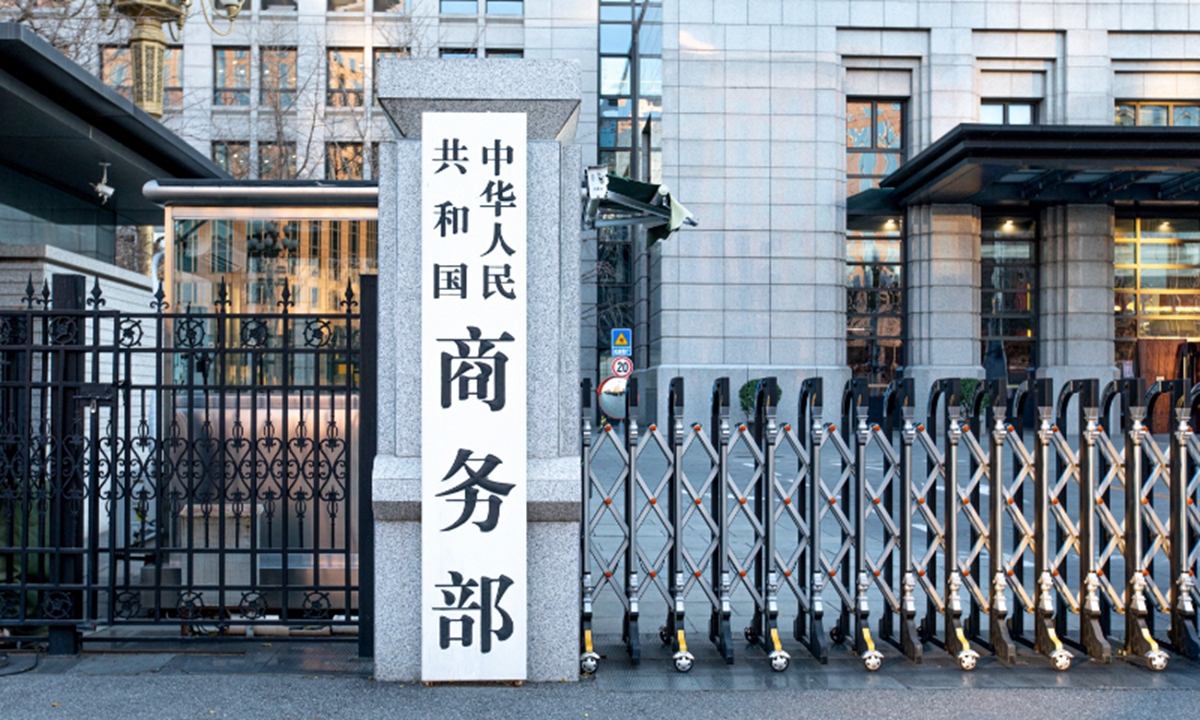
The Ministry of Commerce of China File photo: VCG
The US side's accusation of Chinese artificial intelligence (AI) firms of industrial-scale distillation against US AI models is groundless in fact and without basis in law, China's Ministry of Commerce (MOFCOM) said on Wednesday, stressing that the US move is politicizing and weaponizing distillation - a normal technical and commercial practice in the industry - and to apply double standards in practice.
"The relevant US statement is further proof that the US is pursuing technological hegemony in AI, seeking to monopolize computing power, and suppressing competition. China firmly opposes this," a MOFCOM spokesperson said in a statement on the ministry's website.
Distillation is a common practice through which AI models learn from one another. It is, in essence, a neutral technical means, and is used by model developers worldwide, including US companies. This technique can help models become more efficient at learning and enable more efficient use of human knowledge. It is of positive significance for all countries in developing their AI industries, unlocking the potential of AI technologies, closing the development gap, and bringing broader benefits to developing countries and the general public, the spokesperson said.
The US' move is a typical case of double standards. Where AI is concerned, China encourages open sourcing, openness, cooperation and sharing. China's open-source models are available to companies around the world, US companies included, facilitating the research and development of related models. R&D reports released by US companies have also disclosed that they have extensively distilled Chinese models. The US, by contrast, has repeatedly and unilaterally accused Chinese companies of conducting "industrial-scale" distillation, smearing an industry-wide practice as an act of attack. This reflects both US anxiety and its double standards, the spokesperson stressed.
The US' move is a typical case of using the pretext of cracking down on distillation to pursue industrial monopoly. By having security agencies issue the statement, the US is binding the interests of individual companies and capital to national security, and employing the apparatus of state power to interfere in normal commercial activities. We have noted that certain US AI companies are abusing their dominant market positions by including overly broad geographic restrictions and other unfair terms in their user agreements. The US distillation allegations appear calculated to justify such unfair terms, the spokesperson said.
The US move is a typical case of using state power to safeguard technological hegemony and a monopoly over computing power and to suppress competition. Since the beginning of this year, US executive and legislative bodies have repeatedly threatened sanctions and suppression against Chinese companies over alleged distillation. Their aim is to suppress competition and preserve US monopolies over computing power and data - a logic in which the US alone wins and humanity cannot win together. It seeks to turn global AI resources that should be openly and fairly accessible into the exclusive preserve of a handful of companies, and to prevent other countries from participating in the inclusive sharing of AI innovation outcomes.
At present, the large model industry is at a critical stage characterized by rapid technological iteration, emerging risks and ongoing growth. As major countries, China and the US should address the challenges and risks facing the AI sector with a positive and responsible attitude. The heads of state of the two countries have agreed to launch an intergovernmental dialogue on AI. China stands ready, on the principles of equality, mutual benefit and win-win cooperation, to engage in constructive and professional discussions with the US side through dialogue. Should the US, however, take actions to suppress Chinese AI companies under the pretext of countering distillation, China will resolutely take countermeasures in response. It is hoped that the US will work with China in the same direction, manage risks through dialogue and communication, and ensure that the AI industry benefits the whole world, the spokesperson said.
RELATED ARTICLES