China’s FAST puts together largest atlas of the universe’s gas bodies
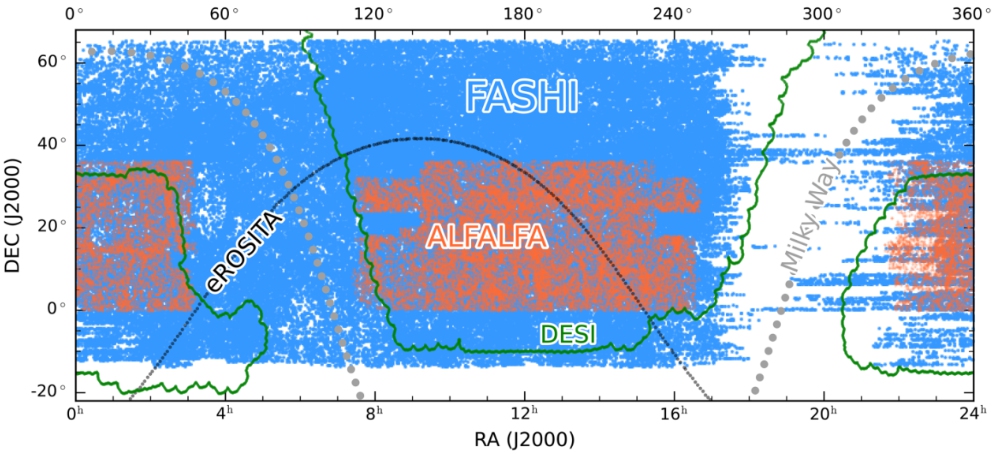
Photo: CCTV News
Over the course of two years of observations, the number of neutral hydrogen sources detected by China's Five-hundred-meter Aperture Spherical Radio Telescope (FAST) surged from 40,000 to 156,411 across nearly half of the entire sky, according to a report on the website of the National Astronomical Observatories (NAO) with the Chinese Academy of Sciences.Neutral hydrogen is the oldest and most fundamental form of matter in the universe - the "raw material" for stars, the "building blocks" of galaxies, and a "historical archive" recording the universe's journey from darkness to light. The 21-centimeter radiation emitted by neutral hydrogen has remarkable penetrating power, cutting through layers of interstellar dust to carry information about the universe's most primordial gas to Earth.
China's FAST is uniquely equipped for capturing this cosmic "beacon," the report said.
The latest data, dubbed FASHI DR2 and published as a cover story in the journal Science China Physics, Mechanics & Astronomy in September, shows that the sky coverage of neutral hydrogen sources surged from 7,600 square degrees to 19,500 square degrees, nearly half the entire sky, according to the report.
In just two years, FAST twice surpassed the record set by the ALFALFA survey conducted with the US Arecibo Telescope, which had dominated the field for nearly two decades, increasing the number of detected sources to five times the previous record, the report said.
The 156,411 galactic "identity cards" are expected to advance multiple frontier fields, including research into galaxy formation and evolution, dark matter distribution, and large-scale cosmic structures, said Zhang Chuanpeng, lead author of the study and an associate researcher at the NAO, as reported by the Xinhua News Agency.
Using the data, the research team has reliably extended the neutral hydrogen mass function down to galaxies of roughly 1 million solar masses and determined the local neutral hydrogen density with a statistical precision of 0.6 percent - the most accurate measurement to date, according to Xinhua.
In January 2024, the initial data, named DR1, set a world record with 41,741 detections. That first dataset has since been cited more than 100 times in scientific literature, and over 10 international research teams have expressed interest in collaborating on topics ranging from galaxy evolution and cosmology to large-scale structures, Xinhua reported.
The newly released data will be widely used in cutting-edge research on galaxy evolution, the large-scale structure of the universe, and the tracing of gravitational-wave sources. It will also provide an important reference benchmark for scientific research with the next generation of Square Kilometre Array radio telescopes, helping advance humanity's ongoing exploration of the mysteries of cosmic evolution.
Located in a naturally deep and round karst depression in Southwest China's Guizhou Province, FAST has a reception area equal to 30 standard football fields. The world's largest single-dish radio telescope, FAST was officially opened to the world in March 2021.
RELATED ARTICLES