ARTS / CULTURE & LEISURE
Chinese mythology games surge overseas, opening new doors to ancient stories
Trailer for new game draws 200m views in 7 days
Genigods: Nezha
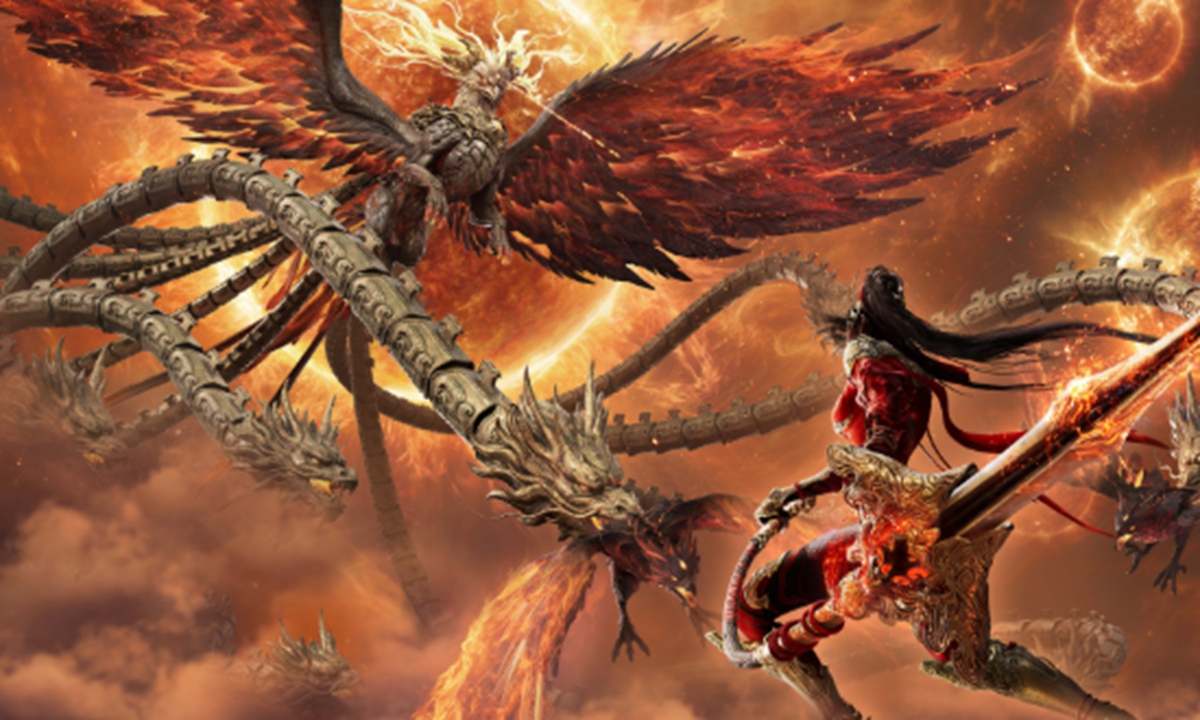
The latest trailer of Chinese third-person action role-playing game Genigods: Nezha has drawn more than 200 million views on overseas social media platforms in seven days since its release during Gamescom 2026, according to the Xinhua News Agency. The trailer has surpassed 6 million views on Chinese video-sharing platform Bilibili as of Wednesday.Genigods: Nezha begins with the Chinese myth of Nüwa creating humanity. In the game's setting, the first human created by Nüwa from clay later reincarnates as Nezha. Other figures from Chinese mythology, including Pangu, a primordial figure associated with the creation of the world in Chinese mythology, are also woven into the game's story.
Liu Yang, producer of the game, said that the team adopted this setting partly because of the relative unfamiliarity of Chinese creation myths among overseas players. The game seeks to first introduce players to the more familiar character Nezha before gradually leading them to the Chinese creation myths behind the character such as the story of Nüwa creating humanity.
The attention surrounding Genigods: Nezha is not an isolated case. In August, video game developer Game Science unveiled the first 15-minute gameplay demo of its new Black Myth title, Black Myth: Zhong Kui, offering the first look at the protagonist's combat moves and parts of the storyline. The new game replaces Wukong with Zhong Kui, a traditional figure in Chinese folklore known for subduing ghosts and demons. The demo quickly climbed trending lists and sparked widespread discussion after its release.
As more Chinese game developers draw inspiration from Chinese mythology, history and traditional culture, a broader and more diverse world of Chinese mythology games is taking shape.
This trend was particularly visible at this year's Gamescom. According to Xinhua, 60 Chinese companies took part in the event, a record high. In addition to Genigods: Nezha and Black Myth: Zhong Kui, Chinese gaming company miHoYo showcased its new title Nodusfall, whose fictional world combines elements from multiple mythological systems. Its trailer featured creatures such as the winged-tiger Qiongqi and the nine-tailed fox from The Classic of Mountains and Seas, an ancient Chinese text blending mythology, geography and folklore.
"Chinese games like these are expanding beyond a relatively concentrated group of cultural IPs (intellectual property) and drawing on a much broader range of mythology and traditional cultural resources," Chinese cultural scholar Wang Deyan told the Global Times on Wednesday.
Wang said that for game developers, bringing mythological figures into games is only the first step. How to help overseas players who are unfamiliar with Chinese mythology truly enter these stories is also becoming a consideration.
Liu Mengfei, a game researcher at the School of Arts and Communication at Beijing Normal University, told the Global Times that the key is not simply to present Chinese cultural symbols, but to turn cultural ideas into something players can experience through the game itself.
"Developers are no longer simply thinking about how to add Chinese architecture, clothing or mythological figures to a game. They are also considering how to further integrate these cultural elements into character settings, story progression and even game mechanics, so that players encounter and understand them through gameplay," she said.
Liu noted that one of the most fundamental differences between games and other forms of media is that games require audience participation.
"Unlike films and television, where audiences receive predetermined content, many outcomes in games have to be achieved through players' own actions. Through making active choices, players can understand the cultural logic and meaning behind a work," she said.
According to Liu, the complete process of "thinking - acting - experiencing the results" is something that other forms of cultural products are less able to provide, and this helps give games a distinctive capacity for cultural communication.
"What truly leaves an impression on players is not necessarily which Chinese mythological figure appears in a game, but also how players interact with that character and the world in which the character exists," she said.
In games built around Chinese mythology, overseas players may not always need prior knowledge of the mythology. They can encounter figures such as Zhong Kui and Nüwa, as well as creatures from The Classic of Mountains and Seas, through exploration, combat and story progression, gradually becoming familiar with the stories and traditions behind them.
RELATED ARTICLES