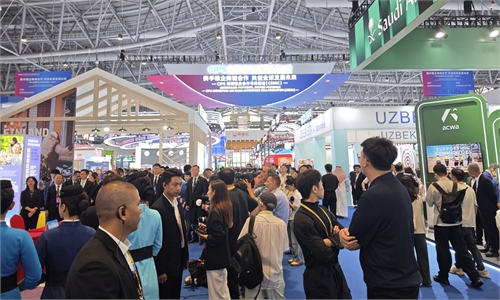
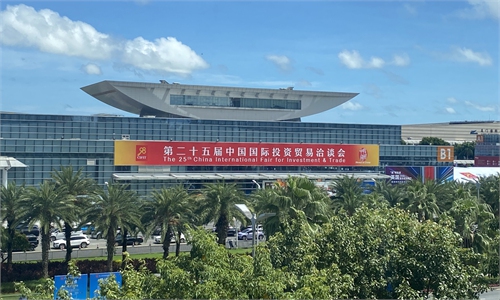
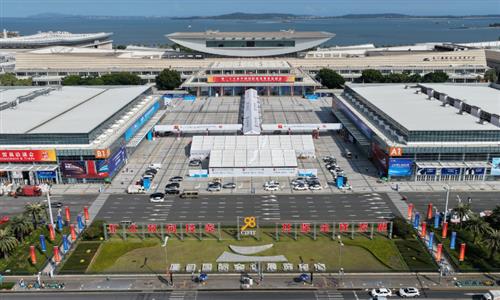
US businesses, local governments active at CIFIT, highlighting commitment to Chinese market
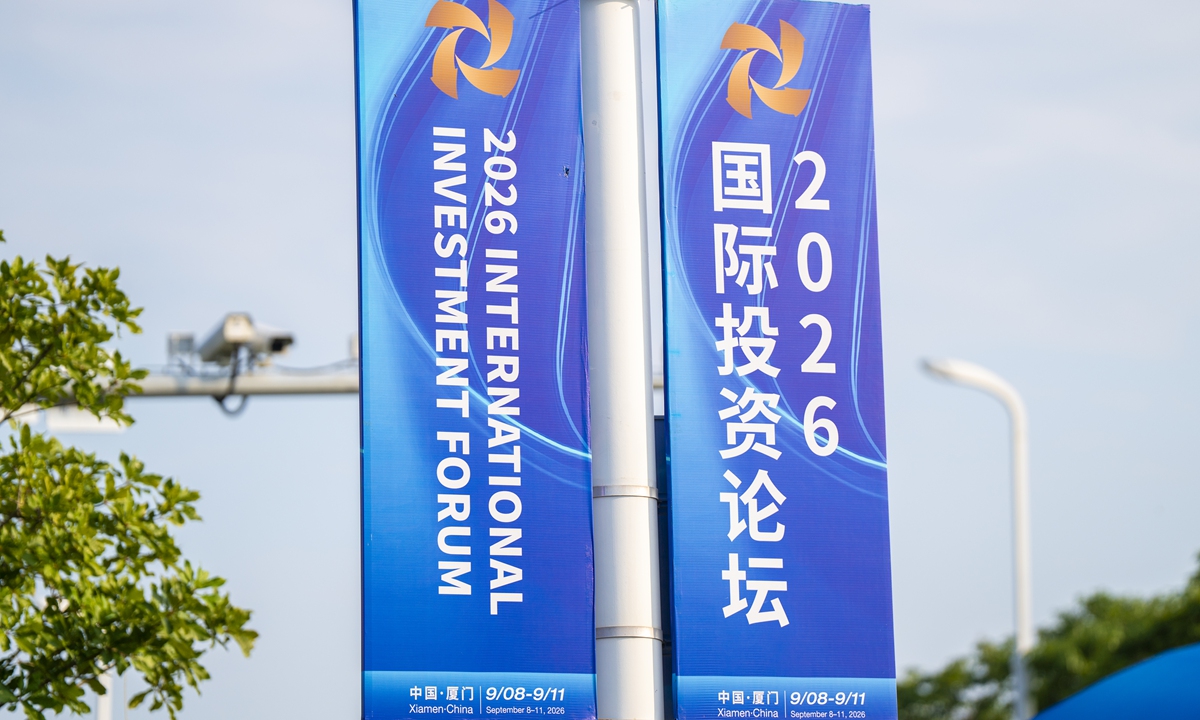
The 26th China International Fair for Investment and Trade kicked off on September 8, 2026 in Xiamen, East China's Fujian Province. Photo: VCG
Representatives of US local governments and businesses attending the ongoing China International Fair for Investment and Trade (CIFIT) in Xiamen, East China's Fujian Province, on Wednesday expressed continued interest in strengthening economic and investment cooperation with China.
From business representatives to officials from US states and counties, American participants at the fair said that maintaining engagement with China remains important for businesses and local economies, while platforms such as the CIFIT offer opportunities to identify investment projects, business partners and new areas of cooperation.
Notably, a delegation of more than 30 US companies attended this year's CIFIT, spanning sectors including sportswear, healthcare, food and beverages, and health and wellness products, the Global Times learned.
The US-China Business Council (USCBC) participates in the CIFIT every year, while this year's event marks Sean Stein's first time attending the fair since becoming president of the USCBC. Stein described the CIFIT as a very important platform for American businesses to learn about the latest developments in China.
"If we look at CIFIT over its 26-year history, it's more important now because the types of investment and trade deals that are happening today are very different from before," Stein told the Global Times at the CIFIT on Wednesday.
"Now, if a multinational — an American company, a European company or another company — comes to China, it's no longer looking for something as simple as cheap labor or just a large market. It's trying to identify where it should invest and, more importantly, who it should partner with and invest with," said Stein, noting "that becomes a much more strategic question than just where I should place a factory."
That shift has also increased the value of platforms that allow businesses to identify and compare potential partners and projects, according to Stein.
The continued search for investment opportunities is also reflected in the plans of US companies already operating in China.
According to the 2026 Special Report on the State of Business in South China released by the American Chamber of Commerce in South China (AmCham South China), 45 percent of companies surveyed ranked China as their top global investment priority, while 75 percent planned to reinvest in China in 2026.
Member companies of AmCham South China have earmarked an estimated $13.79 billion from profits in China for reinvestment over the next three to five years, while 95 percent reaffirmed their commitment to maintaining operations in China.
"These numbers are not just figures. They are a testament to confidence, resilience and long-term strategic vision," Harley Seyedin, president of AmCham South China, told the Global Times.
This year, the chamber brought more than 30 companies to the CIFIT to explore new investment opportunities. Over the past 23 years of attending the fair, the chamber has averaged more than $2 billion in new investments signed each year, according to Seyedin.
"I don't expect this year to be any different, and I think we're going to achieve similar numbers this year," he said, adding that member companies remain profitable and "not a single member company has left or decoupled from China."
"What we've done is that we have moved up the value chain. We're focused on producing higher-end goods and services in China for the Chinese market," Seyedin said.
Such corporate-level engagement is complemented by economic links between Chinese and US localities, another theme evident at this year's CIFIT.
Walter Chuck Jr., a commissioner of Lincoln County, Oregon, was among the members of a US government and business delegation attending the fair. Chuck told the Global Times on Wednesday that maintaining economic connections was an important purpose of the trip, his first to China.
"We're here to see if we can make some connections, foster better business and better relationships between Oregon and China, and make sure that we keep our relationships going regardless of what's happening worldwide," he said.
For Chuck, such links have direct economic implications. Chuck noted that China was Oregon's major export market in 2025, while Lincoln County hopes to further expand exports of seafood, including Dungeness crab, groundfish and shrimp, to China.
"We just want to make sure that we can continue that partnership and show its importance. That's why we're here... we also try to make sure that we get fresh products over here for Chinese New Year," he said.
The exchanges extend beyond the current CIFIT delegation. Chuck said that another delegation will visit China in two weeks, reflecting continued interaction at the subnational level.
Such exchanges are particularly significant amid challenges in global trade.
"It is important to note that the US-China relationship is too large, too interconnected and too consequential to be reduced to a zero-sum game. Our economies are not adversaries. They are partners," Seyedin said.
"The challenges before us, from climate change to supply chain resilience to technological innovation, do not respect borders. They demand collaborative solutions," Seyedin said.
The active participation of US businesses and local representatives at the CIFIT reflects US enterprises' expectations for entering the Chinese market, as well as the resilience of China-US economic ties, Zhou Mi, a researcher at the Chinese Academy of International Trade and Economic Cooperation, told the Global Times on Wednesday.
Despite uncertainties in the global trade environment, companies continue to make investment decisions based on factors such as market demand, supply chains, competitiveness and long-term growth potential, Zhou said.
RELATED ARTICLES