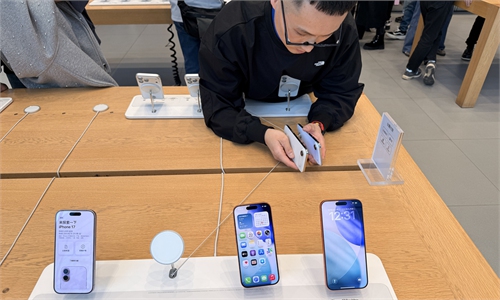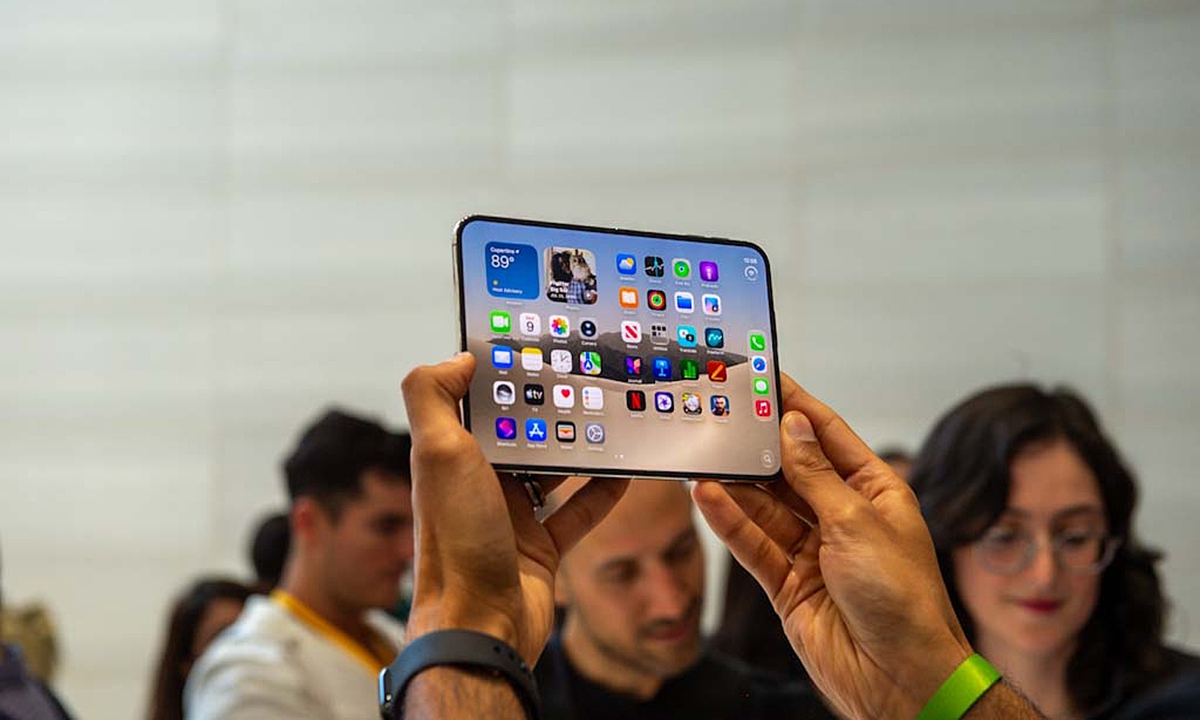
The iPhone Duo, Apple's first flip phone, is on display at one of the company's product launch events on September 9, 2026 Photo: VCG
Apple unveiled its first foldable iPhone on Wednesday, marking the biggest change to the device's physical design since its debut and bringing the US technology giant into a premium smartphone segment where Chinese brands have spent years refining products, supply chains and software ecosystems.
The launch comes amid a flurry of new foldable releases in China, with Huawei and Xiaomi unveiling new flagship models just two days earlier, further intensifying competition at the premium end of the Chinese smartphone market.
Huawei on Monday launched the Mate XT2, its latest tri-fold flagship, starting at 19,999 yuan ($2,980), while Xiaomi unveiled the Xiaomi 18 Fold the same day, priced from 10,999 yuan.
Apple's arrival could broaden the foldable market, but in China it is entering a mature field where domestic brands already hold an edge in product development, supply chains and ecosystem adaptation, analysts said, noting that how the competition plays out remains to be seen.
The iPhone Duo was the centerpiece of the company's annual fall event. The book-style device features a roughly 5.4-inch outer display and a 7.6-inch inner screen when unfolded. Apple also introduced the iPhone 18 Pro and Pro Max, a new generation of Apple Watch and updated AirPods at the event.
This year's fall event was led by new CEO John Ternus and marked what Reuters described as the most notable overhaul of Apple's flagship product since the iPhone X in 2017.
In the Chinese mainland, the iPhone Duo starts at 15,999 yuan for the 256GB version, making it the highest-priced entry model in Apple's current iPhone lineup. Pre-orders will begin on October 16, with sales starting on October 23, according to Apple's website.
The launch quickly generated debate on Chinese social media, with discussions ranging from its price and under-display camera to the visibility of the screen crease and the durability of its folding mechanism.
Foldables have become a key battleground in the premium smartphone market, with major brands including Samsung, Huawei, Xiaomi, OPPO, vivo, Honor and Motorola entering the segment as advances in hinges, displays, glass and chips improve product maturity.
Xiang Ligang, director-general of the Beijing-based Information Consumption Alliance, told the Global Times on Thursday that Apple's brand strength and large existing user base could help attract more consumers to foldable devices and further energize the market.
But as a latecomer, Apple still has to prove the quality, technological maturity and day-to-day usability of its first-generation product, Xiang said, adding that the high price would also test consumers' willingness to pay.
"The bigger impact of Apple's entry may be to expand the category, using its ecosystem, developer support and brand appeal to push foldables beyond the premium Android niche and closer to becoming a mainstream choice in the high-end smartphone market," Chen Jing, vice president and research fellow at the Society for the Study of Technological and Strategic Trends, told the Global Times.
That test may be particularly demanding in China, where domestic manufacturers have already gone through multiple generations of foldable devices, analysts said. Huawei has built a particularly strong position, while OPPO, vivo, Xiaomi and Honor have also developed competitive products.
IDC data showed that Huawei held about 60 percent of China's foldable smartphone market in the first quarter of 2026. Apple's entry, alongside rising demand for wider book-style foldables from Samsung and Huawei, is expected to inject fresh momentum into the segment, with global shipments forecast by Counterpoint Research to grow 37 percent year-on-year in 2027.
Apple's foldable could push Chinese brands such as Huawei, Xiaomi and Honor to further improve software, yields and costs. However, broader sales may still take time to scale, as price, weight, battery life and durability continue to weigh on mainstream adoption, Chen noted.
Xiang said that years of iteration are especially important for foldables, noting that unlike software issues, which can often be fixed through updates, hardware problems require repeated testing and refinement. "Chinese manufacturers have accumulated years of experience in engineering, supply-chain coordination and mass production, giving them an edge in industrial maturity," he added.
That progress has also been underpinned by a rapidly developing domestic component ecosystem. Chinese suppliers have expanded their presence in flexible OLED displays, cover glass, hinges, structural parts and other key components used in foldable devices, helping support faster product iteration and lower manufacturing costs.
Apple's move into foldables could also create new opportunities across the wider smartphone supply chain, including for Chinese component makers with years of experience in key foldable technologies, analysts noted.
The outcome of the competition will ultimately depend on clear advances in areas such as reliability, durability, crease control, weight, battery life, large-screen productivity, yields and costs, Chen said.
"Apple has an edge in ecosystem consistency, while Chinese brands may improve hardware faster and gain market acceptance sooner. But foldables still need time to reach a true inflection point and are not yet a major threat to conventional flagships," he noted.
RELATED ARTICLES