ARTS / CULTURE & LEISURE
120-million-year-old dinosaur fossil found 473 meters underground in Inner Mongolia drilling core
By Published: Sep 10, 2026 05:07 PM

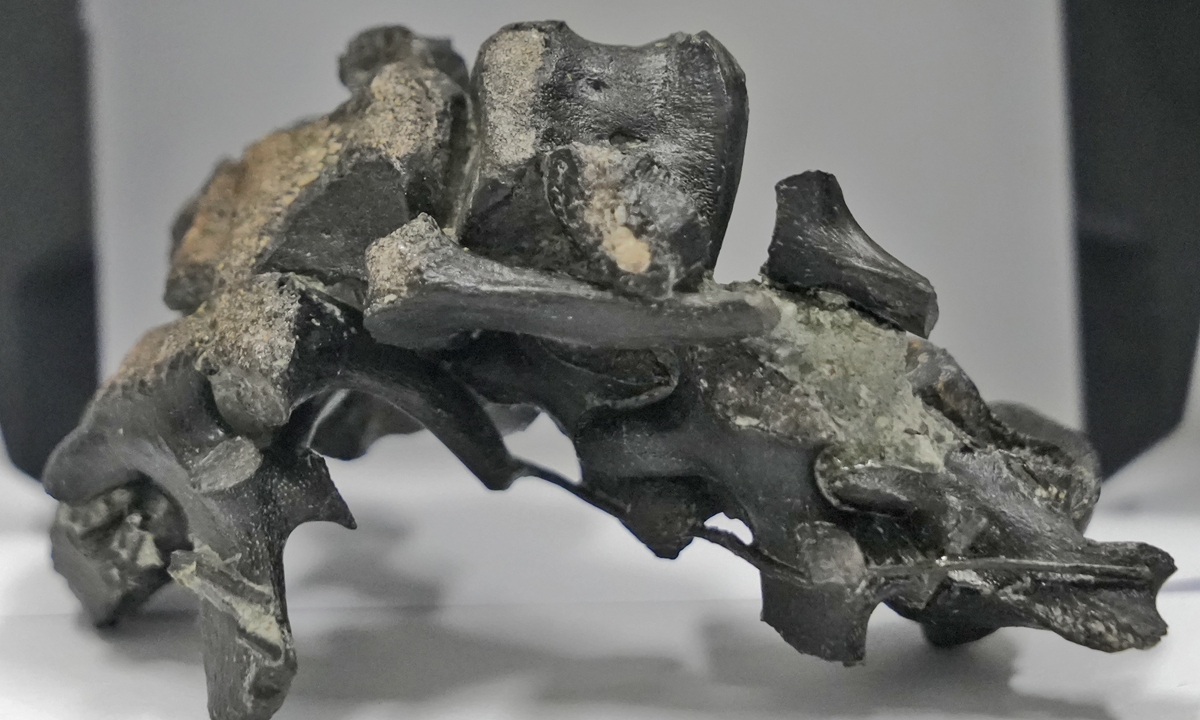
Dinosaur fossil recovered from a 473.2-metre-deep drilling core in North China's Inner Mongolia Auton?omous Region. Photo: Courtesy of Xing Lida
A 120-million-year-old dinosaur fossil has been recovered from a 473.2-metre-deep drilling core in North China's Inner Mongolia Auton¬omous Region. Chinese scientists said the discovery represents the first dinosaur find in the western Yingen-Ejinaqi Basin, extending the known western range of Early Cretaceous dinosaur remains in the region, according to a press release that the research team sent to the Global Times on Thursday.The fossil is from the Aptian age of the Early Cretaceous and was found during a mineral resource survey near the Guaizihu area in Inner Mongolia, in the upper part of the Bayingobi Formation, a key prehistoric stratum in northern China.
According to the press release, the Bayingobi Formation hosts abundant Early Cretaceous dinosaur fossils, with faunal assemblages similar to coeval deposits in western Liaoning Province. Prior discoveries in the basin were almost exclusively limited to the eastern basin, with far lower fossil diversity than Liaoning's renowned Cretaceous biota.
"As the first dinosaur fossil record from the western Yingen-Ejinaqi Basin, the new find fills a gap and opens new prospects for future prehistoric vertebrate exploration in western Inner Mongolia," Chinese paleontologist Xing Lida told the Global Times.
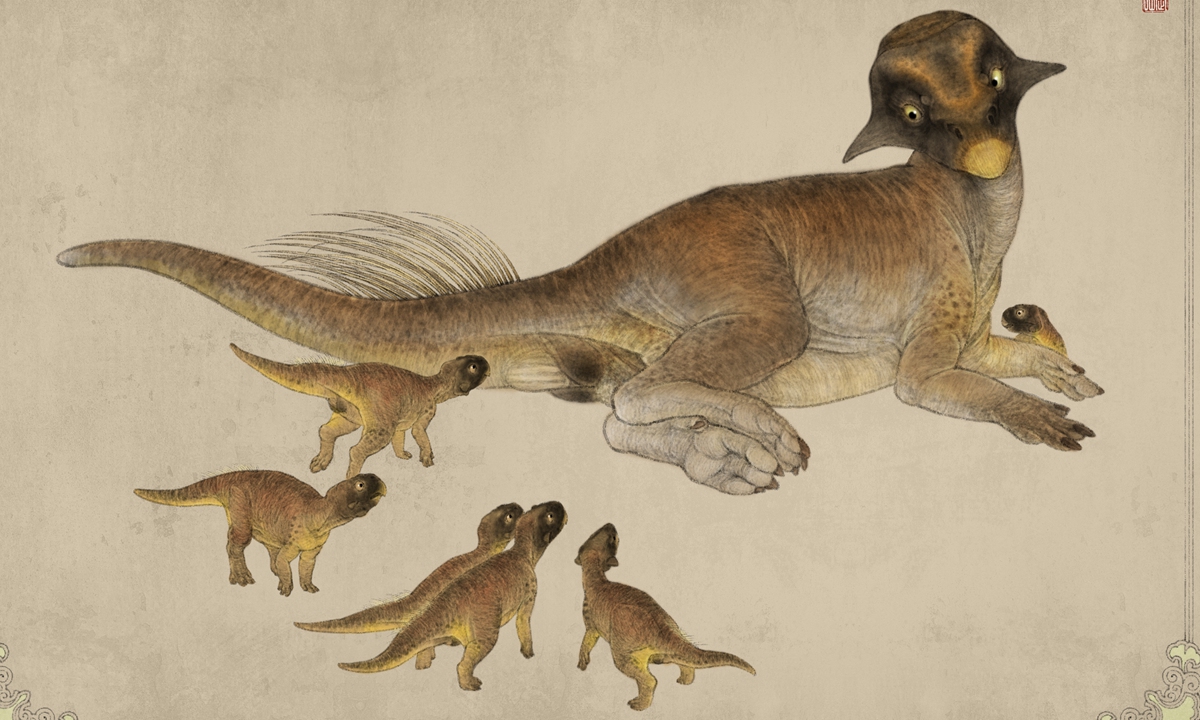
Psittacosaurus reconstruction Photo: Courtesy of Xing Lida
Globally, dinosaur fossils extracted from drilling cores are extremely rare. The most renowned comparable case dates to 1997, when paleontologists uncovered fragmented dinosaur limb bones from a 2,256-metre-deep seabed core in Norway's Snorre oil field in the northern North Sea. That Plateosaurus fossil from the Late Triassic remains the world's deepest recorded dinosaur specimen, showing that the once-terrestrial plain is now submerged beneath ocean waters.Similar to the Norwegian discovery, the new Inner Mongolia fossil originates from mineral exploration drilling, highlighting that industry-derived core samples can harbor vital paleontological evidence of ancient ecosystems, the press release noted.
The specimen comprises a sacral rib, four caudal vertebral centra, six caudal neural arches, several transverse processes and ossified tendons. The incomplete fusion between vertebral centra, neural arches and transverse processes confirms the dinosaur was a juvenile individual at the time of death.
Despite the limited material, the fossil exhibits distinct ornithischian features, including slender and distally tapering caudal transverse processes positioned notably lower than the articular processes, as well as delicate ossified tendons along the dorsal side of the neural arches — a typical derived trait of most ornithischian dinosaurs that supported tail stability.
Quantitative geometric morphometric analysis and principal component comparisons with caudal vertebrae of more than 20 ornithischian dinosaur species show the new specimen bears the closest morphological resemblance to Psittacosaurus, suggesting a relatively close phylogenetic relationship. Researchers have yet to assign it to a specific genus or species due to incomplete fossil material, classifying it as an indeterminate ornithischian specimen for now.
Psittacosaurus, a small herbivorous ceratopsian dinosaur named for its parrot-like keratinous beak, is one of the most abundant and well-documented Early Cretaceous dinosaurs in East Asia. Ranging from one to two meters in length and walking on two legs, its fossils are widely distributed across China, Mongolia and Siberia, within the geographic range of the Jehol Biota.
Exceptionally preserved specimens have revealed detailed biological traits, including skin color, tail bristle structures, gastroliths and brooding behavior, making the genus a critical research subject for understanding dinosaur ecology.
While Psittacosaurus gobiensis has previously been documented from the Bayingobi Formation, the lack of caudal vertebrae in that fossil prevents direct morphological comparison with the new juvenile specimen.
The find also reveals previously unreported regular nutritive foramina on the dorsolateral surfaces of the second to fourth caudal vertebral centra, a structure never recorded in Psittacosaurus or other ornithischian dinosaurs. Researchers ruled out pneumatic foramina origins, identifying the openings as probable neurovascular foramina.
It remains unclear whether the unique feature represents interspecific variation, individual variation or temporary juvenile developmental characteristics, adding new morphological data for assessing dinosaur diversity in the Bayingobi Formation, Xing said.
The discovery, published online in the journal Earth History and Biodiversity, was jointly made by researchers from the Nuclear Industry 208 Brigade, Xing's research group at China University of Geosciences (Beijing), and the Institute of Vertebrate Paleontology and Paleoanthropology under the Chinese Academy of Sciences.
The fossil specimen is curated at the Inner Mongolia Museum of Natural History and will go on public display soon.
RELATED ARTICLES