ARTS / CULTURE & LEISURE
Cretaceous ‘pterosaur Eden’ comes to life in Hami as world’s first pterosaur museum takes flight
Venue offers chance to ‘travel back to 130m years ago’
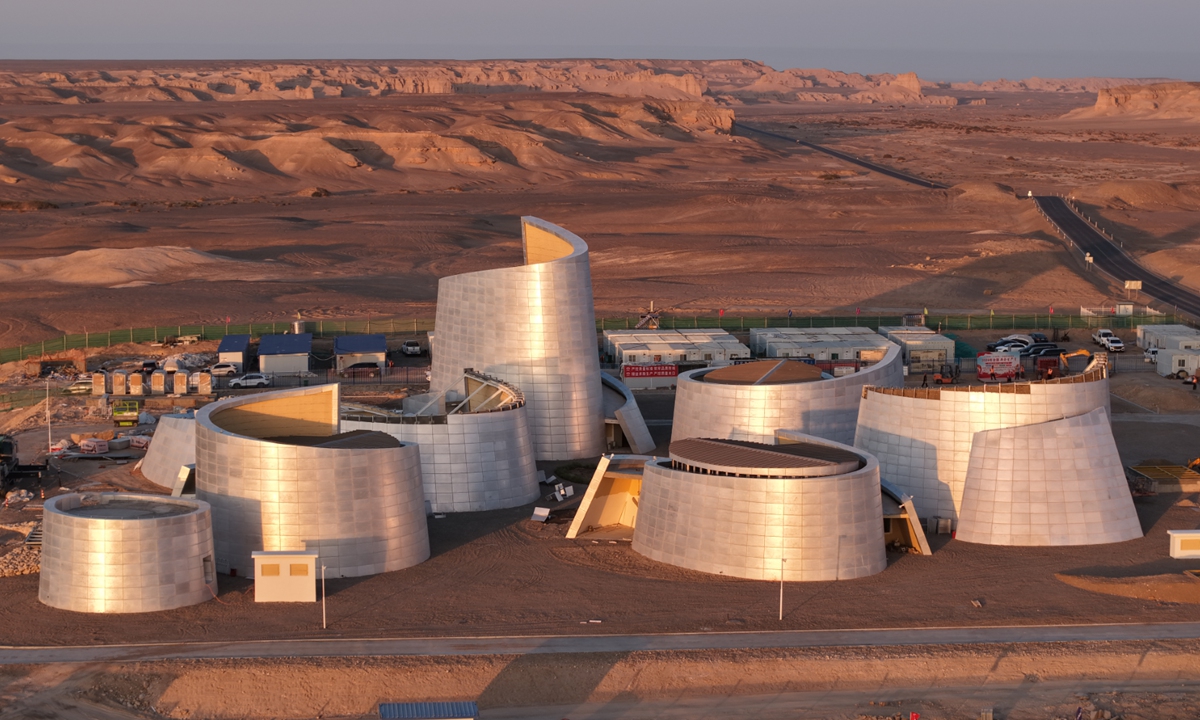
The Hami Pterosaur Museum Photo: Courtesy of Wang Xiaolin
The world's first specialized museum dedicated to the flying reptiles known as pterosaurs, the Hami Pterosaur Museum in Hami, Northwest China's Xinjiang Uygur Autonomous Region, will open on Sunday, Wang Xiaolin, a researcher at the Institute of Vertebrate Paleontology and Paleoanthropology of the Chinese Academy of Sciences, told the Global Times on Thursday.The first nearly complete Hami pterosaur specimen preserving the upper and lower jaws as well as the soft-tissue structures of its head crest will make its public debut when the museum opens, said Wang in an interview with the Global Times.
Designed around the concept of the "spiral of life," the museum covers approximately 8,000 square meters. Its six oval-shaped exhibition halls are arranged at varying heights, resembling a cluster of pterosaur eggs when viewed from above, while the silver-white exterior evokes the look of an interstellar exploration base, Wang noted.
The museum is located within a national yardang geopark in Hami. The park is home to a vast and well-preserved group of yardang (wind eroded rock) landforms that reveal a complete evolutionary sequence, earning it the nickname "the place on Earth most resembling Mars," according to Wang.
The landform was formed from lacustrine sedimentary strata of a lake during the Lower Cretaceous period, dating back approximately 130 million years, and was sculpted by long-term wind erosion. It is also the only yardang landform along the Silk Road known to preserve an ancient human archaeological site, he said.
The national geopark is the world's largest and most densely concentrated pterosaur fossil site. A preliminary assessment estimates that the geopark contains fossils of as many as 80 million individual pterosaurs and other ancient vertebrates, said Wang, whose research team has been engaged in restoring pterosaur fossils unearthed on the site.
The world's first fully three-dimensional pterosaur egg and embryo fossils were both unearthed in the geopark. The discovery is considered one of the most exciting breakthroughs in more than two centuries of pterosaur research as previous to this, these types of fossils were only found as flat impressions.
Pterosaurs, evolutionary cousins to dinosaurs, were the first vertebrates to achieve powered flight. They flew using four extremely enlarged ring finger phalanges to support their winged membranes.
The museum presents a systematic account of the evolution of life on Earth, the "food, shelter and migration" of pterosaurs, the global pterosaur lineage, and China's research and contributions to pterosaur studies, using fossils as evidence to trace their story across time and space, the researcher noted.
A particular focus is placed on the Hami pterosaur fauna, which is unique in the world for its three-dimensional preserved pterosaur eggs and embryos, as well as its large collection of male and female pterosaur specimens from different stages of development and the research findings derived from them. Together, these exhibits recreate the splendor of a Cretaceous "Eden of pterosaurs," Wang said.
The museum will open concurrently with the 10th International Pterosaur Conference to be held from Friday to Monday in Hami, and the 18th annual meeting of the Chinese Society of Vertebrate Paleontology, according to the institute.
At the conference, nearly 400 paleontologists and archaeologists from China and abroad will share their latest academic findings in the field.
According to the latest findings published by Wang's team in August, a detailed morphological study was conducted on a nearly complete, articulated right forelimb specimen of a Hami pterosaur, providing important evidence for understanding the postcranial skeletal anatomy and growth and development of Hami pterosaurs. The Hami pterosaur lived in the Early Cretaceous period in China, about 130 million years ago.
The Hami Pterosaur Museum aims to become a world-class center for pterosaur research and science education, bringing together scientific exploration and research, specimen collection, fossil conservation, academic exchange, public education, and cultural tourism. It offers visitors a chance to travel across hundreds of millions of years and experience firsthand the evolutionary story of pterosaurs, as well as the awe-inspiring "pterosaur Eden" of Hami, Wang said.
With its distinctive design and strong visual character, the museum has become one of Hami's most iconic landmarks.
RELATED ARTICLES