Sharp rebound in business confidence among US companies in China: AmCham Shanghai report
American politicians should listen more to business community: expert
By , Ma Tong and Chen Zishuai Published: Sep 10, 2026 11:58 PM

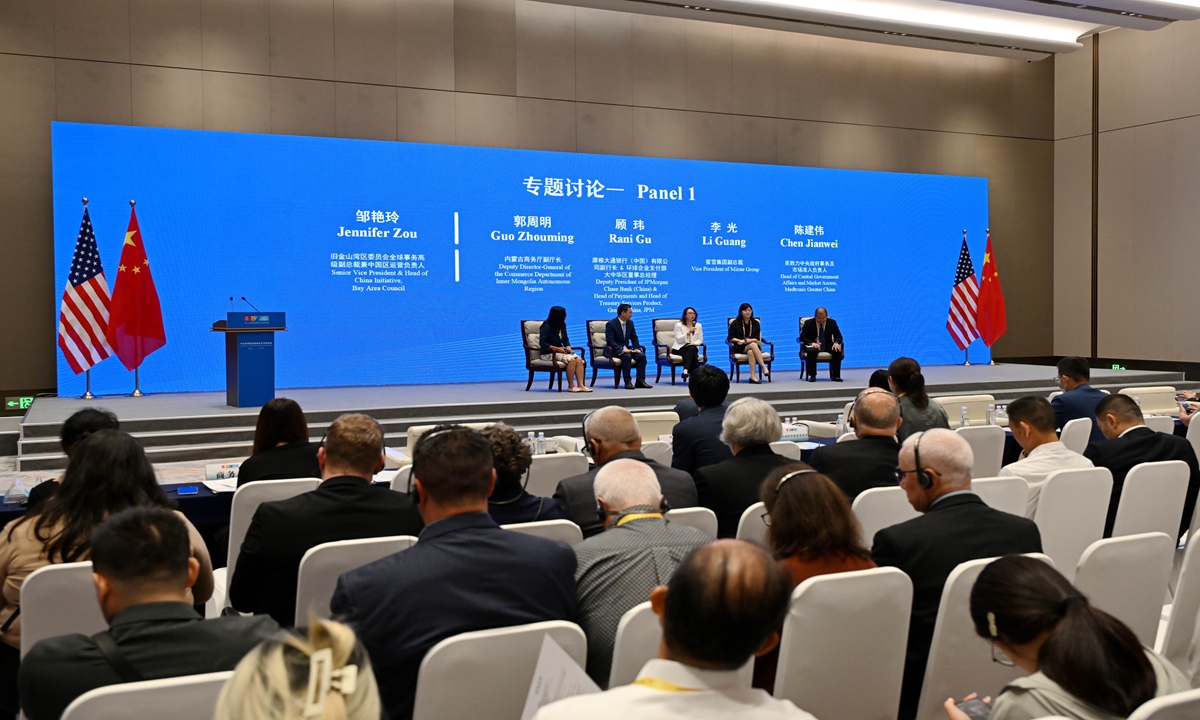
A China-US provincial and state investment and trade cooperation exchange event was held on September 9, 2026, on the sidelines of the 26th China International Fair for Investment and Trade in Xiamen, East China's Fujian Province. Photo: VCG
US companies in China have witnessed a sharp rebound in business confidence, supported by stronger financial performance, an improved geopolitical landscape, and regulatory progress, with nearly 80 percent of respondents seeing 2025 as profitable, the highest rate since 2019, a business report released by AmCham Shanghai showed on Thursday.
The report came against the background of some US politicians taking one action after another to interfere with China-US economic cooperation. Some Chinese experts noted that those US politicians took tough stances toward China-US cooperation for political reasons, with little understanding of the realities of the market.
They should listen more closely to the voices of the business community and take a constructive approach to strengthening bilateral cooperation, they noted.
Rising profits
The survey, which was carried out among 262 AmCham Shanghai members, said that profitability rebounded to a post-pandemic peak, with 78 percent of respondents being profitable in 2025, a seven-percentage-point increase from the previous year and the highest rate since 2019, according to the 2026 China Business Report released by AmCham Shanghai.
The survey showed that business confidence bounced back markedly after four years of record lows, with 58 percent of respondents, or an increase of 17 percentage points year on year, now optimistic about China's five-year business outlook.
Some 55 percent of respondents said that the business environment in China is transparent, up 7 percentage points, and investment confidence in China improved, with 28 percent of respondents increasing their investment last year, the highest level in four years.
During a press conference on Wednesday, Jeffrey Lehman, chair of AmCham Shanghai, said that the heads of state of China and the US agreed in May that they would work on a constructive relationship of strategic stability, which was "very reassuring to our members."
"I think that drives the positive results about the future," Lehman added.
China is a training ground for US companies to maintain their global competitiveness. Three-quarters of members with US operations indicated that their China presence benefits those operations. In particular, one-third said operating in China strengthens the global competitiveness of their US business, said the report.
The report also said that, more broadly, over half of all members say that China's cost advantage enhances their global competitiveness, while a smaller but still significant share pointed to more resilient supply chains, faster product development, and deeper talent pools as tangible gains from being in China.
Among members conducting R&D in China, one-quarter say their main objective is to explore new ideas, and a further 15 percent are here specifically to sharpen their competitive edge worldwide.
Retreating from the Chinese market risks their dropping from the major leagues down to the minors — and losing the capacities needed to hold market share worldwide, according to the report.
The survey shows that the confidence of American companies in China regarding its prospects over the next five years has rebounded markedly, which reflects companies' realistic assessment of the Chinese market and the trend of industrial upgrading, Hu Qimu, a professor at the Maritime Silk Road Institute of Huaqiao University, told the Global Times on Thursday.
Hu believes that, judging from the latest strong foreign trade data, China's manufacturing competitiveness is still strengthening, and the export structure is increasingly driven by high-end manufacturing. Industrial upgrading itself will release new market dividends and attract global capital. At the same time, China's accelerated deployment of new application scenarios such as artificial intelligence (AI) is also driving growth in demand for computing power, integrated circuits, and high-end chips.
"Whether viewed from the manufacturing side, the application side, or the demand side, the Chinese market is still continuously upgrading, which is also an important basis for the rebound in confidence among American companies in China," Hu said.
'Healthy competition'
AI is another front where Chinese firms are pulling ahead, as the report said that 43 percent of members view their local competitors as more advanced in AI adoption. The rapid rise of Chinese open-source AI champions, from DeepSeek to Moonshot's Kimi and Alibaba's Qwen, has been reinforced by the prominence of AI in major government initiatives such as the 15th Five-Year Plan.
Together, these developments underscore Chinese firms' emergence as formidable global contenders in the future's biggest arena, the report said.
US officials on Wednesday local time accused six Chinese companies, including DeepSeek, Moonshot AI, and Alibaba, of tapping variants of American-made AI models to train their AI products more quickly.
However, the US business community tells a different story about US-China AI competition.
"In the area of AI, there are two leaders in the world for sure - the US and China - and the leading companies in those countries. The US is very strong in frontier models and large language models, but those are mostly based on a closed-source strategy, and China is taking a different approach, focusing mostly on open-source and more affordable models," Eric Zheng, president of AmCham Shanghai, told the Global Times on Wednesday.
"It's a healthy competition if you take politics out of it. I believe both markets leverage large language models from the other country - Chinese companies subscribe to some of these US models, and US companies certainly access Chinese models as well," said Zheng.
The interference from some US politicians in China-US economic cooperation stems from domestic politics and narrow election thinking, not market reality. Chamber members, on the front line of bilateral ties, have a deep understanding of the mutual benefits and urgently want normal business with China. US politicians should heed the business community and pursue constructive cooperation, Song Guoyou, deputy director of the Center for American Studies at Fudan University, told the Global Times on Thursday.
On Thursday, a roundtable meeting between the National Development and Reform Commission (NDRC) and senior executives of US multinational companies operating in China, such as Apple, Honeywell, and Corning, was held in Beijing.
Those executives raised questions one after another, and officials from the relevant departments of the NDRC responded to each of them, according to media reports.
The questions and answers not only reflected the specific concerns of businesses about the Chinese market but also conveyed a clear signal that China is further opening up and continuing to attract foreign investment.
RELATED ARTICLES