Silk Road Maritime shipping routes span 153 ports, boosting global trade prosperity amid uncertainty

Xiamen port in Xiamen, East China's Fujian Province Photo: VCG
Across the rippling Baltic waters, a cargo vessel loaded with Chinese goods glides steadily into Poland's Gdansk Port, docking at Europe's largest deep-water container terminal. For decades, the port has served as a critical hub for trade moving between Europe and Asia.
This year, it gained a new role: becoming the first European port to receive an officially named Silk Road Maritime shipping route.
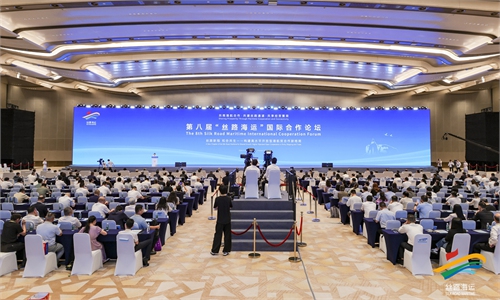
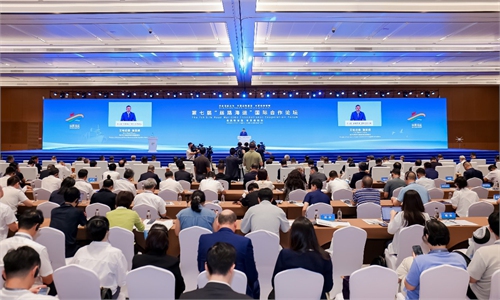
The new route was unveiled at the 8th Silk Road Maritime International Cooperation Forum, held in Xiamen, East China's Fujian Province, from September 8 to 9.
A Polish logistics executive told the Global Times that the new route is more than another line on the map. It represents a tighter connection between sea and rail, between China and the EU, and between two markets whose trade ties are growing more complex and intertwined.
"Gdansk is the largest deep-water container terminal in the Baltic Sea and the final stop of China's maritime container trunk line to Europe," Zhang Bijun, chief representative of the Port of Gdansk Authority's Shanghai office, told the Global Times at the forum. "This route further strengthens our role as Europe's gateway."
Zhang noted that Poland handles around 80 percent of the cargo entering the EU through the China-Europe Railway Express. The addition of a Silk Road Maritime route to Gdansk, she said, creates a seamless two-way logistics channel - one that could help Polish agricultural products, cosmetics and other premium goods enter the Chinese market more efficiently.
That sense of expanding connectivity defines the Xiamen forum, where shipping lines, port authorities and logistics firms from around the world gathered to discuss how trade can remain stable in an uncertain era.
Representatives attending the forum agreed that the Silk Road Maritime is no longer just a shipping brand. It has become a living symbol of how open cooperation can create durable links in a fragmented world.
Jan Van der Borght, port representative of the Antwerp-Bruges Port Authority, told the Global Times that the Silk Road Maritime platform offers "a very good cooperation mechanism" and a useful model for Europe-China cooperation.
Speaking at the forum's press conference, he said China's shipping sector has been moving quickly to adopt technologies related to decarbonization and digitalization, while also improving transport efficiency and cooperation across borders.
"That's really impressive," he said, expressing hope that through the Silk Road Maritime platform, both sides could deepen cooperation in port digitalization, artificial intelligence, green transition and supply chain resilience.
Port of Antwerp-Bruges handled 3.34 million new cars in 2025, making it the largest roll-on/roll-off port in the world.
According to Jan Van der Borght, the structure of China-Europe trade is undergoing profound changes: China's exports of high value-added, high-tech products are growing rapidly. "Our cooperation can go beyond traditional port-to-port collaboration and promote more two-way investment as well as economic and trade exchanges," he said.
Expanding network
At this year's forum, 12 new Silk Road Maritime routes were announced, bringing the total number of named routes to 160. The network now spans 50 countries and regions and connects 153 ports worldwide, according to the organizers.
Its services now cover container transport, bulk cargo, iron ore and cross-border e-commerce, forming a transport web that is both diverse and increasingly dense.
Over eight years of steady operation, the network has accumulated more than 25,000 vessel calls on its container routes, with cargo throughput exceeding 30 million 20-foot equivalent units, the organizers said.
For China, Silk Road Maritime has become one of three major logistics pillars supporting the Belt and Road Initiative (BRI), alongside the China-Europe Railway Express and the New Western Land-Sea Corridor.
Experts say its value lies not only in the movement of goods, but in the stability it brings to trade at a time when global supply chains are under strain. Against a backdrop of volatile markets and rising uncertainty, the network has become an important channel for keeping domestic and international circulation flowing, helping anchor trade with practical, point-to-point connectivity, Hu Qimu, a professor at the Maritime Silk Road Institute of Huaqiao University, told the Global Times on Thursday.
Starting point
If Silk Road Maritime is the golden waterway, Xiamen is where much of that momentum begins. Xiamen Port has been expanding its global reach in recent years, adding faster links to Southeast Asia, longer-haul routes to the Americas and more specialized services for cargo that requires speed and precision.
In May this year, a new direct shipping route between Xiamen and Indonesia was launched, becoming a part of Xiamen's growing "golden corridor" to Southeast Asia, a region that has become one of the port's most active trade destinations.
The Liberian-flagged container ship Yong Wan, carrying food, clothing and daily necessities worth 200,000 yuan ($29,820), departed Xiamen Port's Haitian Terminal at around 8 pm on May 17. The route offers a seven-day voyage to Jakarta and a nine-day voyage to Surabaya, making it the fastest Xiamen-Indonesia service currently in operation, the Fujian Daily reported.
In June this year, a shipment of outdoor supplies, including inflatable swimming pools and air beds worth 200,000 yuan, completed customs clearance and boarded the cargo ship AN YANG 118 at the Haitian Terminal of Xiamen Port, bound for the Port of Cape Town, South Africa. This marked the launch of a new pilot route under the China-South Africa Secure and Smart Trade Line initiative.
Lin Sijia, deputy manager of the Business Development Department at Xiamen Container Terminal Group Co, said Xiamen Port now operates 181 shipping routes, including 148 foreign trade lines.
"It has a strong advantage in near-ocean routes and is also expanding long-haul services with new direct sailings to eastern South America and the US East Coast," Lin told the Global Times, adding that the port's cross-border e-commerce express lane enables point-to-point services with 10 major ports across five Southeast Asian countries, delivering "Made in Fujian" goods to these markets in just two days.
According to Lin, the port is also a major artery for bulk commodities. Dedicated iron ore routes from Brazil and Australia bring in more than 40 million tons annually, helping secure China's supply of critical raw materials.
Moving forward, Xiamen Port will further innovate multimodal logistics, optimize sea-rail combined transport and waterborne cargo transfer, and deepen its presence in high-value niche sectors including cold chain, hazardous chemicals and new energy cargo shipping, Lin said.
Eight years of operation have broadened the golden waterway of Silk Road Maritime. More than just a network of ports and vessels, it is a testament to win-win cooperation, Hu said.
RELATED ARTICLES