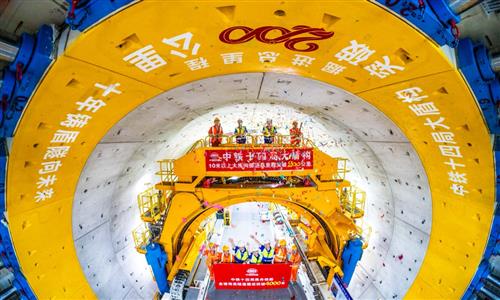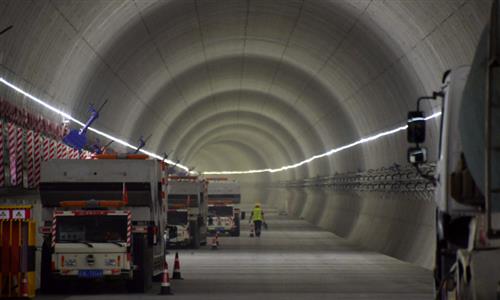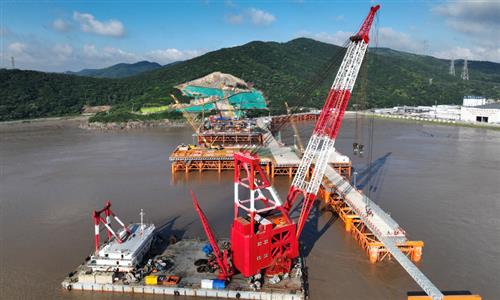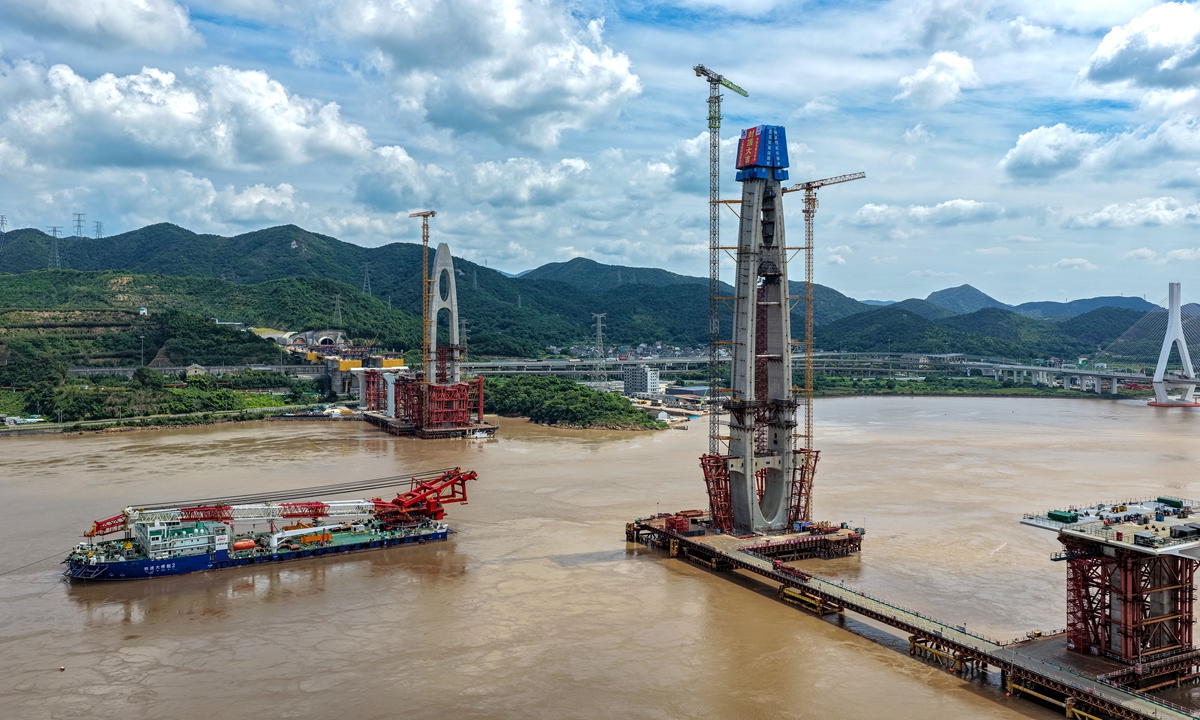
The main tower on the Ningbo side of the Fuchimen road-rail dual-purpose bridge, the last bridge main tower on the Ningbo-Zhoushan railway is capped on September 13, 2026. Photo: VCG
The main tower on the Ningbo side of the Fuchimen road-rail dual-purpose bridge was successfully capped on Sunday. It was the last bridge main tower on the Yongzhou railway, which links Ningbo and Zhoushan in Zhejiang Province. The milestone means all main towers along the railway have now been capped, marking phased progress for the progress, chinanews.com.cn reported.
The railway has a main line length of 76.4 kilometers, with a designed speed of 250 kilometers per hour - a world-class sea-crossing, island-linking project.
The entire line crosses the sea area via a "three bridges and one tunnel" arrangement. From west to east, this consists of the Jintang undersea tunnel and the Xihoumen, Taoyaomen, and Fuchimen road-rail dual-purpose bridges.
According to China Railway Shanghai Group Co, the Fuchimen road-rail dual-purpose bridge is located in the western part of the Zhoushan Archipelago, about 500 meters north of the Fuchimen highway bridge. It crosses the Fuchimen waterway and connects Zhoushan Island with Fuchi Island.
With a total length of 1,725.85 meters and a main span of 388 meters, it is the world's longest-span high-low tower road-rail same-level cable-stayed bridge and also the world's first cable-stayed bridge with cantilevered steel box girders passing through the bridge towers.
The bridge's innovative "beam passing through tower" structural design breaks through the structural limitations of traditional cable-stayed bridges and meets multiple needs simultaneously, including navigational clearance dimensions, same-level road-rail passage, and structural stability and safety.
The main tower stands 153 meters high and its tower body is assembled from 14 arc segments with different radii, featuring a complex shape and high precision requirements. The project team integrated intelligent construction technologies to create a smart climbing formwork system that combines automatic climbing with fully enclosed protection, adopted a segmented curved gradual pouring process, and established a coupled monitoring system for wind, temperature, and sunlight to dynamically correct the formwork posture, thereby ensuring the vertical precision and smooth alignment of the main tower.
The railway line is planned for completion and opening in 2028, which it will end the Zhoushan's history of having no railway access. By then, the fastest high-speed rail trip from Ningbo to Zhoushan will take just 26 minutes, and from Hangzhou, 77 minutes.
Global Times
RELATED ARTICLES