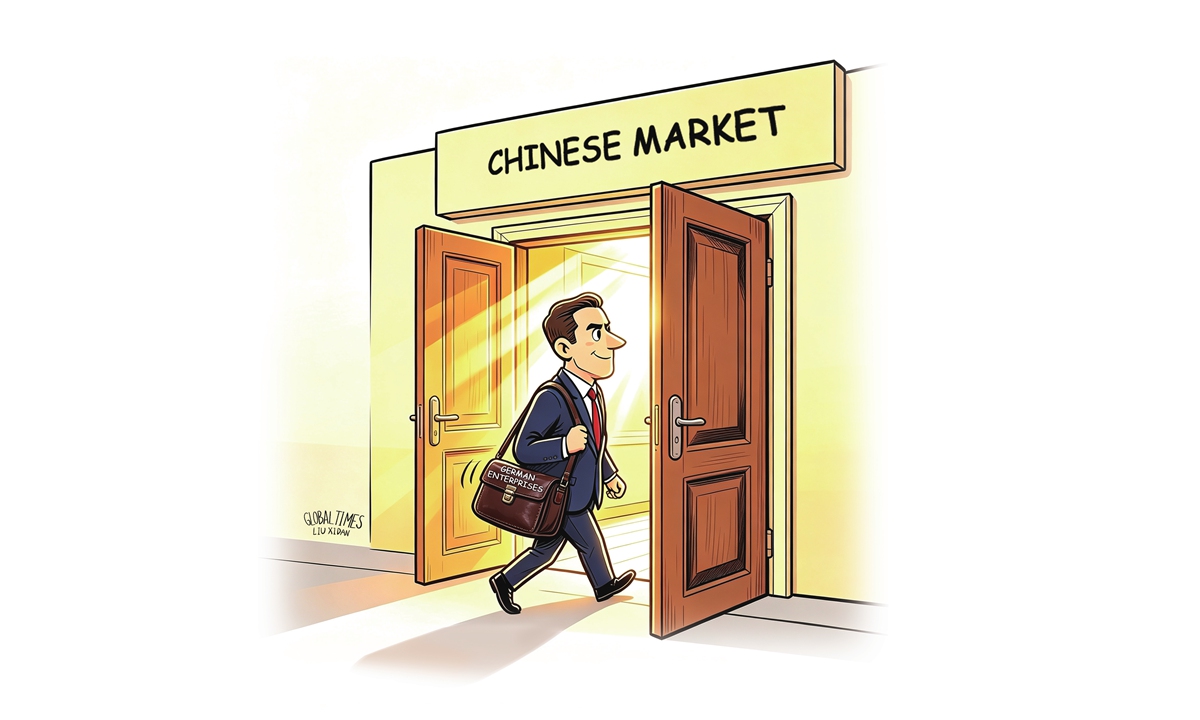
German companies increase their investment in the Chinese market Illustration: Liu Xidan/GT
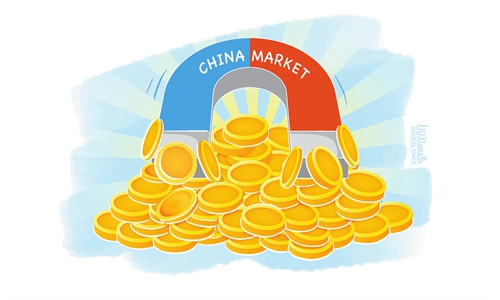
China is known for the competitiveness of its enterprises. If a market is highly competitive, should other countries' companies avoid it? German companies are doing something that is worth thinking: they are investing more.
A study by the German Economic Institute (IW) found that German companies increased investment in China by one-third in the first half of 2026, while sharply reducing investment in the US, Reuters reported on Sunday. The IW's Juergen Matthes was quoted as saying that "German companies have little choice but to continue investing in China."
Matthes described China as both an important sales market and a "gym" where companies can build up their competitive muscle.
The "gym" analogy is not new. Earlier, McKinsey's Joe Ngai called China "the world's toughest gym." It is a vivid description of a market where fierce competition puts pressure on companies to strengthen innovation, control costs and improve efficiency.
Nowadays, in China's many auto factories, an electric vehicle rolls off the assembly line in less than 100 seconds. Hundreds of smart robots handle tasks such as parts transportation and vehicle assembly, while more than 200 processing procedures are fully automated through numerical control. For foreign manufacturers, investing in China can be a form of learning and training. Competing and producing in such a competitive market can push them to meet higher standards of automation and intelligence, and strengthen their competitiveness in return.
Chinese companies, too, have grown through market competition. In the 1950s, China's auto industry was only just getting started. Now, Chinese automakers have become the world's leading electric car manufacturers. That contrast shows what fierce competition can achieve. Chinese automakers have pushed one another to improve products, cut costs and climb up the value ladder.
Some foreign observers wrongly attribute China's industrial progress to so-called industrial policy. But foreign companies that come to China and compete here can feel that competition for themselves. China's manufacturing sector has, in effect, been training in its own gym. Chinese companies have built their competitive muscle by competing with each other.
If foreign companies want to come to China's gym and build their own competitive muscle, they are welcome.
China's manufacturing sector has grown rapidly in recent years, despite protectionist trade measures adopted by some Western economies. This points to a simple fact: competition cannot be kept out by trade barriers. For foreign companies, coming to China and competing with Chinese enterprises can be a very effective and rightful choice. Many have already chosen to do so.
And, competition is also creating deeper cooperation. Some foreign companies are setting up research and development centers in China. Others are using China's industrial supply chains to develop new products. These efforts have the merit of driving those foreign companies more competitive, both in China and globally.
This is where competition can create mutual gains. Global growth remains weak now. Cooperation can make the economic pie bigger, rather than leave everyone fighting over the same slice.
The irony is that even if China is a gym, some in the West still put their faith in trade protectionism. Their deed is increasingly outdated, because protectionism would deny their companies the chance to build the competitive muscle they need.
China's door will remain open, and it will open wider. But China offers no shortcuts to easy gains. It offers a chance to grow through fierce competition. That is true for Chinese companies, German companies and companies from elsewhere. Coming to China means facing tough competition, but some foreign companies have chosen to join this competition. Why? Because they know that the skills they learn and build here will be their own.
German companies' willingness to keep investing in China shows that they are not afraid of market competition. They know perfectly well that standing under the protection umbrella does no good for them in the end. Those who still advocate protectionism need to think about this important issue.
The author is a reporter with the Global Times. bizopinion@globaltimes.com.cn
RELATED ARTICLES