Asian coast guards call for closer co-op on fighting crime in South China Sea; drug trafficking, piracy, robbery among main concerns
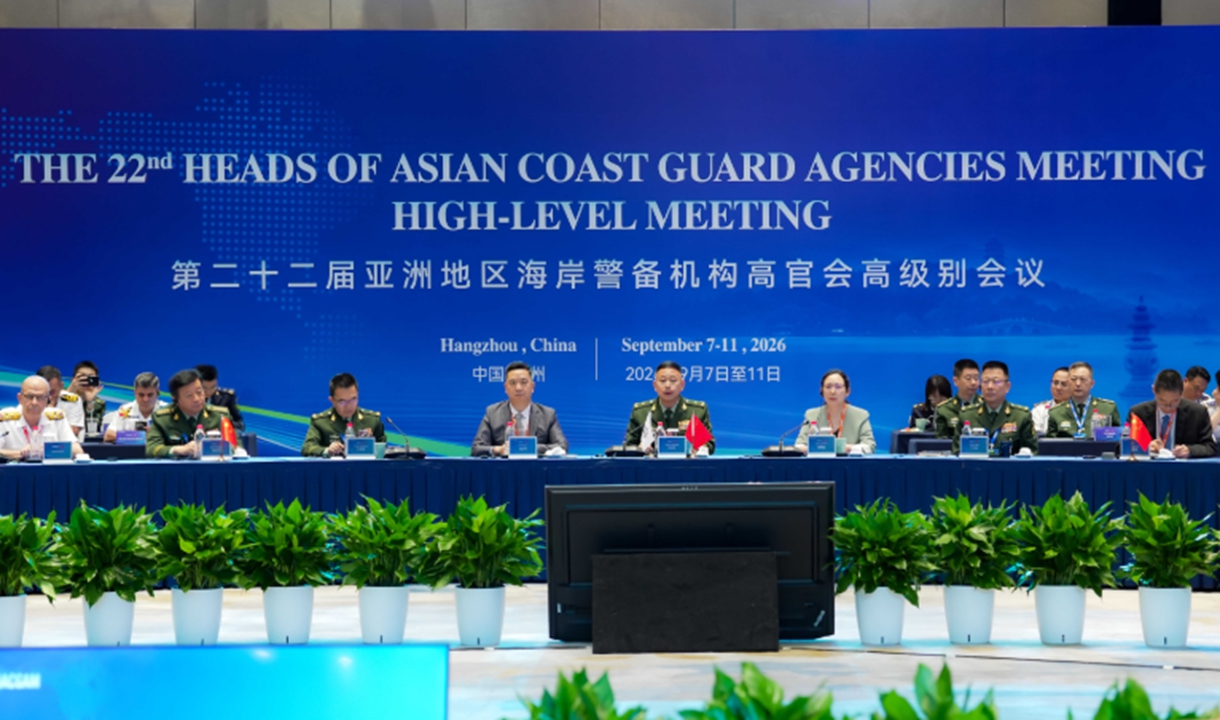
The 22nd Heads of Asian Coast Guard Agencies Meeting
Asian coast guard officials meeting in Hangzhou, East China's Zhejiang Province, called for closer cooperation against drug trafficking in the South China Sea and piracy and armed robbery along key shipping routes, including the Strait of Malacca, with information sharing, coordinated enforcement and training among their priorities.Officials attending the 22nd Heads of Asian Coast Guard Agencies Meeting emphasized the need for practical cooperation as maritime security challenges grow more complex. Officials pointed to a major drug seizure involving China, Thailand and the US as evidence of what cooperation can achieve, while acknowledging differences in laws and enforcement capabilities.
The meeting, which opened on Tuesday, brought together more than 120 participants representing over 20 countries, regions and organizations.
Singapore and the Regional Cooperation Agreement on Combating Piracy and Armed Robbery against Ships in Asia Information Sharing Centre (ReCAAP ISC) have expressed strong interest in working with the China Coast Guard (CCG) to combat piracy and armed robbery, according to Liu Zhixu, head of the international cooperation division of the CCG's law enforcement department.
"Singapore sits astride the critical Strait of Malacca, so it takes a positive stance on relevant cooperation with the China Coast Guard," according to Liu. The CCG and Singapore's Police Coast Guard have maintained close cooperation and sought to use the meeting to discuss deepening those ties, said Liu.
A participant involved in previous bilateral cooperation noted that Chinese personnel had previously traveled to Singapore for joint training. Singaporean officers shared expertise in small-boat handling and tactics, while their Chinese counterparts contributed experience in using certain equipment.
The demand for cooperation reflects persistent threats across interconnected waters. CCG spokesperson Liu Dejun said that piracy and armed robbery incidents have occurred from the Andaman Sea, west of the Strait of Malacca, to the Sulu Sea farther east, posing risks to navigation.
A ReCAAP ISC report recorded 35 incidents of armed robbery against ships in Asia in the first half of 2026, including 21 in the Strait of Malacca, or 60 percent of the total. The center urged ships to maintain vigilance and enforcement agencies to strengthen monitoring and efforts to apprehend offenders.
India's Vijay D Chafekar, the center's executive director, told the Global Times that information sharing has helped members assess incidents and advise the shipping industry on preventive measures. However, prevention alone is insufficient, he said, calling for coast guard action against piracy threatening international trade, supported by appropriate legal frameworks and authorization.
An earlier operation in the South China Sea has illustrated how shared intelligence could translate into enforcement.
On February 24, 2025, Chinese narcotics control and coast guard authorities intercepted the vessel Jisheng about 130 nautical miles southwest of Huangyan Island. They arrested seven suspects and seized 4,973.4 kilograms of methamphetamines, marking the Asia-Pacific region's largest single maritime drug seizure in recent years.
Thailand and the US had supplied intelligence about the vessel, enabling the CCG to respond quickly and intercept it, Liu Dejun told the Global Times.
Thailand's Vice Admiral Pongsak Somboon, the deputy secretary-general of the Thai Maritime Enforcement Command Center, described the operation as a highly effective example of cooperation with China. Information sharing had helped keep drugs out of their shared waters, benefiting people beyond the three countries involved, Thailand, China and the US, he said.
Such cases offer a starting point for broader cooperation, although legal differences remain an obstacle.
Countries define smuggling differently and vary in their interpretation and implementation of international rules, Liu Dejun said. Building cooperation in some areas therefore requires further agreement. Piracy, drug trafficking, migrant smuggling and illegal fishing, however, are issues on which many countries already share common concerns.
These shared concerns shaped discussions in Hangzhou. Bilateral talks covered transnational crime, search and rescue, marine environmental protection and regional maritime security, with preliminary agreement reached on some cooperation plans. A China-led working group on preventing and combating illicit maritime activities also sought to turn shared priorities into concrete action.
Search and rescue provided another example of cooperation extending beyond national boundaries. At the opening ceremony, South Korean delegates raised their phones to record footage of the CCG vessel Sanmen rescuing South Korean fishing vessel 887 EOJIN which was taking on water due to hull damage and facing imminent danger in the East China Sea in 2025. Eight South Korean fishermen were rescued by the CCG.
Chinese coast guard crews have also rescued sailors and fishermen from the Philippines and Vietnam, Liu Dejun said.
"Coast guard participation in maritime search and rescue demonstrates the importance of international cooperation and the humanitarian principle that saving lives knows no borders," he said.
For some Southeast Asian agencies, strengthening cooperation also means improving equipment and training. Somboon praised the CCG's personnel, training and vessel capabilities, while noting that regional counterparts needed upgrades to work more effectively together.
That need, he said, was precisely why agencies seek cooperation through the Hangzhou meeting and other dialogues.
RELATED ARTICLES