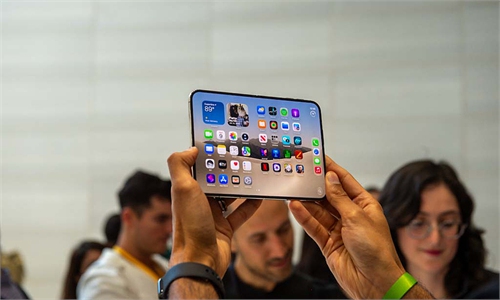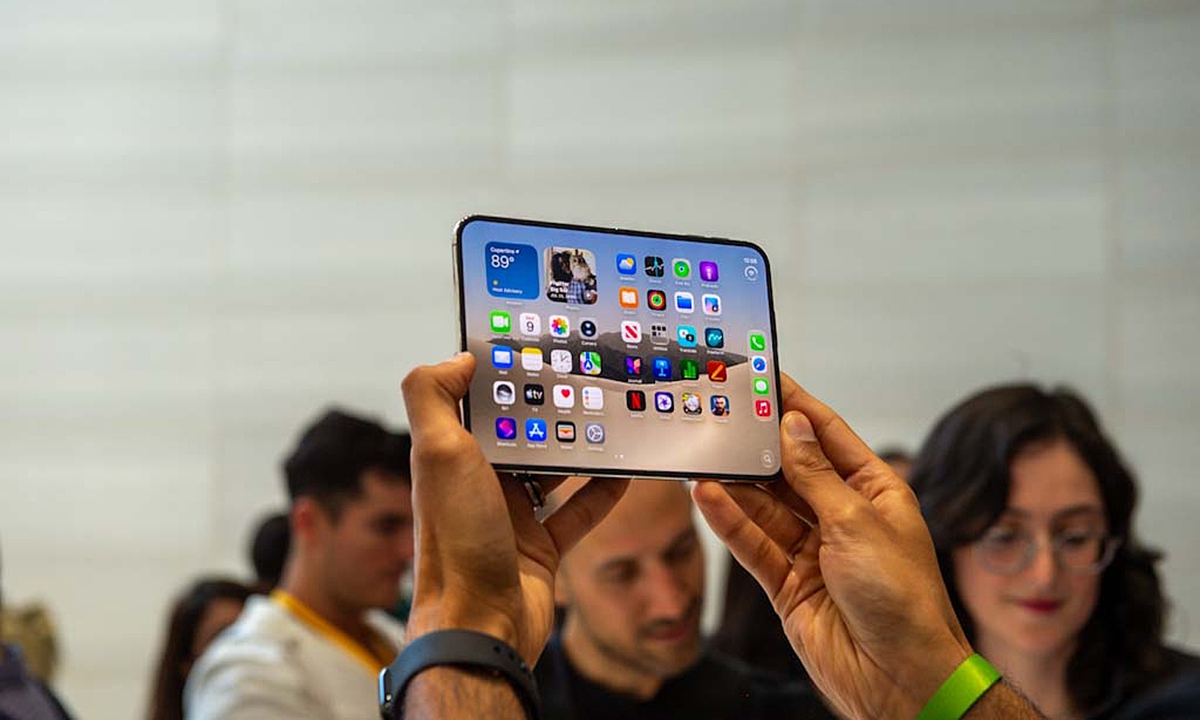
The iPhone Duo, Apple's first flip phone, is on display at one of the company's product launch events on September 9, 2026 Photo: VCG
Apple's first foldable handset, the iPhone Duo, though yet to hit the shelves, has garnered widespread interest in China. As a latecomer in the segment, the new model is set to face fierce competition from established players including Huawei and Samsung after its launch.
As of press time, more than 1.2 million people have already made reservations of iPhone Duo on e-commerce platform JD.com's official Apple flagship store, the Global Times learned from JD.com.
The official pre-orders open on October 16, with official sales starting on October 23. The base 256-gigabyte model carries an official price of 15,999 yuan ($2,385), while the top 2-terabyte configuration reaches 26,499 yuan - positioning the device at the high end of China's foldable market.
On secondhand platforms such as Xianyu, "first-batch reservation" services have proliferated, with markups typically ranging from 1,000 to 5,000 yuan, according to yicai.com.
Apple is a latecomer in the foldable segment. Chinese brands including Huawei, Xiaomi, Honor, OPPO and vivo have spent years refining the technology, Zhang Xiaorong, director of the Beijing-based Cutting-Edge Technology Research Institute, told the Global Times.
Huawei, which offers a tri-fold model, has nearly 80 percent of the Chinese foldable market, according to industry data. According to Bloomberg, former Apple CEO Tim Cook decided to accelerate the project after seeing more consumers using foldable devices from Huawei and Samsung during a trip to Asia around 2020.
"This positions Apple as a follower rather than a rule-setter. Chinese manufacturers lead in areas such as hinges, crease control, thinning and lightening, battery structure, iteration speed, and cost control, and they have even been able to reverse-export technical solutions," said Zhang.
Whether the iPhone Duo ultimately proves "worth it" will be decided by consumers. What is already clear is that the companies able to keep refining technology and user experience in the Chinese market will be best-placed to build lasting competitive advantages - a rule that applies equally to Chinese and foreign players, analysts noted.
China serves as both a testing ground and a development base for Apple. The company included China in the first wave of more than 70 countries and regions able to pre-order the iPhone Duo.
Deeper strategic reliance is visible in the supply chain. Research and development (R&D), trial production and assembly of the iPhone Duo are all taking place in China, Iris Cui, vice-president of Asia procurement and operations at Apple, said on Thursday at a roundtable between China's National Development and Reform Commission and US multinational enterprises. Several Apple executives previously said that more than 80 percent of Apple's 200 core global suppliers have manufacturing facilities in China.
Industry observers describe the Chinese market as the "gym" for global companies - a complete industrial chain, increasingly demanding consumers and a rapidly evolving market that force firms to validate technology and refine products. The emerging R&D model for multinationals, including Apple, is to test and polish products in China before rolling successful formulas out globally.
Counterpoint Research forecasts that shipments of the iPhone Duo could be up to 6 million units this year, and the device could capture roughly 25 percent of the global foldable market.
Yet in its first year it will face simultaneous pressure from Huawei and Samsung, said Zhang.
RELATED ARTICLES