J-10 unit stays combat-ready in modern air combat through tactics, pilot skill: PLA Air Force unit
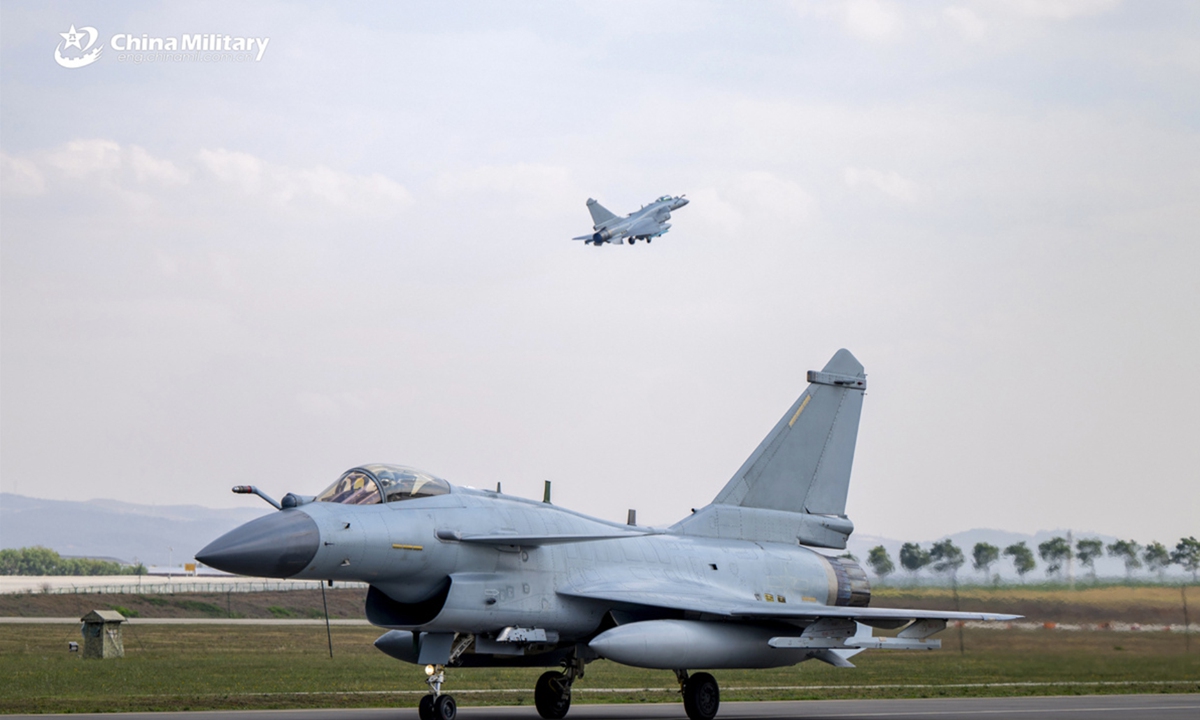
J-10 fighter jets attached to an aviation brigade of the air force under the Chinese PLA Southern Theater Command take off in succession during a day-and-night flight training exercise. (eng.chinamil.com.cn/Photo by Shang Jieyan)
In September, on an airfield runway, a J-10 fighter roared to life, accelerated, and lifted off, its thunderous engine noise sweeping across the entire flight line.This is part of the daily training for Bu Jiawen, a "Most Beautiful Military Personnel of the New Era" recipient and commander of the unit's flight group, and his comrades. With battle-tested tactical wisdom and near-perfect integration between pilot and machine, they keep this classic fighter jet competitive in modern air combat.
In the Chinese People's Liberation Army (PLA) Air Force family, the brightest spotlight falls on the newest advanced fighters, while the J-10, tempered by years of service, has kept a lower profile. Without the backing of cutting-edge new models, how does this flight group hold its ground and rack up wins in high-intensity air-to-air confrontations? In a recent interview with the Global Times, Bu and his comrades gave a straightforward answer.
"The J-10 is not the most advanced, but it is in its prime," Bu said of the fighter he flies every day. He described it as a mature, advanced mainstay fighter capable of air superiority, ground strikes, and other missions, adaptable to complex combat scenarios and highly versatile.
He said future air combat is no longer about a single fighter fighting alone; it is about overall coordination. Different aircraft and platforms each play their role and complement each other, maximizing their strengths to form a complete combat system and produce the strongest overall combat power.
Good equipment is the foundation of combat power, but top-tier pilots are the key to unlocking its full potential. As new domestic fighters enter service, air combat continues to grow more complex, placing higher demands on Bu and his comrades.
"If equipment has 100 percent capability, you need to find a way to push it to 110 or 120 percent. If you only use 60 percent and go into battle, that's not the equipment's fault, it's the pilot's," Bu said. In daily confrontations, he often faces opponents with more advanced hardware.
"They have natural advantages. It's hard to win by playing it straight. So we need to break out of conventional thinking, study the opponent's weaknesses, develop unconventional tactics, and tailored approaches to make up for equipment gaps and find a breakthrough," Bu said.
This is not just talk. In combat-oriented drills, Bu and his comrades have repeatedly used these innovative tactics to exploit openings and score impressive wins, pulling off comebacks despite being outmatched on paper.
"In our first confrontation, we were completely dominated. The results were poor," Bu said. "The opponent's fighters were superior, with an absolute hardware advantage. The gap was obvious." After that, Bu started thinking about how to win another way.
"Over the following period, we kept accumulating experience through repeated drills. After every flight, we debriefed, analyzed the situation, and went back to training," Bu said. This process lasted about one to two years. "It wasn't a sudden flash of inspiration. It took a lot of flying, repeated verification, and constant refinement."
Victory does not come from a single fighter's lone effort; the joint system is key. "With support from the joint system, existing equipment can play a role beyond its own performance through tactical innovation and efficient coordination," Bu said.
Asked about the PLA Air Force's development, Bu summed it up in one word: "Fast." He recalled that when he graduated, the J-10 was the most advanced fighter in service. "In just over a decade, some aircraft have been retired from frontline units and turned into trainers. In the future, we'll have even more advanced planes."
For Lü Wentao, a pilot born in 1998, the younger generation has it better. "The country has created good conditions for us. Compared with me, the new generation of pilots starts from a higher point. The higher the starting point and the better the conditions, the faster combat capability forms."
Both Bu and Lü share the same hope: to fly more advanced fighters in the future. They say this is a common aspiration among pilots. "Advanced fighters can better fulfill missions, and pilots will play an even more critical role in future combat systems," Lü said.
RELATED ARTICLES