Does the decline in actually utilized foreign investment mean foreign companies are withdrawing from China?: Global Times editorial
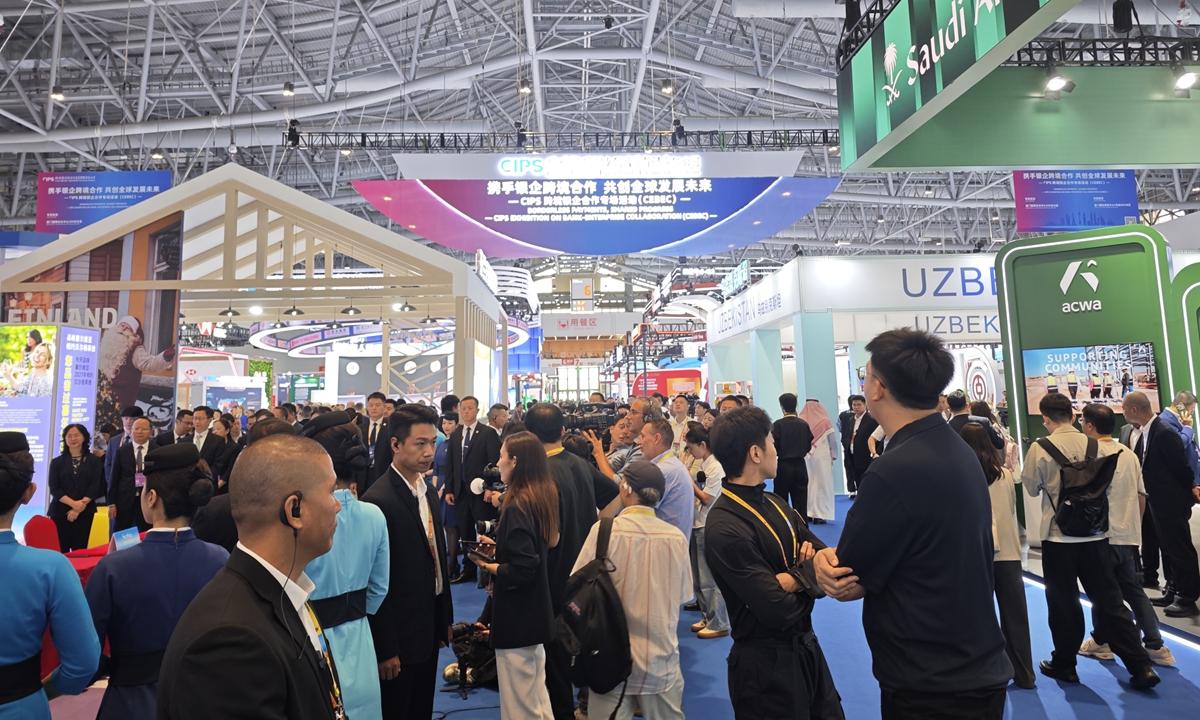
A glimpse of the exhibition at the 26th China International Fair for Investment & Trade in Xiamen, East China's Fujian Province, on September 8, 2026 Photo: Yin Yeping/GT
According to data from China's Ministry of Commerce, 37,711 new foreign-invested enterprises were established nationwide from January to July 2026, up 4.4 percent year on year. Meanwhile, the actual utilization of foreign investment amounted to 438.33 billion yuan ($65.34 billion), down 6.2 percent year on year. The increase in newly established foreign-invested enterprises alongside a decline in actually utilized foreign investment may seem contradictory, and it is easy to use the figures to fuel the narrative that "foreign investment is leaving China." But does a decline in actually utilized foreign investment really mean that foreign companies are "withdrawing" from China? To answer this question, we cannot focus on the overall figure alone. More importantly, we need to look at where foreign investment is coming from and where it is going.
"Actually utilized foreign investment" measures the amount of foreign capital that is actually received over a given period. This figure can be heavily affected by the timing of major projects, corporate financing arrangements, and the size of the previous year's base. By contrast, when foreign companies "withdraw" from China, it means shutting down operations, pulling out capital, personnel and supply chains, and ultimately abandoning the Chinese market. The two are simply not the same thing. Moreover, the number of newly established foreign-invested enterprises continued to grow in the first seven months of this year. If the Chinese market had truly lost its appeal, why would so many foreign companies still be registering new businesses here?
More important than the overall volume is the profound structural shift taking place in foreign investment. In the first seven months of this year, actual foreign investment utilized by China's high-tech industries reached 182.31 billion yuan, up 32.7 percent year on year, accounting for 41.6 percent of the national total. Within this sector, investment in R&D and design services grew 72.1 percent, technology commercialization services rose 62.2 percent, and investment in the manufacturing of electronic and communications equipment increased 39.9 percent. In other words, while total actually utilized foreign investment nationwide fell 6.2 percent, foreign investment in high-tech industries grow by more than 30 percent. This is not foreign capital "withdrawing" from China. It is foreign investment repositioning itself within the Chinese market.
In the past, multinational companies came to China mainly because of its relatively low labor and land costs, treating the country largely as a manufacturing base. That is changing. Comprehensive industrial supply chains, a huge pool of engineers, rapidly evolving application scenarios, and an expanding middle- and high-end consumer market are becoming the new attractions for foreign investors. The way foreign companies are investing in China is changing as well. In the past, they built processing plants and sales networks. Today, they are increasingly establishing R&D centers, innovation platforms and advanced manufacturing bases. What foreign investors value is no longer simply whether "production is cheaper in China," but whether they can "develop products faster, test them faster and scale them faster in China."
Looking at the sources of investment, foreign companies' interest in the Chinese market is far from disappearing. In the first seven months, actual investment in China from Saudi Arabia surged 343.7 percent, while investment from France grew 36.1 percent and that from South Korea rose 15.8 percent. These countries are at different stages of development and come from different regions, yet all are increasing their investment in China. This shows that the appeal of the Chinese market is not built on a handful of countries or industries. Saudi capital is seeking opportunities in the energy transition and economic diversification. French companies are looking to cooperate in consumer markets, manufacturing and green industries. South Korean companies, meanwhile, are deeply integrated with China's electronics, automotive and advanced manufacturing supply chains. Their decision to increase investment in China is based on the simple fact that capital flows where there are strong industrial foundations, a vast market and good long-term returns.
These changes are underpinned by the opportunities presented by China's continuously expanding market and are inseparable from the country's ongoing institutional opening-up and exploration. In recent years, leveraging key platforms for high-standard opening-up - such as pilot free trade zones and the Hainan Free Trade Port - China has pioneered initiatives to open up to foreign investment. By progressively shortening the negative list for foreign investment access, optimizing services for foreign investors, refining rules governing foreign economic and trade activities, and continuously improving a business environment that is market-oriented, law-based, and internationalized, China has boosted the confidence and willingness of foreign investors to invest in the country.
This year's report by the American Chamber of Commerce in China shows that 52 percent of surveyed companies rank China among their top three global investment destinations, while 57 percent plan to increase their investment in the country. Furthermore, reinvestment by foreign enterprises is on the rise; data from the Ministry of Commerce indicates that in the first five months of this year, the reinvestment of earnings by foreign enterprises within China grew by 35 percent year-on-year, reflecting the continued confidence of multinational corporations in the Chinese market.
Attracting foreign investment has never been a simple numbers game. When looking at a large economy undergoing profound structural transformation like China, we cannot use an "old ruler" to measure new changes. Today, more foreign-invested enterprises are being established, more multinational companies are placing their R&D and innovation activities in China, and foreign investment in high-tech industries is growing much faster. These trends are clearly difficult to reconcile with the narrative that "foreign investment is leaving China."
More accurately, China's ability to attract foreign investment is undergoing a shift in gear, not the so-called "withdrawal." China today remains a major destination for global capital seeking market opportunities, while increasingly becoming an important innovation hub for global companies preparing for the next wave of industrial transformation.
RELATED ARTICLES