China, LatAm launch agricultural co-op mechanism as forum puts sustainability, green investment in focus
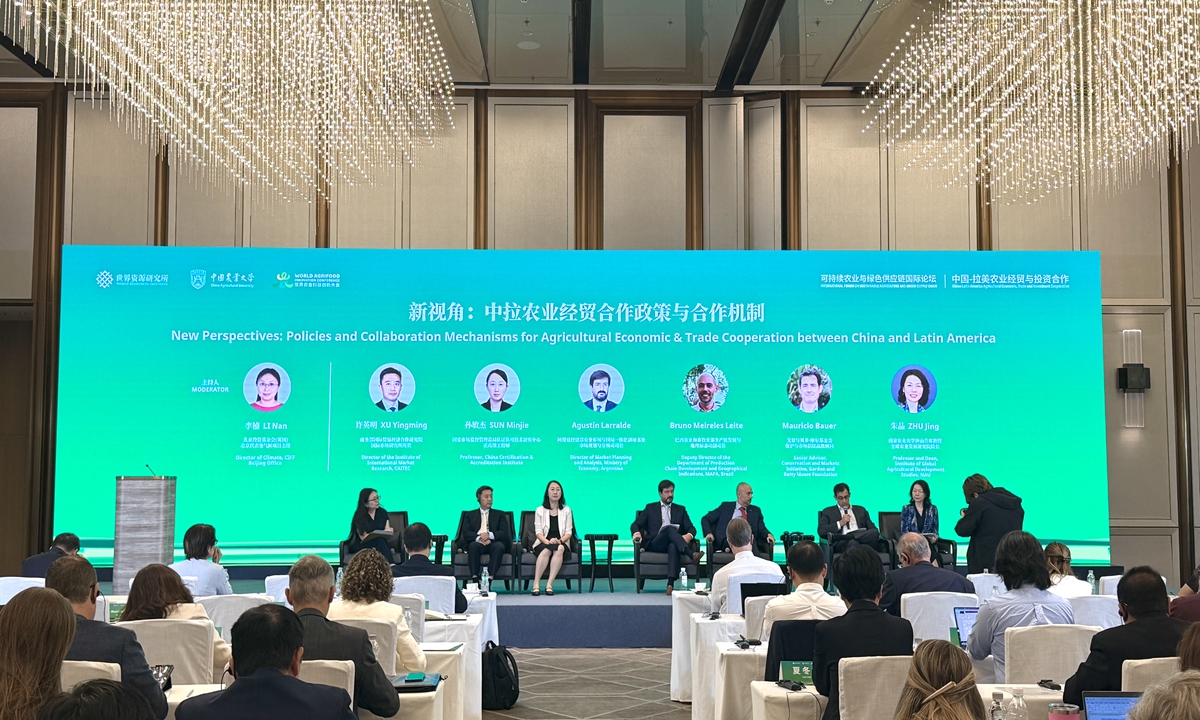
Participants attend a panel discussion at the China-Latin America Agricultural Economic, Trade and Investment Cooperation Forum in Beijing on September 15, 2026. Photo: Ma Tong/GT
China and Latin America are stepping up efforts to deepen cooperation on sustainable agricultural value chains, with greater emphasis on standards, market demand, technology and green investment, as a new cooperation mechanism launched in Beijing on Tuesday seeks to turn growing exchanges into more regular and practical collaboration.
Officials, industry representatives and experts from China, Brazil and Argentina said that the two sides have a strong trade base and clear agricultural complementarity, while cooperation is expanding into traceability, sustainable production, technology and financing.
The remarks were made on Tuesday during the China-Latin America Agricultural Economic, Trade and Investment Cooperation Forum, organized by the World Resources Institute, China Agricultural University and the Secretariat of the World Agrifood Innovation Conference (WAFI). The forum focused on policy, standards, markets and investment related to sustainable agricultural commodity supply chains between China and Latin America.
As one of the forum's highlights, the WAFI China-Latin America Working Group on Sustainable Agricultural Economy and Trade was launched to connect policy, research, industry and capital and advance sustainable agricultural trade between the two sides.
According to the organizers, the group plans to establish an executive committee and an expert advisory committee, along with several specialized working groups covering agricultural trade and sustainable investment and financing. A three-year action plan is expected to be announced in 2027.
The initiative comes as China-Latin America agricultural cooperation continues to deepen amid shifting global supply chains and a stronger focus on sustainability. Latin America is a major agricultural producer and supplier, while there is rising demand in China's large market for high-quality, safe and sustainably produced goods, experts said.
China's agricultural trade with Latin American countries reached $13.44 billion in the first two months of 2026, up 44 percent year-on-year, the fastest growth for the period in five years, data from the China Chamber of Commerce of Import & Export of Foodstuffs, Native Produce & Animal By-Products (CFNA) showed.
Latin America accounted for 26.5 percent of China's total agricultural trade, with imports surging 46.6 percent, far outpacing the 8.6 percent increase in exports and highlighting the strong growth in agricultural flows from Latin America to China.
Xu Xiaohu, vice president of the CFNA, said at the forum that the scale of China-Latin America agricultural trade reflects not only the size of the market, but also the depth and resilience of bilateral cooperation.
Against the backdrop of climate change, Xu called for the two sides to jointly develop greener value chains for major agricultural commodities, advance sustainable and traceable systems and strengthen technological cooperation, saying that such efforts would both respond to climate challenges and add a stronger sustainability dimension to bilateral agricultural trade.
China-Latin America agricultural cooperation is at a new starting point, with efforts underway to move beyond trade toward deeper integration through policy coordination, technological empowerment and financial support, Du Taisheng, vice president of China Agricultural University (CAU), said at the forum.
Du cited a CAU-backed China-Brazil project that pairs Chinese small and medium-sized farm machinery with digital tools for family farms. At its Apodi site, 31 machines have been deployed across nearly 1,000 hectares, helping about 1,000 local farmers cut operating time by 80 percent and production costs by 60 to 80 percent.
Latin American officials at the forum highlighted market demand, traceability and green investment as areas for deeper cooperation with China.
China and Brazil should deepen their shared understanding of sustainability while exploring new areas of cooperation, including organic products, coffee and green investment, Bruno Meireles Leite, deputy director of the Department of Production Chain Development and Geographical Indications at Brazil's Ministry of Agriculture and Livestock, told the Global Times on the sidelines of the forum.
"We need to better connect Brazil and China so that both sides understand what the other means by sustainability and can see where we are aligned," Leite said.
Agustín Larralde, director of Market Planning and Analysis under Argentina's Ministry of Economy, told the Global Times that Argentina and China have long maintained a strong relationship in agricultural trade, with sustainability becoming an increasingly important part of the agenda.
"If there is demand from China and from buyers, that creates a market opportunity. And when there is a market opportunity, producers will respond to what the market needs," Larralde said, adding that closer cooperation in sustainable agriculture would be driven largely by market demand rather than politics.
Leite said that China remains a major agricultural partner for Brazil and that both sides should keep strengthening dialogue and cooperation. More broadly, he said that China and Latin America, as part of the Global South, should work together on approaches to sustainable development that reflect their own conditions rather than simply copying models developed elsewhere.
RELATED ARTICLES