ARTS / CULTURE & LEISURE
AI is bringing China’s ancient legends to life, and viewers can barely tell the difference
Copyright draws creators to ancient literature works
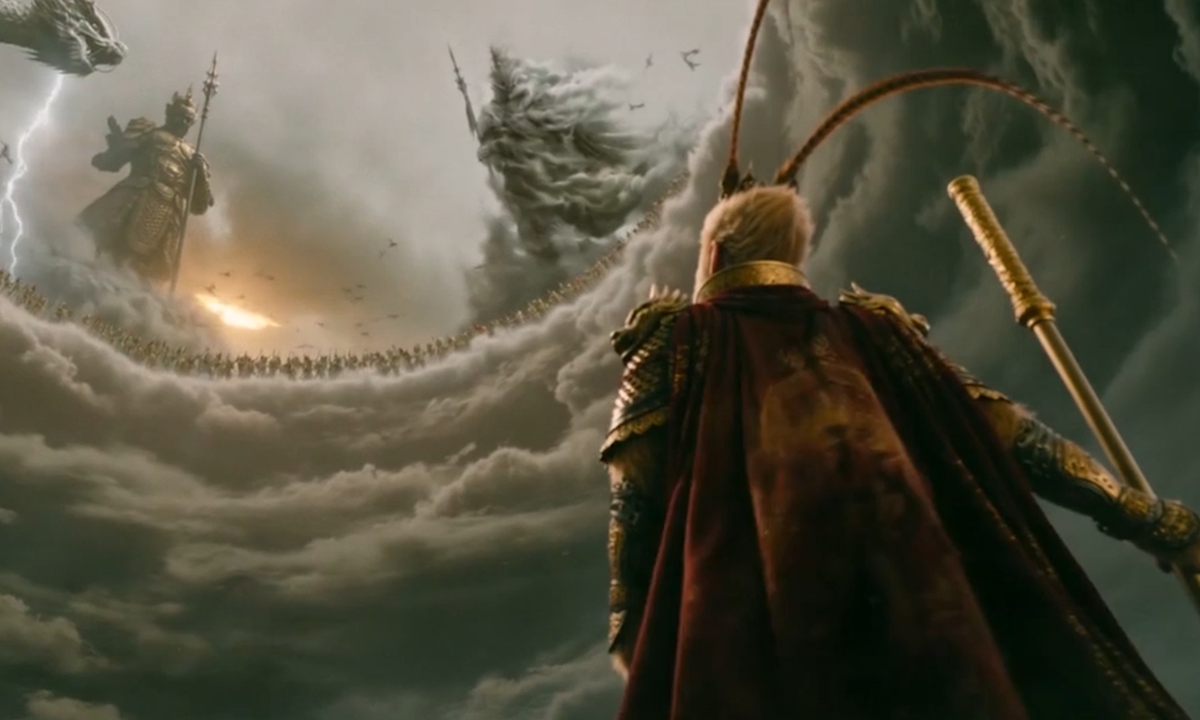
Promotional material for Beyond Wukong Photo: Courtesy of Mango TV
Fox spirits, the Monkey King, mythical birds and ancient monsters are finding new life on Chinese short-video platforms - this time without the need for a conventional film crew.A growing number of AI-generated short dramas are drawing on Chinese classics, from Strange Tales from a Chinese Studio, a renowned collection of supernatural stories, to Journey to the West, one of China's four great classical novels, and the Classic of Mountains and Seas, a major source of Chinese mythology dating back more than 2,000 years. Familiar characters and stories are being given new life through AI.
Some of the videos have attracted hundreds of thousands of likes on Douyin, the Chinese version of TikTok. Their increasingly polished visuals and special effects are also making it harder for viewers to immediately distinguish them from traditionally produced dramas.
For 27-year-old Tang Ye, who has been watching AI-generated dramas since the beginning of the year, the technology is no longer the novelty it once was.
Tang recently watched several AI dramas generated from Strange Tales from a Chinese Studio and was impressed by their character designs and visual effects. The characters did not look obviously artificial, she said, and some productions even offered a more immersive experience than dramas featuring human actors.
"I don't really care whether it was made by AI," Tang told the Global Times, adding that AI-generated productions are improving so fast. She can tell that some creators are clearly putting their own ideas into the works.
Zhang Yiwu, a professor in the Department of Chinese Language and Literature at Peking University, told the Global Times that classic Chinese literature has become attractive to AI creators for several reasons, with copyright being one of the most practical.
Many traditional works are in the public domain, meaning they face fewer copyright restrictions than contemporary works, which gives AI creators wider room to adapt familiar stories, Zhang said.
Classic works also provide something AI-generated productions need: a story that has already been tested by generations of readers. Using established characters and plots as a foundation can lower the threshold for creation while giving AI creators access to stories that are already familiar to audiences, he said.
Cost is another major advantage.
Traditional costume dramas require actors, costumes, props, makeup, sets and other elements that can make production expensive. AI now can reproduce or replace parts of those processes digitally, sharply reducing the resources required to create an ancient or fantastical setting.
For AI short dramas, the combination of a familiar story, relatively low production costs and increasingly sophisticated technology creates what Zhang described as a strong advantage in "cost reduction and efficiency improvement."
According to Zhang, early AI dramas were often easy to identify because of the appearance of repetitive faces and unnatural performances. But successive generations of AI tools have significantly improved visual quality and performances.
In some cases, he said, viewers may struggle to tell whether a scene features a human actor or an AI-generated character unless they are specifically told which is which.
The same trend is now moving beyond short-form content.
China's first fully AI-generated long-form drama, Beyond Wukong, recently aired on prime-time satellite TV. The production features no human actors and was generated throughout with the help of AI.
Director Li Dongshen has described human-AI collaboration as one of the production's main innovations, with AI serving not simply as a production tool but as a creative partner.
Using a cloud-based creative platform, with Seedance 2.0 and Seedance 2.5 as its main production tools, the 70-plus-member team was able to work through a streamlined, collaborative workflow. Team members could share creative materials online while tracking and managing production costs in real time.
AI is still often used for special effects, fantasy sequences and other supporting tasks in long-form productions, but its role is likely to expand as the technology improves. Zhang said it remains difficult to say whether AI-generated performances are better or worse than those by human actors. As the technology continues to evolve, it is becoming increasingly difficult to tell the difference.
Copyright is one unresolved issue. Some celebrities have already begun licensing their likenesses for use in AI-generated productions, while some AI dramas have faced complaints and been taken down after incorporating recognizable features of celebrities without authorization.
At the same time, some AI-generated characters may combine facial features from multiple people, making it difficult to determine whose likeness has been used.
Zhang said AI-generated works should still be assessed under existing copyright laws and industry standards. Excessive borrowing or plagiarism should not be excused simply because AI was involved in the creative process.
AI's rapid development could also reshape employment across the film and television industry, as fewer actors and workers involved in making costumes and props and other production work may be needed. At the same time, new roles such as AI trainers and other specialists are emerging.
RELATED ARTICLES